

A roof leak rarely announces itself at a convenient time. It tends to start during a storm, late at night, or on a weekend — exactly when professional help is hardest to reach. What makes the situation worse is that most homeowners respond to it in the wrong order: some immediately try to get on the roof before the rain has stopped, others freeze and wait, and some call a contractor before they’ve done anything to contain the water inside.
The sequence of an emergency roof leak repair matters more than most guides acknowledge. Acting in the wrong order can increase interior damage, create a safety hazard, or give an insurer grounds to reduce a legitimate claim. This guide breaks down the correct response not as a generic checklist, but as a practical explanation of why each step happens when it does.
Is This Actually an Emergency?
The word emergency gets applied loosely to roof problems, but the distinction has real consequences for how fast you need to act and what resources you should mobilize.
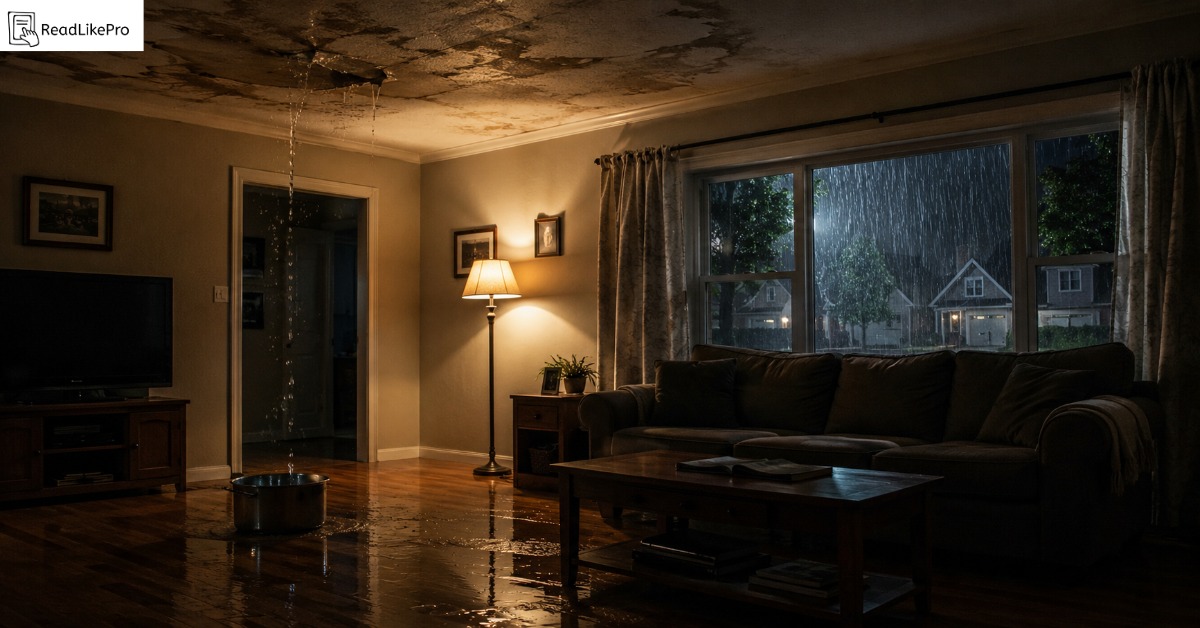
Roofing industry consensus is clear that active water intrusion inside the living space requires same-day response. According to Angi’s emergency roof repair guide, the following situations qualify as genuine emergencies:
- Water actively dripping or running inside any part of the house — not just a dried stain
- A ceiling that’s visibly sagging, soft to the touch, or showing a dome-shaped bulge
- Water appearing anywhere near light fixtures, outlets, ceiling fans, or the electrical panel
- Physical impact to the roof — a fallen tree, large branch, or debris heavy enough to penetrate the deck
- Storm-stripped shingles leaving underlayment or bare decking exposed to weather
- Standing water pooling on a low-slope or flat roof section with no drainage path
Problems that don’t require immediate emergency response include algae or moss growth, dried water stains from previous minor incidents, granule accumulation in gutters, or superficial hail marks without penetration. Those are legitimate maintenance concerns, but they don’t carry the same urgency.
There’s one thing worth understanding before you assess anything: a single drip inside the house isn’t evidence of a small problem. By the time water has traveled through roof decking, underlayment, insulation, and ceiling drywall to appear visibly, it has already migrated further than the stain suggests. The visible drip is an exit point the actual entry could be several feet away and already affecting materials you can’t see from below.
Cut Power Before Anything Else
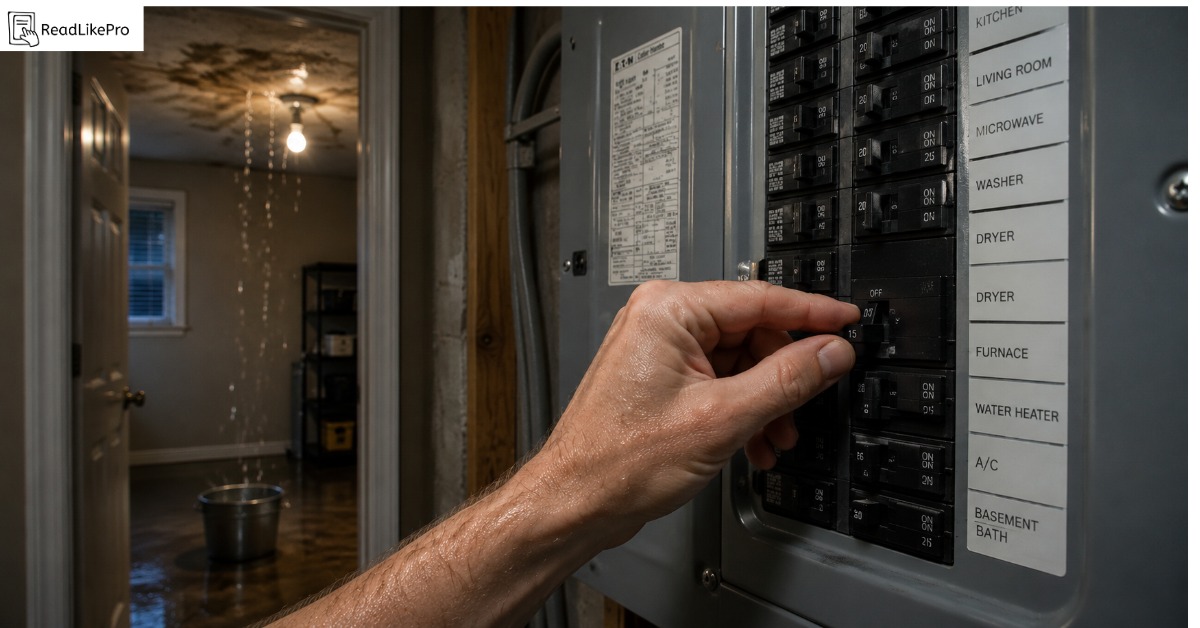
This step comes before buckets, before the attic, before calling anyone. If there’s active water intrusion and any uncertainty about whether it’s near electrical wiring, the first action is to go to the breaker panel and cut power to the affected area.
The reason isn’t always obvious: water doesn’t need to make direct contact with a wire to create a hazard. It wicks into drywall, migrates along insulation and joists, and can pool inside a ceiling junction box that appears completely fine from the living space below. Angi’s safety guidance is explicit water near wiring can cause short circuits, arcing, and fire, and the correct response is to cut power immediately and contact both a roofer and an electrician.
If you’re unsure which breaker covers the affected zone and the leak is active, cut the main. Operating without power in one area of the house is a recoverable situation. An electrical fire is not.
The Most Productive Early Work Happens Inside, Not on the Roof
One of the most consistent patterns in how homeowners mishandle roof leak emergencies is the rush to the roof before doing anything inside. Industry guidance is clear on this: interior containment should happen first.
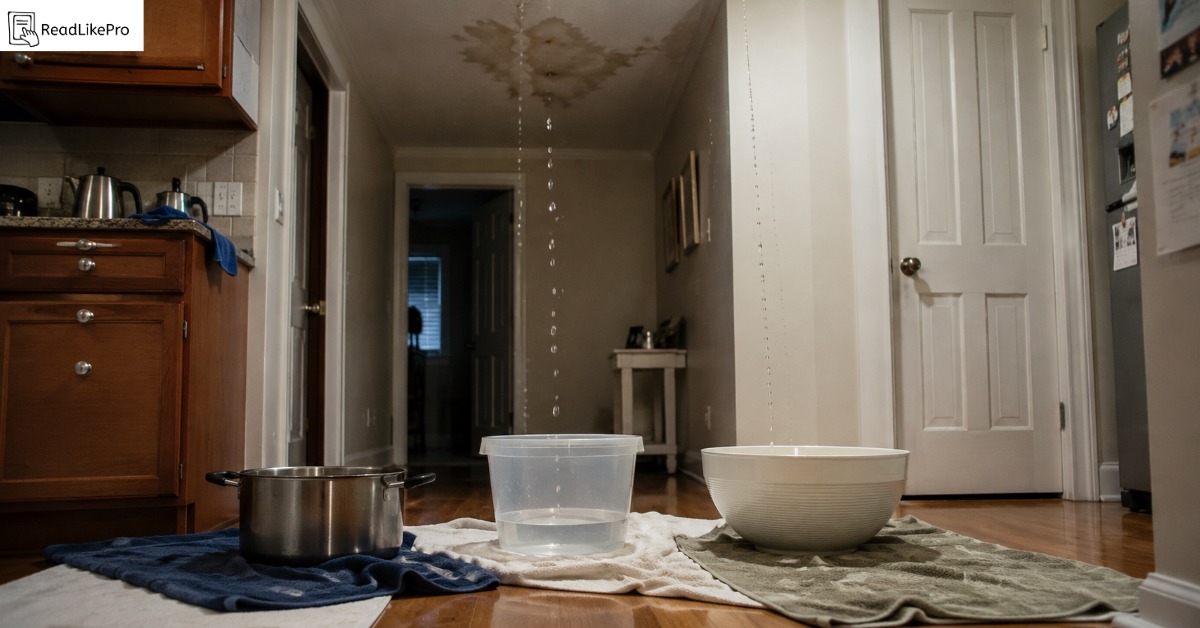
Get containers under every active drip point buckets, large pots, laundry baskets with trash bags lining them. Place towels around each container, because water hitting the hard bottom of a metal bucket will splash outward and soak floors faster than the drip itself. Move furniture and roll up any rugs in the affected area. None of this is about being neat — it’s about preventing secondary damage while you assess the situation.
Then look at the ceiling carefully.
A ceiling that’s visibly bulging or dome-shaped has water pooled above it. That’s not a stable condition. Saturated drywall will fail on its own schedule, and when it does, it doesn’t drip it collapses suddenly, dumping the pooled water across a wider area and causing far more damage than a controlled drip would.
The counterintuitive but correct response: take a screwdriver and poke one small hole at the lowest point of the bulge. This creates a controlled drainage point into the bucket below, relieving pressure before the ceiling fails on its own. The hole is repairable drywall work. A collapsed three-foot ceiling section is a much larger restoration project.
The Leak Source Is Rarely Where You Think It Is
This is the aspect of emergency roof leak repair that trips up homeowners most, and understanding it saves significant wasted time and effort.
Water inside a roof assembly doesn’t fall straight down. It enters through a gap — a cracked pipe boot seal, a lifted flashing edge, a failed caulk joint — and then travels. It follows the slope of the decking, runs along the top of a rafter, soaks sideways through insulation. The entry point and the visible drip location can be five or six feet apart. Searching directly above a ceiling stain will frequently find no visible damage at all.
The correct approach is to follow the water trail uphill.
Get a flashlight into the attic if it can be accessed safely. Look for:
- Dark staining or streaks along the rafters — water leaves mineral deposits as it travels, and those trails always run downhill, so tracing them upward leads toward the entry point
- Insulation that’s matted, clumped, or visibly discolored compared to dry sections nearby
- Wood that yields slightly under gentle pressure — soft decking is almost always a sign the leak predates the homeowner’s first awareness of it
- Any visible daylight through the sheathing — this is the most obvious indicator of a breach location
When the staining leads to its uphill starting point, that’s the entry zone. Push a finish nail through the decking from the attic side at that location. It becomes a precise marker visible from the exterior, which matters later for both DIY repair and for a roofing professional’s assessment.
Where leaks most commonly originate:
Roofing professionals and industry sources consistently note that the vast majority of residential water intrusion originates at transition points and penetrations — not in the open field of shingles. The most frequent failure locations, and the reason each fails, are:
- Pipe boots — the rubber collar around plumbing vent stacks. Most are rated for 8–10 years. After that, UV exposure and thermal cycling crack the rubber, creating a gap that’s small enough to go unnoticed but large enough to admit water
- Chimney and skylight flashing — the caulk sealing metal flashing to masonry or shingles dries out, shrinks, and separates from the surface over time. On roofs older than 15 years, this is typically the first location a professional examines
- Valley flashing — where two roof planes meet, rainfall from a large area concentrates into a narrow channel. Thin flashing material or improperly lapped valley installation creates a consistent weak point under high-volume rain conditions
- Ridge cap shingles — these receive more direct wind and UV exposure than any other part of the roof. Lifted or cracked ridge caps after significant storms are more common than most homeowners expect
- Step flashing at dormers and sidewalls — often installed correctly but pulled gradually loose by years of thermal expansion and contraction along the joint
This Old House confirms that when attic access isn’t available, professional roofers focus on exactly these penetration and transition locations before looking anywhere else.
Should You Get on the Roof Right Now?
The honest, research-based answer to this is: almost certainly not, at least not until conditions are genuinely safe.
Wet asphalt shingles provide almost no traction. This isn’t a matter of footwear quality — the surface itself changes character when wet, and a pitch that looks reasonable from the ground becomes genuinely hazardous once you’re standing on it. Roof falls are a significant cause of serious injury among homeowners attempting DIY repairs, and the consequences are permanent in a way that water damage is not.
The conditions that make roof access inadvisable are straightforward:
- Active rain or any precipitation
- Darkness
- Roof pitch steeper than approximately 6:12 — meaning 6 inches of rise per 12 inches of horizontal run
- Any surface wetness, even from earlier rain
- No second person present who knows you’ve gone up
The practical reality is that everything covered in the next section can be executed from inside the attic or from ground level. There’s no emergency roof situation where getting on a wet roof at night is the only available option.
If conditions are genuinely safe — daylight, dry surface, moderate pitch, another adult present — and you’ve made an informed decision to proceed, the standard safety protocols apply: three points of contact on the ladder at all times, rubber-soled shoes, deliberate and unhurried movement. Speed on a roof surface is consistently a factor in DIY falls.
Temporary Repairs That Will Actually Hold
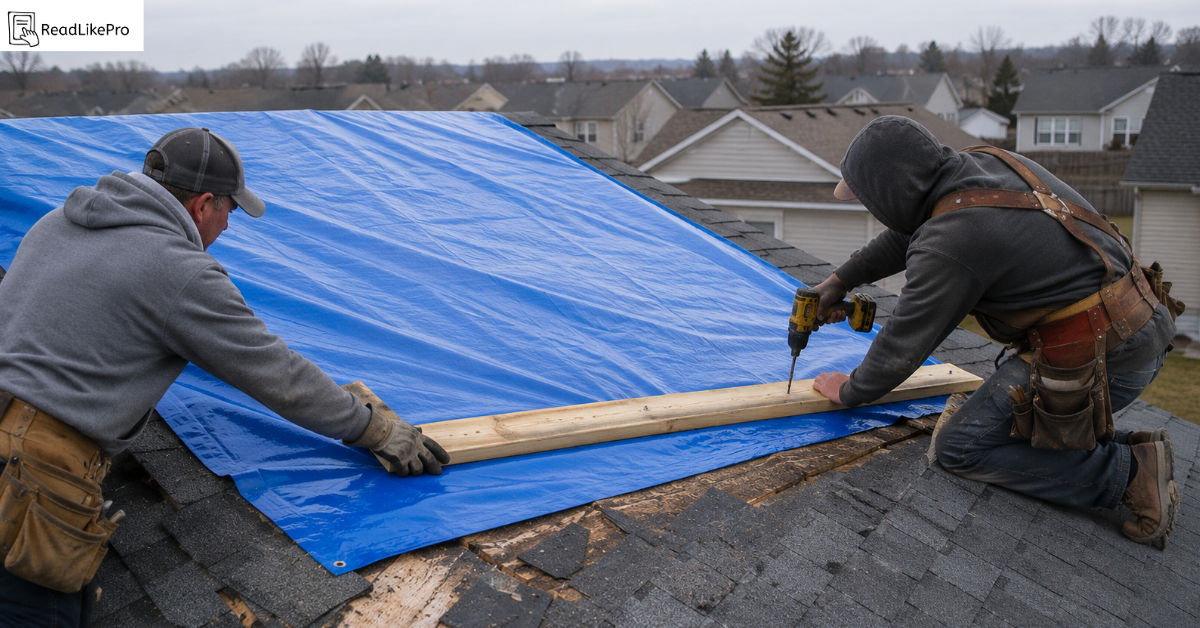
Nothing accomplished in the next few hours is a permanent repair. The goal is stopping additional water from entering until a qualified roofer can assess and properly fix the actual problem. That’s a realistic and achievable objective — and some of these temporary measures, when done correctly, are more durable than homeowners expect.
For Significant or Wide-Area Damage
Missing shingles across a broad section, physical penetration from a branch, or any area where the decking is visibly exposed requires a tarp. A thin general-purpose tarp from a hardware clearance bin isn’t adequate. Use a minimum 6-mil polyethylene tarp, sized to extend at least four feet past the damaged area on every side, and ideally extended up and over the ridge so there’s no exposed upper edge for water to run underneath.
The single most important installation detail: do not nail the tarp directly to the shingles. Tarps secured this way pull loose in wind within hours. The correct method is the same technique used by FEMA’s Operation Blue Roof program — lay 2×4 boards along the tarp edges and screw or nail those boards through the tarp into the roof decking. This distributes holding force across the full board length, and the tarp can’t pull free without tearing entirely. Per FEMA’s own documentation, this wood-strip installation method is the standard for their blue roof program, which is engineered to last 30 days. A properly installed 6-mil or heavier tarp using this method can perform comparably under most conditions.
For Localized Small-Area Damage
A cracked pipe boot seal, a gap where flashing caulk has separated, a single lifted shingle — self-adhesive roofing tape is the right tool. Products like Henry’s Flashing Tape or GAF WeatherWatch are peel-and-stick roofing membranes designed specifically for these applications. The factor that determines whether they hold or fail: surface preparation. The area needs to be as clean and dry as possible before application, and every edge needs firm manual pressure to fully activate the adhesive bond. Applied correctly, these products regularly hold through an entire season.
For flashing joint failures specifically — anywhere metal meets masonry or a transition between roofing materials — roofing cement (asphalt-based sealant, $8–$12 at any hardware store) applied with a putty knife provides reliable temporary sealing for weeks when the surrounding flashing is otherwise in serviceable condition.
When Roof Access Isn’t Safe or Possible
This is a more practical scenario than most guides acknowledge. Once the entry point has been marked from the attic with the finish nail:
Apply roofing cement around the underside of the breach point at the sheathing. This slows additional infiltration considerably on its own.
For greater effectiveness: cut a piece of sheet metal or rigid plastic sheeting a few inches larger than the affected area, slide it up against the decking from the attic side, and nail it flat. This intercepts water running down the sheathing surface and redirects it away from the weak point. It’s not a fix, but it’s reliable for the 24–48 hours needed to arrange professional repair — and it requires no exterior roof access whatsoever.
Document Everything Before Any Cleanup Begins
The impulse after a roof leak is to start mopping, but taking ten minutes to document first protects the insurance claim significantly.
Before moving furniture, before discarding wet insulation, before any cleanup or restoration work — photograph and video the wet ceiling, the exterior from ground level, the attic, and any damaged belongings. Write down the specific time the leak was first noticed, the weather conditions, and each action taken. Keep every purchase receipt — tarps, tape, roofing cement, containers.
Most US homeowners insurance policies allow recovery of “emergency mitigation costs” — expenses incurred to prevent further damage. Documentation and receipts make that reimbursement possible.
The more significant documentation issue is claim classification. Standard US homeowners policies cover sudden, accidental damage: storms, high winds, hail, falling trees. They explicitly exclude gradual deterioration or known maintenance-deferred leaks. Timestamped photos combined with weather service records establish that the damage was sudden and accidental — a classification that insurers may otherwise challenge in order to reduce a payout. Your documentation is the evidence that determines how that conversation goes.
Call your insurer promptly. Most policies include “prompt notification” requirements, and delayed reporting creates complications regardless of the claim’s legitimacy.
How to Hire a Roofer After a Storm Without Getting Burned
After any significant storm system, neighborhoods in the affected area typically see door-to-door contractor canvassing within 24–48 hours. Some of these are legitimate regional contractors looking for storm-season work. A significant portion are what the industry calls “storm chasers” — traveling crews that follow weather events, collect large deposits, deliver work that holds for six to twelve months, and are no longer reachable when problems develop.
The warning signs are well-documented and consistent:
Unsolicited door-to-door approach. Established local contractors with existing customer bases don’t need to canvass neighborhoods after storms. Companies that do are typically unfamiliar to the local market.
Same-day contract pressure. Any legitimate contractor can allow 24 hours to review a written estimate. Urgency pressure to sign immediately is a consistent indicator of high-volume, low-quality operations.
Large upfront deposits. Standard industry practice is 10–15% at contract signing. Requests for 30–50% upfront before work begins are a significant red flag.
No verifiable local presence. Out-of-state license plates, inability to provide a local physical address, or vague answers about how long they’ve operated in your area are warning signs.
Offers to waive or cover the insurance deductible. This is insurance fraud under most US state laws — illegal in the majority of states. A contractor willing to commit fraud at the proposal stage is not someone you want executing work on your home.
Angi recommends having the contractor present when the insurance adjuster visits, as they can assess damage together and often reach a same-day agreement — eliminating weeks of back-and-forth paperwork. That dynamic only works with a locally accountable, licensed contractor.
The verification process: get at least two written estimates before work begins. Check licensing through your state’s contractor licensing database (every US state maintains one). Request certificates of general liability insurance and workers’ compensation — if an uninsured crew member is injured on your property, your homeowner’s policy may carry the liability. Ask for references with verifiable local addresses.
What Emergency Roof Repair Actually Costs in 2026
Cost estimates are impossible without seeing the specific damage, but the available market data provides a clear picture of typical ranges.
Angi’s 2026 roof repair cost data puts the national average at $1,171, with the full range from $150 for very minor patching to $8,000 for significant structural damage. Emergency service typically adds a $100–$300 after-hours or weekend surcharge on top of the base repair cost.
Bob Vila’s cost analysis, drawing on Angi and HomeAdvisor data, shows a national range of $379–$1,758 for standard repairs. For true emergency response, current 2026 pricing data indicates emergency calls run 25–40% above normal scheduled repair rates, reflecting urgency premiums, after-hours labor, and priority material sourcing.
Here’s how specific repair types typically break down:
| Repair Type | Typical US Range (2026) |
|---|---|
| Pipe boot replacement | $150 – $400 |
| Replace 1–3 shingles | $150 – $450 |
| Chimney or skylight flashing repair | $200 – $600 |
| Valley flashing repair | $300 – $1,000 |
| Emergency roof tarping (professional) | $200 – $700 |
| Partial section replacement | $1,000 – $4,000 |
| Emergency after-hours surcharge | $100 – $300 additional |
| Full roof replacement | $6,000 – $20,000+ |
Regional variation matters: labor markets in California and the Northeast run substantially above these national averages, while the Midwest and Southeast typically come in below. Interior restoration — drywall replacement, insulation removal, flooring repairs — is budgeted separately from the roof repair. Delayed response significantly increases that interior cost component; the longer water sits in building materials, the more extensive the restoration required.
Get the full scope of work in writing before approving anything.
The Mold Risk Window Is Shorter Than Most People Realize
Roof leak guides routinely understate the mold timeline, but the public health guidance on this is specific and consistent.
The CDC recommends cleaning and drying or removing wet materials within 24–48 hours after water enters the home to prevent mold growth. The EPA’s mold guidance is equally direct — mold can begin forming on damp building materials in as little as one day. Johns Hopkins Medicine, citing FEMA research directly, confirms that mold can grow within the same 24–48 hour window following water damage and continues spreading until the conditions are addressed.
What this means in practical terms: a leak noticed on Friday evening that’s scheduled to be dealt with Monday morning has already provided 60-plus hours of favorable conditions in wall cavities, insulation, and ceiling materials before anyone begins drying. In warm, humid climates — the Gulf Coast, Southeast, Florida, and most of the country during summer months — conditions are particularly favorable for rapid colonization.
If a musty or earthy smell develops after a leak, don’t begin cleaning or scrubbing independently. Disturbing mold growth without proper respiratory protection disperses spores through HVAC systems and into unaffected areas of the house. Professional mold assessment should precede any remediation work.
Why Most Roof “Emergencies” Have Deeper Roots
An important pattern in roof leak emergencies, consistently noted by industry sources and roofing professionals: most failures that present as sudden emergencies had identifiable precursor conditions that were already present weeks or months before the event.
Storm events don’t typically create failures from nothing. They create enough water volume and wind force to push through existing weaknesses that were already losing integrity. A pipe boot cracked from UV exposure. A flashing joint where caulk had already separated a quarter inch. A ridge cap shingle that was lifting but hadn’t fully failed. Each of these is a $150–$300 maintenance repair when caught during a scheduled inspection. Left unaddressed, they become emergency calls with interior damage on top.
The NRCA (National Roofing Contractors Association), which establishes professional standards for the US roofing industry, recommends professional roof inspections as part of a regular maintenance program. Spring and fall — twice annually — is the standard schedule that roofing professionals and industry guidelines consistently cite.
Beyond inspections, a few maintenance practices carry outsized impact:
Clean gutters at least twice a year. Clogged gutters are responsible for more interior water intrusion than they typically get credit for. Water backing up under the drip edge works into the fascia board and eventually into wall cavities — by the time it’s visible as a stain on an interior ceiling, rot is often already present inside the wall structure.
Trim branches that overhang the roof. Sustained branch contact abrades granules from asphalt shingles over time, accelerating premature aging. More immediately, a fallen branch during a storm creates structural damage on contact.
Check attic ventilation, particularly in northern states. Ice dams — a leading cause of winter roof leaks in Minnesota, Wisconsin, Michigan, and similar climates — are almost always a ventilation problem, not a materials failure. When attic air can’t escape properly, heat builds up, melts snow on the roof surface, and the meltwater refreezes at the colder eaves. That ice forces water back under the shingles. Addressing ventilation prevents the cycle; replacing shingles doesn’t.
None of this maintenance is particularly demanding. But most homeowners skip it until a leak makes it unavoidable.
Frequently Asked Questions
How do I temporarily stop a roof leak from inside without going on the roof?
Find the water entry point in the attic by tracing the staining along rafters uphill until it starts — that’s the origin zone. Push a finish nail through the decking at that location to mark it externally. Apply roofing cement around the underside of the breach to slow infiltration. For greater effectiveness, cut a piece of sheet metal or rigid plastic a few inches larger than the affected area, slide it up against the decking from the attic side, and nail it flat. This intercepts water running across the sheathing and redirects it away from the weak point. The method is reliable for 24–48 hours without any exterior roof access.
Does homeowners insurance cover emergency roof repair?
Generally yes, when the cause is sudden and accidental — storms, wind, hail, falling trees. US homeowners policies consistently exclude gradual deterioration, deferred maintenance, or leaks the homeowner was previously aware of and didn’t address. Documentation determines how claims are classified. Photograph damage with timestamps immediately, note the specific weather event, and report to the insurer promptly. Delayed notification can create complications even on otherwise valid claims.
How quickly does mold develop after a roof leak?
Both the CDC and the EPA are consistent: mold can begin developing within 24–48 hours of water exposure under appropriate conditions. In warm and humid regions — the Southeast, Gulf Coast, and most of the US during summer — conditions are closer to the 24-hour end of that range. A leak noticed Friday evening that’s scheduled for Monday attention has already had 60-plus hours of favorable conditions before drying begins. Get materials dried as quickly as possible, and consult a professional if any musty odor develops before starting cleanup.
What does emergency roof repair typically cost in the US?
Based on Angi’s current 2026 data, the national average for roof repair is $1,171, with most emergency scenarios ranging from $300 to $3,200. After-hours or weekend emergency surcharges typically add $100–$300 on top of standard repair rates. Professional emergency tarping runs $200–$700. Major structural damage from storm or tree impact starts around $5,000 and climbs significantly. Interior restoration — drywall, insulation, flooring — is budgeted entirely separately.
Can a homeowner fix a roof leak themselves?
Minor localized repairs — a failed pipe boot seal, one or two displaced shingles, a small flashing gap — are within reach for a careful homeowner. The two factors that most frequently cause DIY repairs to fail are misidentifying the source (looking directly above the ceiling stain rather than tracing uphill to the actual entry point) and safety during roof access. The attic-based repair method is a practical alternative when exterior conditions make roof access inadvisable. More complex repairs — structural decking, underlayment, chimney flashing, widespread damage — consistently warrant professional assessment, as errors in these areas tend to compound the original problem.
What can I do right now if I have no repair materials on hand?
Split open heavy-duty garbage bags and overlap them flat across the breach. Tape seams with duct tape. If the attic is accessible, staple or nail the plastic to the sheathing around the opening. This provides only a few hours of marginal protection, but it buys time to source proper materials or reach a contractor. Contact a local emergency roofing service immediately — most would rather receive the call at 10pm than respond to significantly worsened water damage two days later.
The Sequence, Condensed
Cut power to any area where water is near electrical components — this step always comes first. Drain any bulging ceiling section with a small controlled hole into a bucket. Get containers under every active drip. Access the attic with a flashlight, trace water staining uphill to the entry zone, and mark it with a finish nail through the decking. Cover the breach — tarp with board-secured edges for significant damage, roofing tape or cement for localized failures. Photograph and video everything before any cleanup begins. Contact your insurer promptly. Source a licensed, locally accountable contractor, verify their credentials, and get the full scope of work in writing before any job starts.
Working the sequence in that order prevents a manageable repair situation from escalating into an expensive one.
Sources
- Angi — Emergency Roof Repair: Everything You Need to Know
- Angi — How Much Do Roof Repairs Cost? (2026)
- This Old House — Emergency Roof Leak Repair: Costs and Safety Measures
- Bob Vila — How Much Does Roof Repair Cost? (2026)
- FEMA — US Army Corps of Engineers and FEMA Begin Operation Blue Roof in Florida
- FEMA — FEMA Tarps and USACE Blue Roofs Aid in Protecting Homes From Further Damage
- CDC — Dry Off Wet Items After a Storm (Mold Guidance)
- EPA — Mold Resources
- Johns Hopkins Medicine — Molds in the Environment
- NRCA — Roofing Guidelines and Standards
- Bluelineremodels — Emergency Roof Repair Cost in 2026
- Artisan Quality Roofing — How to Spot a Storm Chaser

Baldeep builds and researches content sites full time. For ReadLikePro he
compiles home service pricing from contractor quotes, industry cost surveys,
and public data, then checks the numbers against more than one source before
publishing. He isn’t a licensed contractor, so every estimate here is a
research-backed range, not a quote for your specific job.