
Roof leak repair cost typically runs $150 to $1,500 for most homeowners, with a national average landing somewhere around $650 to $850 for a single leak that hasn’t yet caused significant interior damage. If water has already reached your drywall, insulation, or roof decking, total costs commonly rise to $1,000–$6,000+, and severe cases involving structural rot or mold can push past $10,000.
That’s the honest range but if you’ve searched this topic before, you’ve probably noticed every site gives you a slightly different number. One says $360–$1,550. Another says $1,147 average. A third says anywhere from $150 to $10,000. None of these are wrong exactly. They’re measuring different things, and almost nobody explains that clearly.
This guide breaks roof leak repair cost down by the actual type of leak you have, because that’s the single biggest factor in your final bill. It also covers what insurance will and won’t pay for, how to tell if a contractor’s quote is reasonable, what happens if you wait too long, and the questions homeowners on Reddit and Quora keep asking that most cost guides skip entirely.
How We Researched This Guide
This guide combines current SERP analysis of the top-ranking roof repair cost pages, verified cost data from established home-services research sites, official guidance from industry and government sources, and recurring patterns from homeowner discussions on Reddit and Quora.
Specifically, we reviewed:
- Cost data from HomeGuide and ConsumerAffairs, two of the largest published datasets on roof leak repair pricing in the US
- Insurance claims statistics from the Insurance Information Institute homeowners insurance claims data
- Maintenance and inspection standards from NRCA’s roof maintenance recommendations published via Professional Roofing
- Storm preparedness and home maintenance recommendations from FEMA’s hurricane preparedness guidance for homeowners
- Contractor pricing references from multiple regional roofing companies’ published rate breakdowns
- Homeowner discussions on Reddit and Quora focused on repair cost surprises, insurance claim disputes, and contractor quote discrepancies used only to identify recurring questions and concerns, not as factual pricing sources
Every cost figure below traces back to one of these sources. Where community discussions raised a concern, we verified it against the relevant industry or insurance source before including it.
Quick Answer: Roof Leak Repair Cost at a Glance
| Severity | What’s Involved | Typical Cost Range |
|---|---|---|
| Minor (caught early) | Single pipe boot, a few shingles, small flashing patch | $150 – $500 |
| Moderate | Larger flashing or valley repair, partial underlayment replacement | $500 – $1,500 |
| Major (water damage present) | Decking replacement, drywall/insulation repair, possible mold | $1,500 – $6,000 |
| Severe/Structural | Rotted rafters, multiple leak points, widespread damage | $6,000 – $10,000+ |
These tiers are consistent across HomeGuide’s published roof leak repair cost breakdown and ConsumerAffairs’ cost research, both of which independently arrive at similar minor/moderate/major groupings.
Why Roof Leak Repair Cost Estimates Online Vary So Much
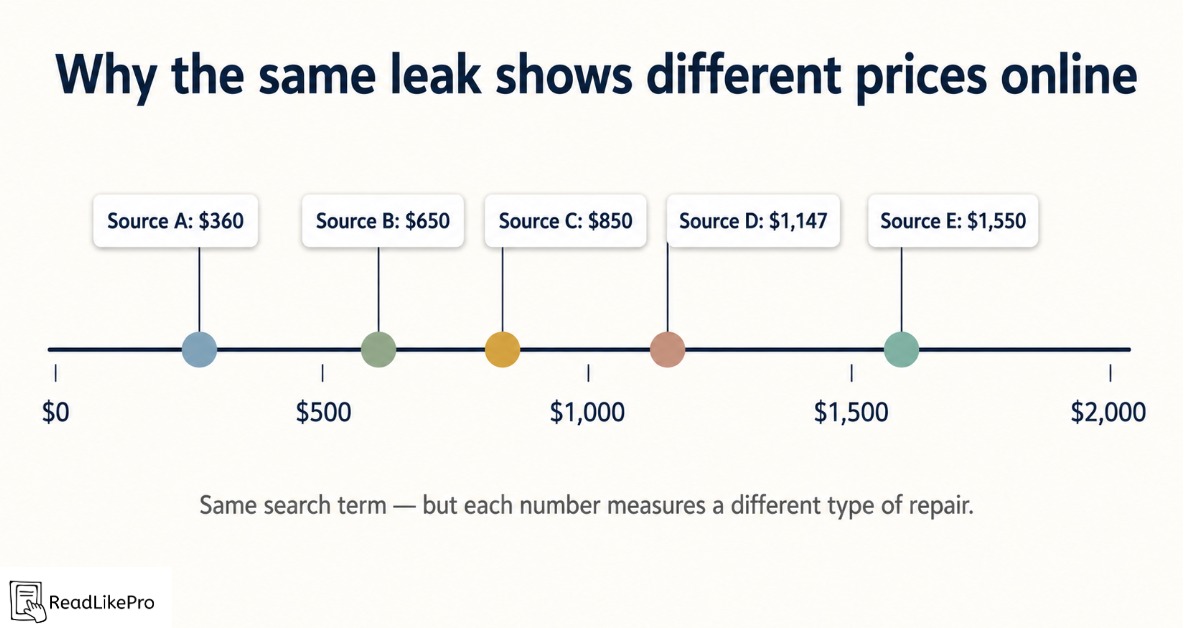
Cost guides report different “average” figures because they’re sampling different populations of repair jobs — some include water damage restoration, some don’t, and regional labor rates vary significantly.
A few specific reasons the numbers diverge:
- Scope differences. A “roof leak repair” that’s purely a flashing patch is a $300 job. One that includes replacing rotted decking, drywall, and insulation is a $3,000 job. Both get reported under the same search term, which is how you end up with a $360 figure on one site and a $1,550 figure on another for what sounds like the same thing.
- Sample composition. Some figures average across all leak types, while others isolate the cheapest and most common repairs — pipe boots and minor shingle fixes.
- Regional labor costs. A repair that runs $400 in a smaller Midwest market can cost $700–$900 in coastal California or the Northeast for the identical job, purely due to labor rate differences.
- Data source. Self-reported contractor figures, aggregated marketplace job data, and direct interviews with roofing companies all produce slightly different numbers — none are inherently wrong, but they’re not measuring identical things.
The most useful approach: identify your leak type first, then layer on the cost factors (material, region, severity) that apply to your situation. That’s the order the rest of this guide follows.
Roof Leak Repair Cost by Leak Type
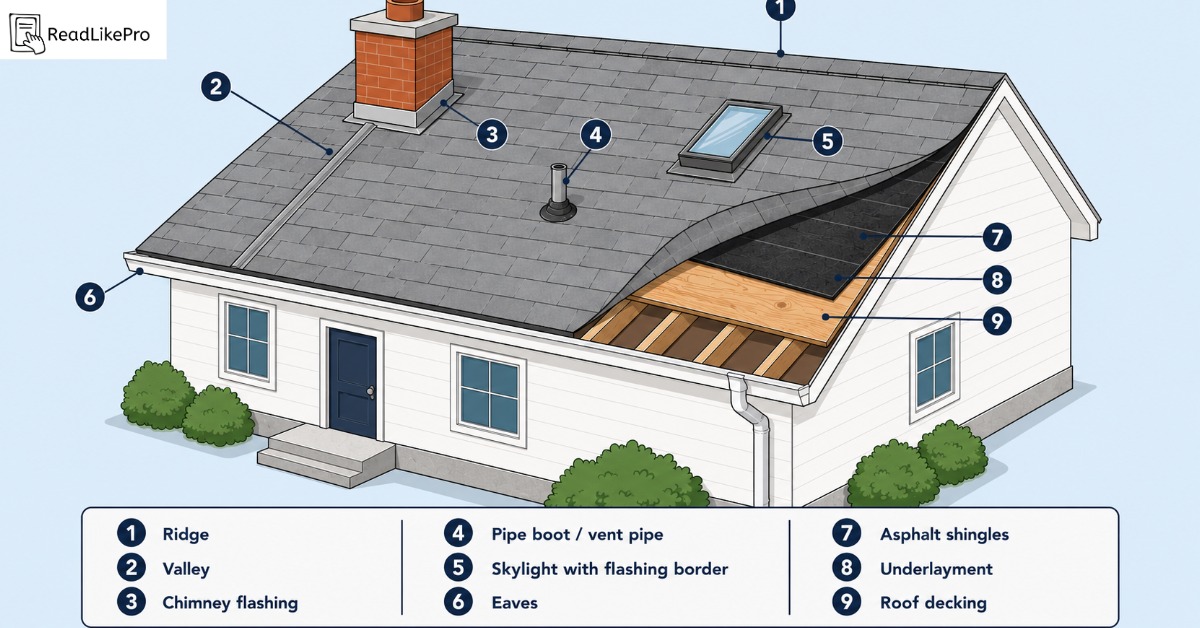
Leak type drives cost more than any other single factor. A pipe boot replacement averages $100–$600, while structural decking repair from a long-ignored leak can run $1,000–$3,000 or more.
| Leak Type | Typical Cost Range | What Drives the Price |
|---|---|---|
| Pipe boot / vent pipe seal | $100 – $600 | Cheapest, most common repair; 30–60 minute job |
| Missing or damaged shingles | $100 – $1,000 | Scales with shingle count and matching difficulty |
| Roof vent leak | $100 – $700 | Reseal vs. full vent replacement |
| Flashing damage (chimney, wall, skylight) | $200 – $2,000 | Partial reseal vs. full re-flashing |
| Valley leak | $300 – $1,500 | Labor-intensive; high water volume area |
| Nail pops | $200 – $500 | Often signals installation issues |
| Skylight leak | $225 – $900 | Flashing fix vs. full unit replacement |
| Chimney leak | $150 – $3,500 | Small crack repair vs. full crown rebuild |
| Ice dam damage | $350 – $5,000+ | Removal cost separate from leak repair |
| Flat/low-slope roof leak | $300 – $1,200 | Patch vs. seam re-weld vs. section replacement |
| Structural/decking damage | $1,000 – $3,000+ | Result of any of the above left unaddressed |
These ranges come from HomeGuide’s per-leak-type cost data, corroborated by multiple regional contractor pricing breakdowns that report similar splits.
Pipe Boots, Vents, and Shingles The Cheap, Common Fixes
Pipe boot failures are usually the first thing a roofer checks if you’ve got a water stain near a bathroom or kitchen ceiling. The rubber boot around your plumbing vent pipe cracks and shrinks over time — typically after 7 to 10 years — letting water run straight down the pipe into your attic. It’s a genuine 30-to-60-minute job: materials run $15–$50, with labor making up most of the rest. A quote over $500 for a straightforward pipe boot replacement with no decking damage is worth questioning.
Missing or damaged shingles, usually from wind or hail, cost more depending on whether your roofer can match your existing shingles. Roofs over 10 years old often have discontinued profiles, which adds sourcing time. A small area under 100 square feet typically runs $200–$500; larger sections, or ones where the underlayment beneath also needs replacing, push toward $1,000.
Flashing, Valleys, and Skylights The Mid-Range Repairs
Flashing — the metal sealing joints around chimneys, valleys, walls, and skylights — is one of the most common leak points because it depends on sealant and metal-to-surface contact, both of which degrade with sun exposure and, in coastal areas, salt air corrosion. The wide $200–$2,000 range reflects everything from a $300 resealing job to an $800+ full chimney re-flashing. If you’re near the coast, ask whether your roofer is using galvanized steel (cheaper, corrodes faster) or stainless steel/copper (costs more upfront, lasts considerably longer).
Roof valleys — where two roof planes meet — handle more water volume than almost any other part of the roof, since every drop from both adjacent slopes funnels through one channel. That’s why valley repairs ($300–$1,500) cost more: they require careful shingle removal on both sides, new valley flashing or membrane, and precise reinstallation to maintain proper water flow.
Most skylight leaks ($225–$900) are flashing problems around the frame, not glass problems — meaning a $300–$700 flashing fix is far more common than a $800–$2,400 full unit replacement. If your skylight is over 15 years old, flashing degradation is the likely cause. Condensation between the panes, on the other hand, signals a failed seal in the unit itself.
Chimneys, Ice Dams, and Flat Roofs — The High-Variance Repairs
Chimney leak repair ($150–$3,500) has one of the widest ranges of any leak type because “chimney leak” spans everything from a small crown crack (a $150–$700 fix) to a full crown rebuild ($1,000–$3,000).
Ice dams form when heat escaping through your roof melts snow, which refreezes at the colder eaves and backs water up under your shingles. Removal of the ice itself ($350–$1,500) is billed separately from the actual leak repair and restoration ($1,500–$5,000+) — something many homeowners don’t realize until two separate invoices arrive.
Flat roofs use membrane systems (TPO, EPDM, modified bitumen) that fail at seams, around penetrations, or where water pools for too long. A small patch runs $300–$500, seam re-welding $200–$400, and larger section replacement $500–$1,200.
Structural and Decking Damage — What Happens When You Wait
This is what a “roof leak repair” becomes when water sits long enough to rot the plywood or OSB decking under your shingles, and eventually the rafters or trusses themselves. Decking replacement runs roughly $2–$5 per square foot for materials plus $5–$10 per square foot for labor; rafter sistering runs $200–$500 per rafter. Combined with re-shingling, a structural repair commonly lands at $1,000–$3,000+, sometimes well beyond that if multiple sections are affected.
What Waiting Actually Costs You
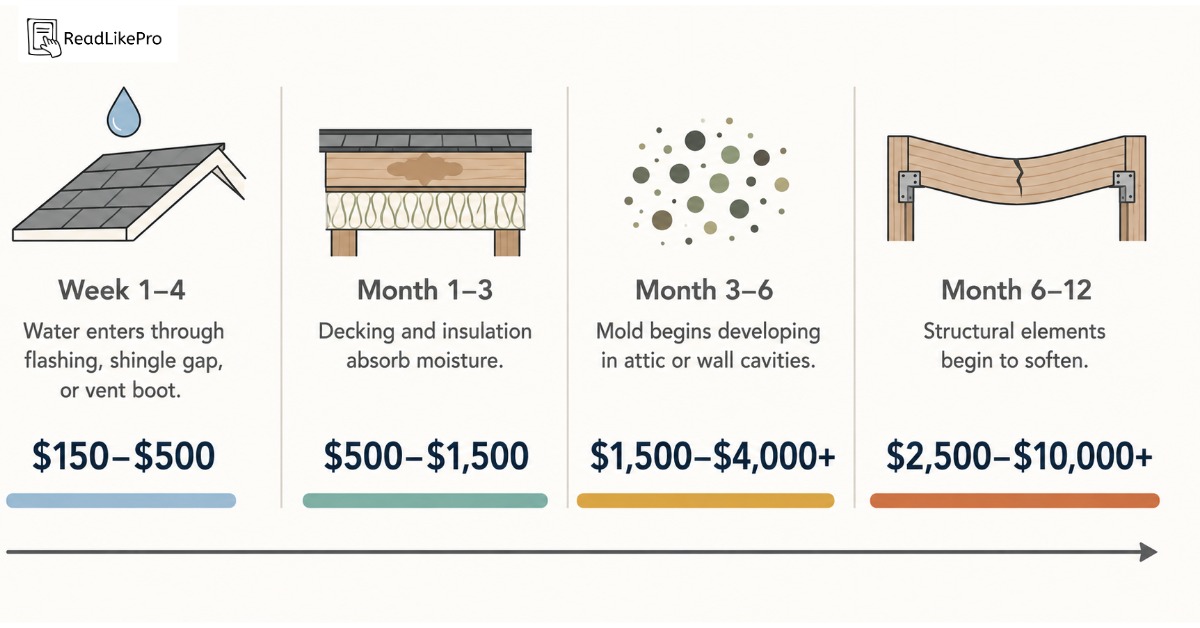
A leak that’s a $150–$500 fix in week one can become a $2,500–$10,000 repair within a year, because the cost increase comes from the expanding scope of the repair — not from contractors charging more over time.
| Timeframe | What’s Happening | Cost If Repaired Now |
|---|---|---|
| Week 1–4 | Water enters through flashing, shingle gap, or boot; decking begins absorbing moisture | $150 – $500 |
| Month 1–3 | Decking saturation spreads; insulation gets wet | $500 – $1,500 |
| Month 3–6 | Mold begins developing in attic or wall cavities | $1,500 – $4,000+ |
| Month 6–12 | Structural elements (rafters, trusses) start to soften | $2,500 – $10,000+ |
The mold remediation figures ($1,200–$4,000) are consistent with ConsumerAffairs’ cost research on water-damage-related cleanup. The broader pattern — small, undetected issues compounding into much larger losses — also aligns with how the Insurance Information Institute homeowners insurance claims data describes water damage claims generally: gradual, unnoticed leaks frequently result in disproportionately large losses compared to sudden events.
A $300 flashing repair caught in week one is a fundamentally different financial situation than the same flashing failure discovered eight months later as a $4,000 mold-and-decking job.
What Affects Roof Leak Repair Cost
Beyond leak type, the biggest cost drivers are roof material, pitch/accessibility, number of stories, leak location, labor rates (which make up roughly 60% of total cost), and seasonal demand.
Roof Material
| Roof Material | Relative Repair Cost | Why |
|---|---|---|
| Asphalt shingles | Baseline (cheapest) | Most common; most roofers experienced with it |
| Metal panels/shingles | 1.3x – 1.8x baseline | Requires metal-specific tools and technique |
| Clay or concrete tile | 1.5x – 2x baseline | Fragile; walking boards needed to avoid breakage |
| Slate | 2x – 3x baseline | Requires a specialist roofer |
| Flat/TPO/EPDM | 1.2x – 1.5x baseline | Membrane-specific repair methods |
Pitch, Stories, and Location
A standard 4/12 to 6/12 pitch roof adds no real premium. Above 8/12, expect a 15–30% labor increase from the extra safety equipment and slower work required. Above 12/12 (roughly 45 degrees), some contractors require scaffolding, which can roughly double the labor portion.
Second-story roof work typically adds a 10–20% premium over single-story jobs due to ladder setup and material hauling; third-story access can add 20–40%.
| Location | Access Difficulty | Relative Cost |
|---|---|---|
| Mid-field / penetrations | Easy | Lower |
| Eaves | Easy, but may signal gutter/ice dam issues | Moderate |
| Ridge | Moderate | Moderate |
| Valley | Difficult (two intersecting planes) | Higher |
| Chimney | Multi-step flashing work | Higher |
Labor, Season, and Region
Labor typically makes up 60% or more of a roof leak repair’s total cost, with hourly rates running $35–$100, depending on region, contractor experience, and whether it’s emergency work. This proportion is consistent across multiple published roofing cost breakdowns.
Spring storm season (March–May) and hurricane season (June–November in coastal regions) bring higher demand — prices during these windows can run 10–25% higher than during slower months, typically late fall and winter outside snow-heavy climates.
Regionally, based on cost data reported by ConsumerAffairs:
| Region | Typical Repair Cost Range |
|---|---|
| Northeast | $450 – $1,100 |
| Midwest | $400 – $950 |
| South | $350 – $900 |
| West | $500 – $1,200 |
Homes in higher cost-of-living areas — particularly coastal cities and dense urban markets — tend to land toward the upper end, driven mainly by labor rates rather than materials.
Emergency Roof Leak Repair Cost
Emergency or after-hours repairs typically add $200–$500 on top of the standard repair cost, and a temporary tarp installation runs $300–$600 when done by a professional.
If your roof starts leaking during a storm and you need same-day or after-hours help, that premium reflects the contractor mobilizing a crew outside normal scheduling. If the full repair can’t happen immediately — unsafe conditions, materials not on hand — a tarp keeps water out until the permanent fix is scheduled. DIY tarping, if conditions are safe enough to access the roof, runs roughly $50–$150 in materials.
One useful thing to know: emergency tarping is generally considered part of your “duty to mitigate further damage” under most homeowners insurance policies, meaning the cost is often reimbursable if your leak stems from a covered event. Keep the receipt.
If you’re dealing with an active leak right now, our emergency roof leak repair guide walks through the immediate steps — what to do before the roofer arrives, how to protect your interior, and how to document damage properly for an insurance claim.
Does Insurance Cover Roof Leak Repair?
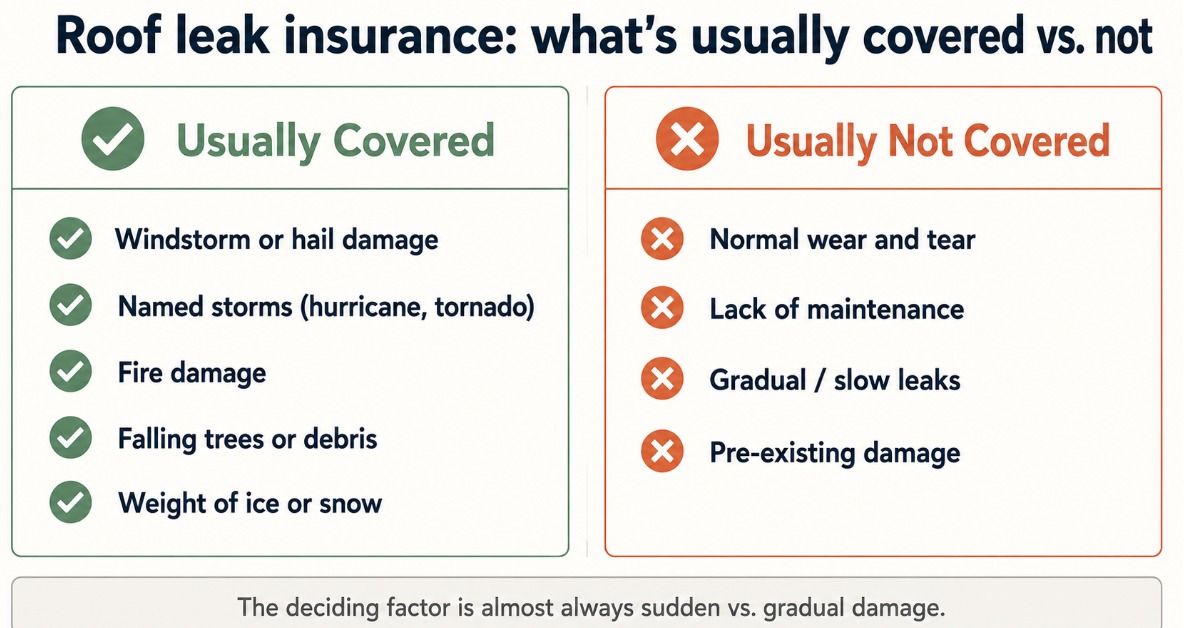
Insurance typically covers roof leaks caused by sudden events — storms, hail, fire, falling debris — but not leaks from gradual wear, lack of maintenance, or pre-existing conditions. The distinction between “sudden” and “gradual” damage is the deciding factor in most claims.
When Coverage Typically Applies
- Windstorm or hail damage
- Named storms (hurricanes, tropical storms, tornadoes)
- Fire damage
- Falling trees or debris
- Weight of ice or snow (policy-dependent)
When Coverage Typically Doesn’t Apply
- Normal wear and tear on an aging roof
- Lack of maintenance (clogged gutters causing backup, neglected flashing)
- Gradual deterioration that developed over months or years before being noticed
- Pre-existing damage that predated the policy
According to the Insurance Information Institute homeowners insurance claims data, about 1 in 67 insured homes files a property damage claim related to water damage or freezing each year, and water damage/freezing accounts for roughly 24% of all homeowners insurance claims on average between 2019 and 2023, with an average claim severity around $13,954–$15,400 depending on the dataset period. That figure spans both quickly-approved sudden-event claims and the much more contested territory of gradual-leak claims, which insurers scrutinize heavily because “gradual” implies the damage could have been caught earlier through maintenance.
It’s also worth noting that FEMA’s individual assistance program operates separately from homeowners insurance and has its own limits FEMA may help repair a disaster-related roof leak that damages ceilings or threatens electrical components, but typically does not cover cosmetic issues like ceiling stains themselves, and FEMA assistance generally requires a federal disaster declaration for your area.
How to File a Roof Leak Insurance Claim
- Document immediately — timestamped photos and video of interior and visible exterior damage.
- Prevent further damage — arrange emergency tarping if needed; keep receipts, as this is typically reimbursable.
- Contact your insurer within 24–48 hours and get a claim number.
- Don’t make permanent repairs before the adjuster inspects — temporary fixes are expected.
- Get a professional inspection with a written estimate — this often catches damage an adjuster might miss.
- Have your roofer present during the adjuster’s inspection if possible.
- Compare the settlement to your roofer’s estimate and file a supplement or dispute if there’s a significant gap.
Does a Home Warranty Cover Roof Leaks?
Home warranty plans often offer roof leak coverage as an add-on rather than standard coverage, typically capping at $500–$1,500 per claim. Coverage generally applies to normal wear on existing components not storm damage (a homeowners insurance matter) and not pre-existing conditions. If a leak causes mold, that’s usually handled under your insurance policy rather than the warranty, since the two cover fundamentally different categories of damage.
How to Read a Roofing Estimate (And Spot a Bad One)
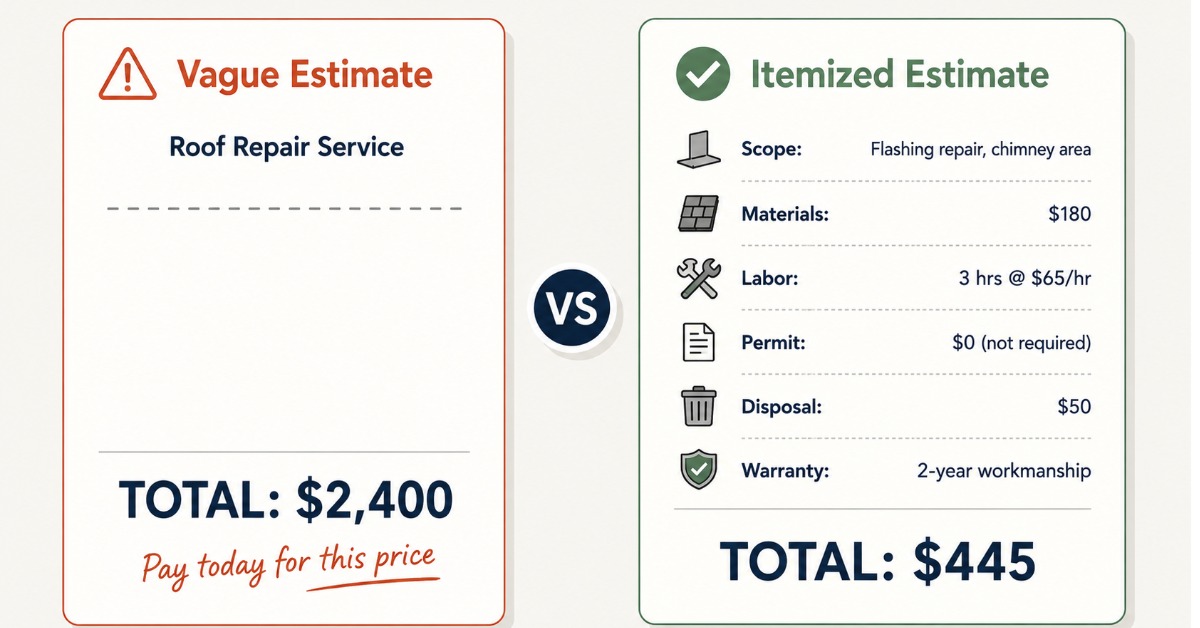
A trustworthy estimate breaks down scope of work, materials, labor, permits, and disposal fees separately — not just a single total. Estimates that vary by thousands of dollars for the “same” leak are usually scoping different repairs, not necessarily scams.
What a Fair Estimate Includes
- Scope of work — specifically what’s being repaired, not just “roof repair”
- Materials — type, quantity, and brand if relevant
- Labor — estimated hours or a flat charge
- Permit fees, if applicable roofing permits for repairs affecting more than 100 square feet or 25% of the roof typically run $70–$250
- Disposal/debris removal fees — typically $50–$150
- Warranty terms — both on materials and contractor workmanship
Red Flags in a Quote
- A single total number with no breakdown of what it covers
- Pressure to sign immediately, especially with “today only” pricing
- A full roof replacement recommended before any inspection has documented the actual extent of damage — industry commentary on overpriced home repairs specifically flags unnecessary full roof replacements, sometimes justified by pointing to mold or “code violations” without supporting documentation
- Requests for full payment upfront, particularly for emergency work
- A contractor unable or unwilling to provide proof of license and insurance
- An “Assignment of Benefits” (AOB) request, which signs over control of your insurance claim and can limit your ability to dispute their pricing later
Why Two Estimates Can Differ by Thousands
This is one of the most common sources of homeowner confusion, and it’s not always a sign of dishonesty. A few legitimate reasons:
- Different scoped repairs. One roofer quotes just the visible flashing fix; another got into the attic, found wet decking, and quoted the full repair including replacement.
- One quote includes a full inspection, the other doesn’t — the cheaper number may not reflect true scope until work begins and a change order appears.
- Material quality and warranty length differ — premium underlayment with a longer workmanship warranty costs more than minimum-grade materials with a 1-year warranty.
- Overhead differences — a small local operation versus a larger company with marketing and insurance overhead baked into pricing.
The practical move: get two or three estimates for anything beyond a simple pipe boot or minor shingle fix, and ask each contractor to explain why their number is what it is — not just what the number is.
DIY vs. Professional Roof Leak Repair
DIY makes sense only for small, accessible fixes on low-pitch roofs sealant touch-ups or an easily reachable pipe boot. Anything involving flashing, valleys, multiple shingles, or steeper roofs should go to a professional, partly because misdiagnosing the leak source is extremely common.
| Factor | DIY | Professional |
|---|---|---|
| Cost | $20 – $150 in materials | $150 – $1,500+ depending on scope |
| Best for | Small sealant touch-ups, accessible pipe boot on low-pitch roof | Flashing, valleys, multiple shingles, steep roofs |
| Risk | Misdiagnosis (water travels before it drips); fall risk | Lower diagnostic risk; workmanship warranty |
| Warranty impact | May void manufacturer shingle warranty if done improperly | Often preserves warranty coverage |
An important point that’s easy to underestimate: water often enters in one spot and travels along the underside of the decking or along rafters before dripping through your ceiling somewhere entirely different. This is why DIY interior patching — caulking a ceiling crack, for example — frequently fails. You’re treating where the symptom appears, not the actual entry point. If you can’t identify the true source from the attic with a flashlight, a professional leak detection inspection ($100–$400), sometimes using moisture meters or infrared cameras, is often worthwhile before any repair begins.
A few things to avoid regardless of DIY or professional work: don’t climb onto a wet or icy roof (falls are a leading cause of injury during storm cleanup), don’t use silicone caulk as a “permanent” fix (it appears to work briefly, then fails), and don’t ignore an occasional drip — see the cost-escalation timeline above for why.
Roof Leak Repair vs. Roof Replacement: When Repair Stops Making Sense
If your repair estimate approaches or exceeds roughly 30% of a full roof replacement cost, replacement often becomes the more financially sound choice — you get a new warranty, updated materials, and eliminate leak risk across the roof’s full lifespan rather than patching one section while the rest ages toward failure.
Signs you’re closer to replacement territory:
- Your roof is at or past its expected lifespan — asphalt shingles typically run 20–30 years depending on climate and ventilation
- You’ve had leaks in multiple, unrelated locations rather than one isolated spot
- The same area has already been repaired more than once
- Decking damage covers a significant portion of the roof, not just the area around one leak
- Shingle deterioration (curling, cracking, granule loss) is widespread, not localized
For cost context, a full roof replacement generally runs $5,700–$16,000+ depending on roof size, material, and pitch — which is why the 30% threshold functions as a useful decision tool rather than just a number.
How to Prevent Roof Leaks
NRCA’s official maintenance guidance recommends scheduling roof inspections at least twice a year in spring and fall — to catch cracked or curling shingles, deteriorated flashing, and granule accumulation in gutters before they become active leaks.
A few habits that meaningfully reduce leak risk:
- Keep gutters clear. Clogged gutters cause water backup at the roof edge, a documented contributor to eave leaks.
- Trim overhanging branches and keep gutters clear. FEMA’s hurricane preparedness guidance recommends trimming or removing trees that could fall on your house and cleaning out gutters so rain doesn’t pool on the roof — both of which directly reduce leak risk.
- Check attic ventilation. Poor ventilation contributes to both ice dam formation in cold climates and accelerated shingle aging in hot ones.
- Do a post-storm visual check. After any significant wind event, a ground-level look for missing shingles or displaced flashing can catch a problem while it’s still a $300 fix instead of a $2,000+ one.
According to NRCA’s official roof maintenance guidance published in Professional Roofing, roof systems should be inspected — and any necessary repairs made at least twice a year, preferably in spring and fall, with additional inspections recommended after severe weather events.
What Homeowners on Reddit and Quora Are Saying
The points below reflect recurring patterns in homeowner discussions, not verified statistics. We’re including them because they highlight real frustrations that most cost guides ignore — and where possible, we’ve connected them to the verified information above.
“I got quotes that varied by thousands of dollars for what sounded like the same problem.” This comes up constantly, and as covered in the estimates section, it’s often because the quotes weren’t scoping the same work — one included attic access and a decking assessment, the other didn’t. The consistent advice across these discussions is to get multiple quotes and ask each contractor to explain their reasoning.
“A previous repair didn’t actually fix the leak, and I paid twice.” This pattern shows up often enough to matter: a homeowner pays for a repair, the leak seems to stop, then resumes weeks or months later because the original fix addressed a symptom rather than the actual water entry point. This connects directly to the “water travels before it drips” issue discussed in the DIY section. The practical lesson: ask your contractor specifically what they identified as the source, not just what they patched.
Frustration with insurance claims being partially or fully denied. This pattern traces directly back to the sudden-vs-gradual distinction covered in the insurance section above. Homeowners often feel blindsided when a leak that seems storm-related gets classified as “wear and tear” by an adjuster. The recurring theme: documentation — prior inspection records, maintenance receipts — helps demonstrate the roof wasn’t already failing before the storm event.
Concerns about being pushed toward unnecessary full roof replacement. This aligns with the red flags covered above. The consistent advice from these discussions: request a detailed inspection report with photos before agreeing to anything beyond a targeted repair, and get a second opinion if a full replacement is recommended for what was reported as a single leak.
None of this means the roofing or insurance industries are inherently untrustworthy — it means understanding why these situations happen helps homeowners navigate them more effectively, which is the purpose of the sections above.
Frequently Asked Questions
How much does it cost to fix a small roof leak?
A small, isolated leak — most often a failed pipe boot or a handful of damaged shingles — typically costs $100 to $500. The key variable is whether it’s caught before water reaches the decking; if decking replacement is needed, even a “small” leak can move into the $500–$1,000 range.
What is the average cost to repair a roof leak?
Most homeowners pay roughly $650–$850 for a single leak repair without significant interior damage. Published averages range from about $360 to $1,550, with the variation driven by leak type, severity, and region — see the leak-type table above for a more precise estimate.
Will homeowners insurance cover my roof leak?
Only if it resulted from a sudden, covered event — storm, hail, fire, falling debris, or a named weather event. Leaks from gradual wear, lack of maintenance, or aging materials are generally not covered, since the sudden-versus-gradual distinction is the deciding factor in most claims.
Is it cheaper to repair or replace my roof?
Repair is almost always cheaper upfront for an isolated leak. Replacement becomes more cost-effective when your repair estimate approaches roughly 30% of a full replacement cost, when you’ve had repeated leaks in different areas, or when your roof is at or past its expected lifespan.
How long does a roof leak repair take?
Most repairs take 1 to 4 hours of on-roof time. A pipe boot replacement is often under an hour; flashing repairs run 2–3 hours; valley repairs can take half a day; structural repairs involving decking replacement may take a full day or longer.
Can a roof leak be repaired from inside the house?
Interior fixes like caulking a ceiling crack only address the symptom — the actual entry point is often elsewhere on the roof, since water travels along decking and rafters before it drips through. A lasting repair almost always requires addressing the entry point from the exterior.
What’s the most common cause of roof leaks?
Pipe boot failures and missing or damaged shingles are among the most frequently cited causes, alongside flashing failures around chimneys, valleys, and skylights. Clogged gutters causing water backup at the roof edge is another common, often-overlooked contributor.
How much do roofers charge per hour?
Labor rates typically run $35–$100 per hour, varying by region, contractor experience, and whether it’s standard or emergency work. Labor generally makes up 60% or more of total repair cost.
Is a service call fee separate from the repair cost normal?
Yes, particularly for emergency or same-day visits. Reputable contractors disclose this upfront — some credit it toward the repair if you proceed, others charge it regardless. Ask before scheduling.
Does fixing a roof leak void my roof’s manufacturer warranty?
It depends on who performs the work and how. Repairs by a licensed, manufacturer-certified contractor using approved materials typically preserve coverage. DIY repairs or work using non-approved materials can void portions of a manufacturer warranty — check your specific terms before attempting any repair yourself.
How much does emergency roof leak repair cost?
Emergency repairs typically add $200–$500 on top of the standard cost as an after-hours premium, and a temporary tarp installation runs $300–$600 when done professionally. For the immediate steps to take before a contractor arrives, see our emergency roof leak repair guide.
The Bottom Line
The type of leak you have matters more than any “average cost” figure you’ll find online. A pipe boot failure and a structural decking repair both fall under “roof leak repair,” but they’re separated by thousands of dollars and entirely different scopes of work.
Before calling anyone, try to identify — or have a professional identify — what kind of leak you’re actually dealing with. That single piece of information tells you more about your likely cost than any national average ever could. And if a contractor’s estimate doesn’t match what you’d expect for that leak type, ask them to walk you through why. The answer is usually informative either way.

Baldeep builds and researches content sites full time. For ReadLikePro he
compiles home service pricing from contractor quotes, industry cost surveys,
and public data, then checks the numbers against more than one source before
publishing. He isn’t a licensed contractor, so every estimate here is a
research-backed range, not a quote for your specific job.