

Ask five contractors what a bathroom remodel costs and you’ll get five different numbers. Sometimes thousands of dollars apart — for the same room. That’s not dishonesty. Bathroom remodeling costs depend on a handful of decisions most homeowners haven’t made yet when they start collecting quotes.
In 2026, most full bathroom remodels in the US land between $6,600 and $25,000, with the national average around $12,000–$15,000, according to cost data from Angi and NerdWallet’s remodel research. A powder room refresh can stay under $5,000. A primary bath with a walk-in shower and heated floors can blow past $50,000.
Same word — “remodel.” Very different projects.
Quick answer: A typical 2026 bathroom remodel costs $10,000–$25,000 for a full renovation. Budget refreshes start near $3,500–$8,000. Mid-range projects land at $12,000–$25,000. Luxury primary bathrooms run $30,000–$80,000+. Expect roughly $125–$350 per square foot — more than a kitchen, because nearly every inch involves plumbing, waterproofing, or tile.
Want a number for your specific project first? Our home renovation cost calculator has a bathroom option — pick your size and finish level and get a realistic 2026 range in seconds.
Bathroom Remodeling Costs by Size
Bathroom pricing scales with square footage, but not the way you’d expect. Fixed costs — permits, a plumber’s minimum charge, hauling away debris — don’t shrink with the room. That’s why a tiny bathroom often costs more per square foot than a big one.
| Bathroom type | Typical size | 2026 cost range |
|---|---|---|
| Powder room / half bath | 15–25 sq ft | $2,500 – $8,000 |
| Small full bath (5×8) | 40 sq ft | $6,500 – $15,000 |
| Standard full bath | 40–75 sq ft | $10,000 – $25,000 |
| Primary / master bath | 100–200+ sq ft | $20,000 – $50,000+ |
A few notes on these ranges.
The 5×8 bathroom is the industry’s reference layout — toilet, vanity, and a tub/shower combo along one wall. Most “average cost” figures you see online quietly assume this size. This Old House’s 2026 research puts full remodels for spaces between 40 and 150 square feet at roughly $6,500 to $24,700, which matches what contractors are quoting this year.
Half baths punch above their price. No shower means no waterproofing, no tile surround, and far less plumbing labor. If your budget is tight and guests actually see your dated powder room, it’s the cheapest high-impact remodel in the house.
Primary bathrooms are where budgets climb fast. Double vanity, separate tub and shower, heated floors — each one pulls in more trades and more days of labor.
Bathroom Remodeling Costs by Scope
Size sets the floor. Scope — how much you’re actually changing — sets the ceiling.
Budget refresh ($3,500–$8,000)
Everything stays where it is. New vanity, toilet, faucet, and lighting. Regrout or repaint. Maybe new flooring over the existing subfloor. No tile demolition, no plumbing moves. Done carefully, a refresh makes a bathroom feel new for a fraction of full-remodel pricing.
Mid-range remodel ($12,000–$25,000)
This is where most homeowners land, and it’s the sweet spot for value. Wet areas get gutted to the studs. New tub or shower with proper waterproofing, new tile, new vanity, updated lighting and ventilation — but the toilet, sink, and shower stay in their current spots. Quality materials, professional installation, nothing exotic.
Luxury / full gut ($30,000–$80,000+)
Walls move. Plumbing relocates. Curbless walk-in shower, freestanding tub, custom tile, heated floors, smart fixtures. In high-cost metros, luxury primary bathrooms regularly pass $80,000 — and per NerdWallet’s 2026 analysis, high-end remodels can top that figure even outside coastal markets.
Where the Money Actually Goes
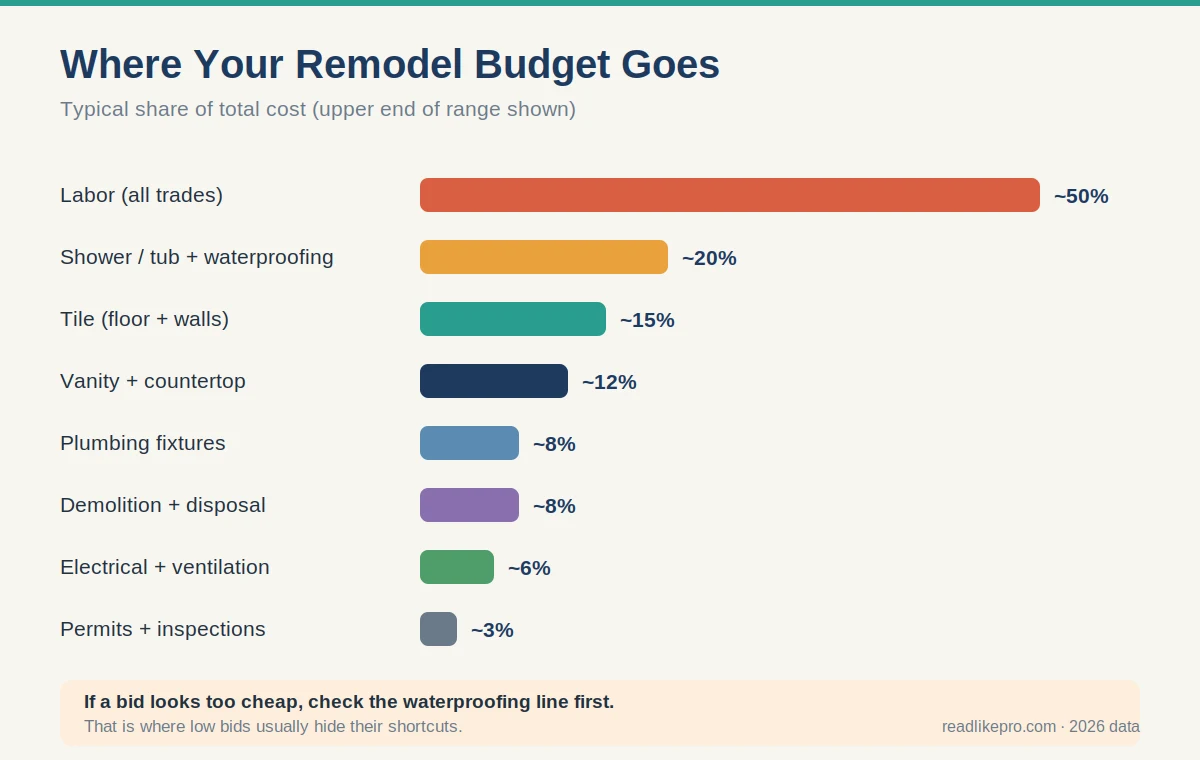
Knowing the typical budget split does two things. It tells you when a bid looks padded, and it shows you where to cut if the total comes in high.
| Component | Share of budget | 2026 typical cost |
|---|---|---|
| Labor (all trades) | 40–60% | Usually the biggest line |
| Shower / tub + waterproofing | 15–25% | $1,500 – $8,000+ installed |
| Tile (floor + walls) | 10–20% | Labor-heavy work |
| Vanity + countertop | 8–15% | $500 – $4,000+ |
| Plumbing fixtures | 5–10% | Toilet, faucets, shower valve |
| Demolition + disposal | 5–10% | $1,000 – $2,300 |
| Electrical + ventilation | 4–8% | Exhaust fan, GFCI, lighting |
| Permits + inspections | 1–5% | $100 – $1,000 |
Two things stand out.
Labor dominates. Angi’s 2026 data shows demolition alone running $1,000–$2,300, with permits adding $100–$1,000 — before a single tile goes up. Bathrooms pull in more trades per square foot than any other room: plumber, electrician, tile setter, carpenter, all working in a space the size of a walk-in closet. In This Old House’s 2026 survey of 1,000 recent renovators, about 40% of homeowners said labor and materials split their budget roughly down the middle.
Waterproofing is not the place to save. The shower system behind your tile — membrane, pan, backer board — is invisible on day one and makes or breaks the room by year five. Skimped waterproofing is how a $15,000 remodel turns into a $30,000 mold and subfloor repair. If one bid is dramatically cheaper than the others, this is usually where the money came out.
The Wet Wall Rule: The One Decision That Controls Your Budget
Here’s the cost lever most pricing guides bury: whether your fixtures stay on the existing wet wall.
The wet wall is the wall carrying your water supply lines and drain pipes. Keep the toilet, sink, and shower in their current positions, and your plumber is doing simple hookups — a few hundred dollars per fixture. Move a toilet or shower drain, and now you’re cutting into the floor, rerouting drain lines, moving vent pipes, and passing an extra inspection. Typical contractor quotes for relocating a single drain run $2,500–$5,000. And that’s before anything visible changes.
The practical version of this rule: a mid-range remodel that keeps the layout often looks identical to one that shuffled fixtures around — same tile, same vanity, same shower glass — for $5,000–$10,000 less. Unless your current layout truly doesn’t work (the door hits the toilet, the shower is unusable), keep the footprint. Spend the savings on materials you’ll touch every day.
Hidden Costs: The Pre-Demo Audit
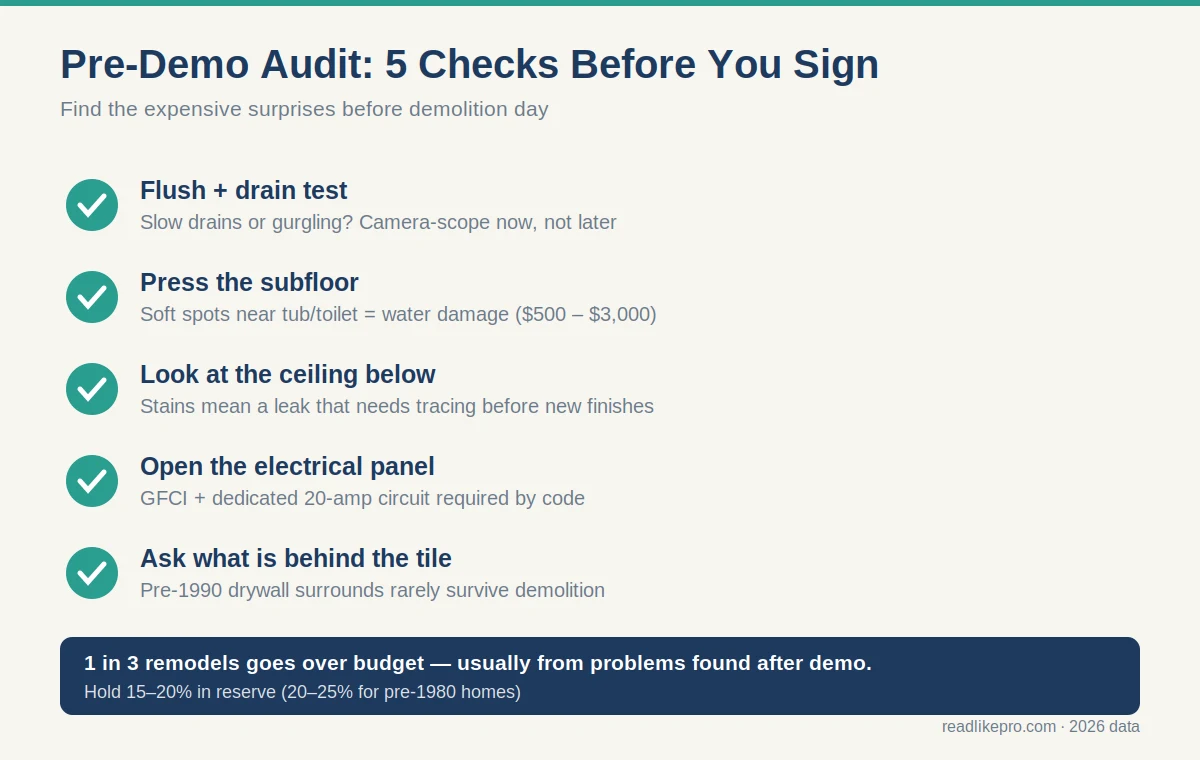
This Old House’s 2026 survey found that about 1 in 3 homeowners paid more than expected on their bathroom remodel. The usual culprits: plumbing upgrades, water damage, or structural repairs discovered mid-project.
The good news? Most of those surprises are findable before demolition day. Run this audit with your contractor before signing anything.
- Flush and drain test. Slow drains or gurgling can signal venting problems or blocked lines. Cheap to scope with a camera now. Expensive to discover after the new floor is in.
- Press on the subfloor around the toilet and tub. Softness or flex underfoot usually means water has been sneaking past old caulk or a failed wax ring for years. Subfloor replacement adds $500–$3,000.
- Look at the ceiling below. Water stains under the bathroom mean an active or past leak that needs tracing before new finishes cover it up.
- Open the electrical panel. A remodel must meet current code — GFCI protection and, in most areas, a dedicated 20-amp circuit. Homes with older panels sometimes need an electrical panel upgrade before the bathroom work can even be permitted.
- Ask what’s behind the tile. Pre-1990 homes often have plain drywall (not cement board) behind tub surrounds. It rarely survives demolition, and replacing it properly is a cost some low bids conveniently leave out.
Even with a clean audit, hold 15–20% of your budget in reserve — closer to 20–25% for older homes. Contractors build in this cushion as standard practice. You should too.
Remodeling a Bathroom in a Pre-1980 Home
Older homes deserve their own section, because national averages quietly assume modern plumbing and wiring. If your house predates 1980, three costs show up that newer-home owners never see.
Galvanized or cast iron plumbing. Galvanized supply lines rust from the inside and are usually at end-of-life by now. Cast iron drain pipes crack and scale up. Many plumbers won’t connect new fixtures to failing galvanized lines, which means partial repiping — often $1,500–$5,000 added to the project.
Outdated electrical. Bathrooms built before GFCI requirements need new protected circuits, and older wiring complicates everything. If you’re also noticing flickering lights or warm outlets elsewhere in the house, have an electrician look before demo starts. A remodel is the cheapest moment to fix wiring — the walls are already open.
Surprise materials. Pre-1980 construction can hide asbestos in flooring adhesive and lead paint on trim. Testing runs $200–$800. Professional removal, if needed, adds $1,500–$5,000+. Budget for the test even if you skip everything else in this section.
None of this means an older-home remodel isn’t worth doing. It means the 20–25% reserve isn’t pessimism — it’s the realistic price of opening sixty-year-old walls.
How Long Does a Bathroom Remodel Take?
A cosmetic refresh wraps in 3–7 days. A mid-range full remodel typically runs 2–4 weeks of active work. Layout changes, custom glass, or special-order tile stretch that to 4–8 weeks or more. Custom shower glass alone often carries a 2–4 week wait after final measurement — which happens after the tile is done.
One scheduling trap catches almost everyone: demo starts before materials arrive. Don’t let anyone swing a hammer until the tub, tile, and vanity have confirmed delivery dates. An unusable bathroom waiting on a backordered vanity is how a three-week project becomes a seven-week one.
Is a Bathroom Remodel Worth It? ROI in 2026
Bathrooms hold their value well — with a catch. Per the 2025 Cost vs. Value Report from Zonda, a mid-range bathroom remodel recoups roughly 70–80% of its cost at resale. Upscale remodels recoup far less — around 35–40% — because luxury finishes rarely translate dollar-for-dollar when you sell.
The pattern mirrors what we found researching kitchen remodel pricing: the cheaper project returns the higher percentage. If resale drives the decision, stay mid-range with neutral finishes. If you’re staying ten years, build the bathroom you actually want. Daily use is its own return — and This Old House’s survey found nearly 95% of renovators were happy with the result, budget surprises and all.
One small upgrade pays back twice: WaterSense-labeled fixtures. Per the EPA, swapping one showerhead for a WaterSense model saves the average family around 2,700 gallons of water a year, plus real water-heating energy. A quiet, permanent discount on your utility bills.
Smart Ways to Lower Your Bathroom Remodeling Costs
- Keep the wet wall. Worth repeating. Not moving plumbing is the single biggest save available — often $2,500–$5,000 per relocated fixture.
- Reglaze instead of replace. A structurally sound tub can be professionally refinished for $300–$600, versus $1,500–$4,000+ for replacement including plumbing labor.
- Tile the wet areas, paint the rest. Floor-to-ceiling tile is beautiful and expensive to install. Tiling just the shower surround and using quality bathroom paint elsewhere cuts tile labor dramatically.
- Pick a prefab shower base with tiled walls. You get the custom look where eyes land, without paying for a fully custom tiled floor pan.
- Buy fixtures during holiday sales — but let your contractor confirm specs first. A returned special-order faucet erases the discount.
- Get three itemized bids, not lump sums. Itemized bids expose padding and make the waterproofing line visible — which, as covered above, is exactly where cheap bids hide their shortcuts.
Frequently Asked Questions
What is the average bathroom remodeling cost in 2026? Most full bathroom remodels cost $10,000–$25,000, with the national average around $12,000–$15,000. Budget refreshes start near $3,500, and luxury primary bathrooms can exceed $80,000 depending on size, materials, and layout changes.
How much does it cost to remodel a small 5×8 bathroom? A full remodel of a standard 5×8 (40 sq ft) bathroom typically runs $6,500–$15,000 in 2026, assuming the layout stays put. Moving plumbing pushes the number higher fast.
What is the most expensive part of a bathroom remodel? Labor, which takes 40–60% of the typical budget. Among materials, the shower or tub area — including waterproofing and tile — is usually the biggest single expense.
Is $10,000 enough to remodel a bathroom? Yes, for a small-to-standard bathroom that keeps its existing layout. $10,000 covers a solid refresh or a modest full remodel with mid-grade materials. It won’t stretch to layout changes or custom tile work.
Why do bathroom remodels go over budget? Hidden damage is the top reason — about 1 in 3 homeowners in This Old House’s 2026 survey paid more than expected, usually due to plumbing upgrades, water damage, or structural repairs found after demolition. A pre-demo inspection and a 15–20% reserve prevent most of the pain.
Does a bathroom remodel add home value? Yes. Mid-range remodels recoup roughly 70–80% of their cost at resale per the Cost vs. Value data, making them one of the stronger interior investments. Upscale remodels recoup closer to 35–40%.
Do I need a permit to remodel a bathroom? For any plumbing or electrical work, almost always yes — expect $100–$1,000 depending on where you live. Purely cosmetic swaps (paint, vanity, faucet) usually don’t need one. A legitimate contractor pulls permits as standard practice.
Your Bathroom Remodel Budget at a Glance
The whole guide, boiled down to what to do next:
- Pick your tier first. Refresh ($3.5k–$8k), mid-range ($12k–$25k), or luxury ($30k+). Everything else follows from this.
- Keep the wet wall unless the layout truly fails you. It’s a $2,500–$5,000 save per fixture, invisible in the finished room.
- Run the pre-demo audit — drains, subfloor, ceiling below, electrical panel, wall material behind tile. Surprises found now cost a fraction of surprises found mid-project.
- Hold 15–20% in reserve. Make it 20–25% for pre-1980 homes.
- Demand itemized bids and check the waterproofing line. Cheap bids cut where you can’t see.
- Run your numbers through the renovation calculator linked at the top for a personalized 2026 range, then get two or three local quotes to anchor it.
A bathroom remodel rewards planning more than almost any project in the house. Nail the layout decision, audit before demo, protect the reserve — and the number you budget has a real chance of being the number you pay.

Baldeep builds and researches content sites full time. For ReadLikePro he
compiles home service pricing from contractor quotes, industry cost surveys,
and public data, then checks the numbers against more than one source before
publishing. He isn’t a licensed contractor, so every estimate here is a
research-backed range, not a quote for your specific job.



[…] expensive, dense, and full of things that can go wrong. A bathroom remodel runs $5,000 to $25,000 depending on […]