

Ask ten security companies what a home system costs and you’ll get ten different answers — sometimes almost $3,000 apart. Forbes Home’s research team reviewed 16 major providers and found pricing running anywhere from about $60 for a single camera up to roughly $3,000 for a fully installed system, which says less about home security than it does about how loosely this industry uses the word “cost.” NerdWallet puts the entry point even lower, around $130 for a basic DIY kit. Vivint quotes $199 to $2,500+ on its own site. None of these numbers are wrong, exactly — they’re answering slightly different questions, and none of them tell you the number that actually matters: what you’ll have paid after year one, year three, year five.
That gap isn’t a data problem. It’s a definitions problem, and this guide is built to close it — real pricing by brand, by home size, by install type, and by what happens to your total once monitoring fees run for a few years.
most homeowners land between $200 and $600 in upfront equipment, plus $20 to $40 a month for monitoring. Installation is free if you go DIY, or $99–$199 if you want it done for you. The part almost nobody spells out is what happens to that number once you factor in a few years of monitoring fees — which is where this guide is going to be more useful than the ten other tabs you probably have open.
Why Every Cost Guide Gives You a Different Number
It’s not that these sites disagree — it’s that “cost” means three different things depending on which one you’re reading.
Some guides quote equipment only (a $130 DIY starter kit). Some quote a fully installed system with monitoring baked in (Vivint-style, $600+). Some average across dozens of brands and land somewhere in the middle. A basic DIY alarm kit can run from around $130, while a comprehensive professionally installed system can climb past $2,000 once cameras, sensors, and installation are factored in — and monitoring itself ranges from free self-monitoring up to $80 a month for premium plans, according to NerdWallet’s most recent pricing breakdown.
So the honest answer is: it depends which of those three questions you’re actually asking. Most people asking “how much does a home security system cost” mean the whole picture — equipment, install, and a few years of monitoring — not just the sticker price on a starter kit. That’s the number this guide builds, brand by brand and scenario by scenario.
The Real Cost Over Time: DIY vs. Financed Contract
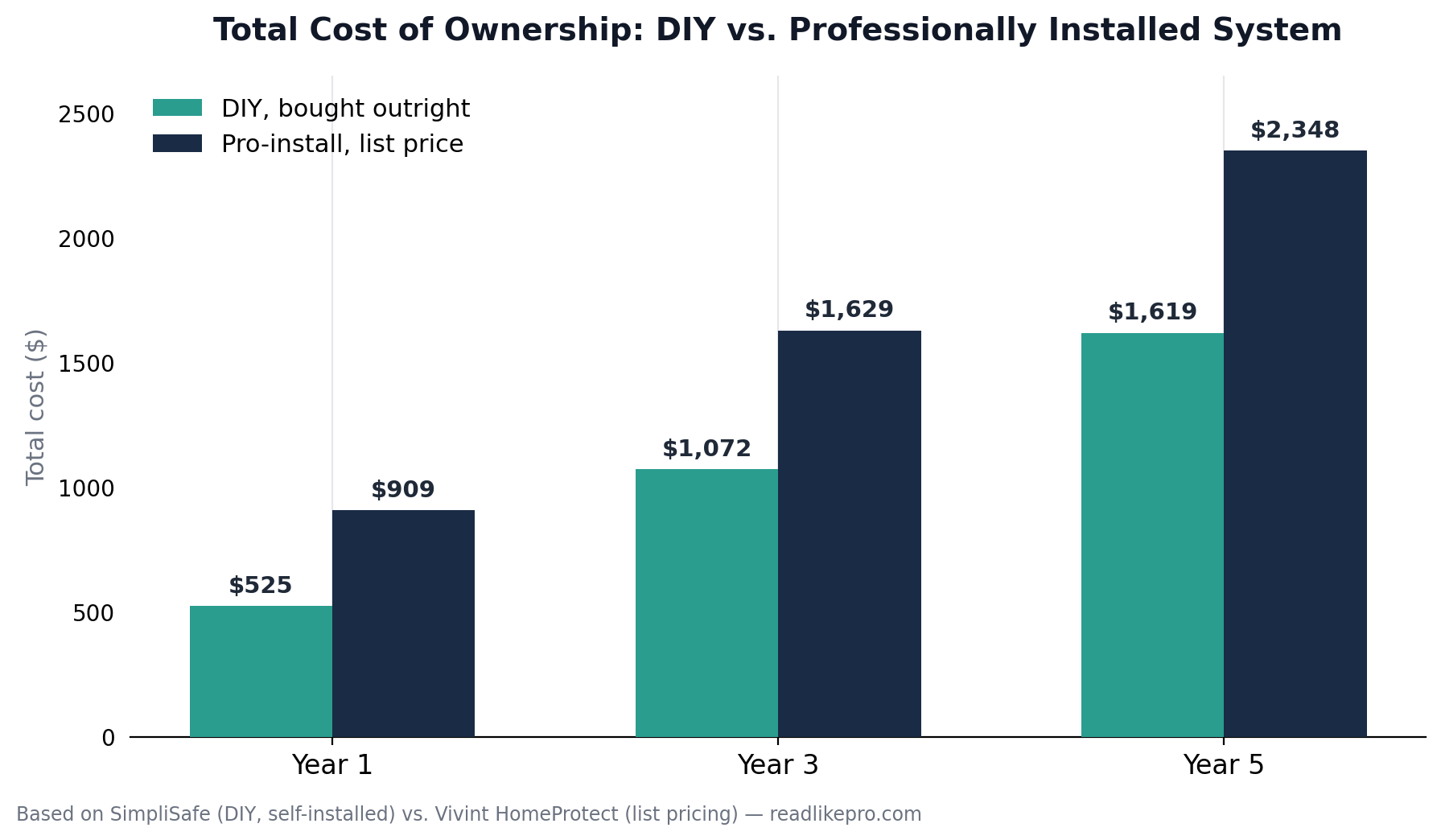
This is the piece that’s missing everywhere else. A cheaper upfront system isn’t automatically the cheaper system — it depends how long you keep it.
Take two real, currently listed packages as a comparison — not because these are “the best” systems, just because both companies publish transparent pricing that’s easy to verify.
DIY, bought outright (SimpliSafe Foundation package): equipment runs $250.96 with free self-installation, and SimpliSafe’s standard professional monitoring plan costs $22.80 a month, according to SafeWise’s pricing breakdown, which tracks SimpliSafe’s published rates directly.
Professionally installed, contract system (Vivint HomeProtect, list pricing): the HomeProtect equipment package is priced at $349.99, professional installation at $199, and monitoring at $29.99 a month at regular rates — per Vivint’s own published package terms.
| DIY, bought outright | Pro-install, list price | |
|---|---|---|
| Upfront (equipment + install) | $250.96 | $548.99 |
| Monitoring, Year 1 | $273.60 | $359.88 |
| Total after Year 1 | $524.56 | $908.87 |
| Total after Year 3 | $1,071.76 | $1,628.63 |
| Total after Year 5 | $1,618.96 | $2,348.39 |
A few things worth noticing here. First, the gap doesn’t close over time — it widens, because the pro-install system carries a higher monthly fee on top of a higher starting cost. Second, this is the list price comparison. Vivint (and most contract-based providers) frequently advertise promotional pricing instead — free installation, or equipment as low as $199.99 tied to a 36-month agreement. That’s not a trick exactly, but it does mean the “$199.99 system” you see advertised and the “$349.99 system” listed in the same company’s own terms and conditions are the same package priced two different ways. Read the fine print on any promo before you compare it to a DIY number — you’re often not comparing like for like.
If you want to run this math against your own setup instead of these two examples, our Home Security System Cost Calculator lets you plug in your install type, home size, and gear list to get your own upfront and monthly numbers side by side.
Home Security System Cost by Brand
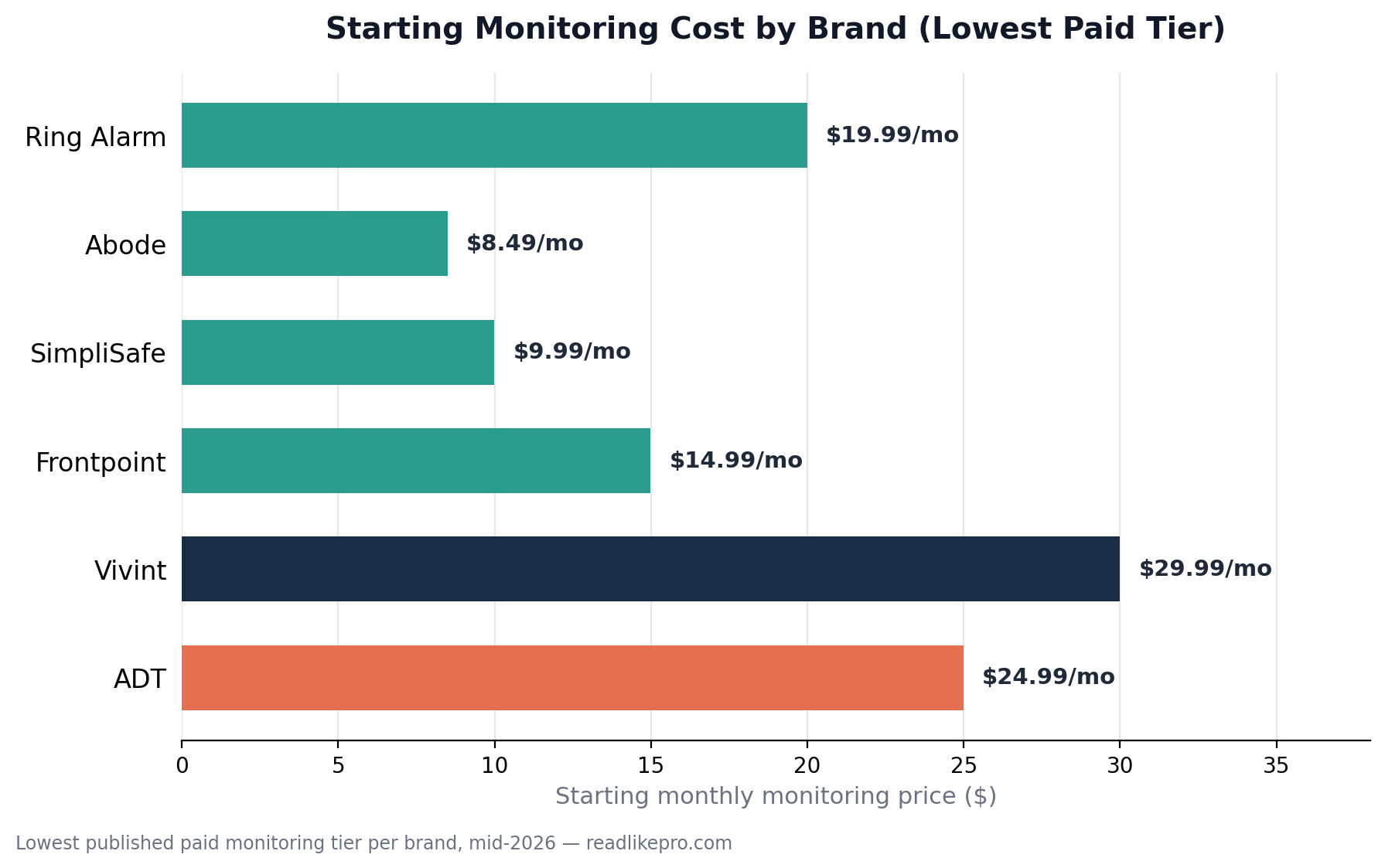
Six brands cover most of what US homeowners actually buy: three DIY-first (SimpliSafe, Ring Alarm, Abode), one hybrid (Frontpoint), and two professionally-oriented (ADT, Vivint). Here’s how their published pricing compares.
| Brand | Equipment Cost | Installation | Monitoring | Contract | Best For |
|---|---|---|---|---|---|
| SimpliSafe | $250.96–$733.90 | Free DIY (pro install from $124.99) | $9.99–$79.99/mo | None | No-contract DIY buyers who still want the option of full professional monitoring |
| Ring Alarm | $199.99–$449+ | Free DIY (pro install from $129.99/device) | $19.99/mo (Ring Protect Pro/AI Pro) | None | Amazon/Alexa households, budget buyers already using Ring cameras |
| ADT | $269+ (DIY), $599–$1,449 (pro packages) | Often bundled; ~$99–$150 standalone | $24.99–$60.99/mo | 36 months typical on pro-install | Homeowners who want the most established monitoring network and don’t mind paying for it |
| Vivint | $349.99+ (HomeProtect base) | $199 (often waived on contract) | $29.99–$44.99/mo | 36–60 months typical | Full professional install/monitoring plus deeper smart-home integration |
| Abode | $65–$199 | Free DIY (pro install from $99) | $0 self-monitor, $8.49–$26.99/mo pro tiers | None | Apple HomeKit households, and anyone who wants a genuinely free self-monitoring tier |
| Frontpoint | $69–$414.93+ | Free DIY (pro install from ~$99 via HelloTech) | $14.99–$49.99/mo | 3 years by default online, avoidable by paying upfront over the phone | Renters and DIYers who want Alarm.com’s professional-grade backend without a dealer |
A couple of patterns worth flagging. The two brands with genuinely no contract and no minimum monitoring commitment are SimpliSafe and Ring Alarm — both let you run the system with zero monthly fee if you’re comfortable self-monitoring through the app. Abode is the outlier that actually delivers on “free professional-grade DIY,” with a $0/month self-monitoring tier that still includes local processing and smart home automation, not just a stripped-down alarm.
ADT and Vivint sit at the other end — higher equipment and monitoring costs, but backed by their own in-house monitoring centers rather than third-party platforms, and typically bundled with professional installation. Frontpoint is the interesting middle case: DIY installation, but it runs on Alarm.com, the same backend that powers many professionally-dealer-installed systems, which is part of why its monitoring costs more than Ring or Abode despite being self-installed.
Pricing sourced from SafeWise, Security.org, and each brand’s own published pricing pages as of mid-2026. Equipment and monitoring prices change frequently — verify current rates directly with the provider before publishing a comparison based on these figures.
Home Security Equipment Cost Breakdown
Package prices bundle several devices together, which makes it hard to know what any single piece actually costs — useful if you’re building a custom system or just want to know what you’re really paying for.
| Component | Typical Price Range |
|---|---|
| Base station / hub | $100–$230 |
| Keypad | $50–$70 |
| Entry sensor (door/window) | $15–$30 each |
| Motion sensor | $30–$40 each |
| Indoor camera | $50–$150 |
| Outdoor camera | $100–$300 |
| Video doorbell | $130–$250 |
| Glass break sensor | $30–$45 |
| Smart lock | $100–$200 |
| Smoke / CO detector | $45–$70 |
| Flood / water sensor | $15–$30 |
These ranges are drawn from published à la carte pricing across SimpliSafe, Vivint, and Forbes Home’s component research — individual cameras alone can range from about $20 for a basic door alarm up to $300 for a premium outdoor unit, depending on resolution and features. The wide range on cameras specifically comes down to three things: resolution (HD vs. 4K), whether it stores video locally or requires a cloud subscription, and whether it includes AI-based person detection versus basic motion triggers.
One practical note: entry sensors and motion sensors are the cheapest way to add real coverage. A camera looks more impressive, but a $20 door sensor on every entry point closes more actual security gaps per dollar than a single premium camera pointed at your porch.
Cost by Home Size
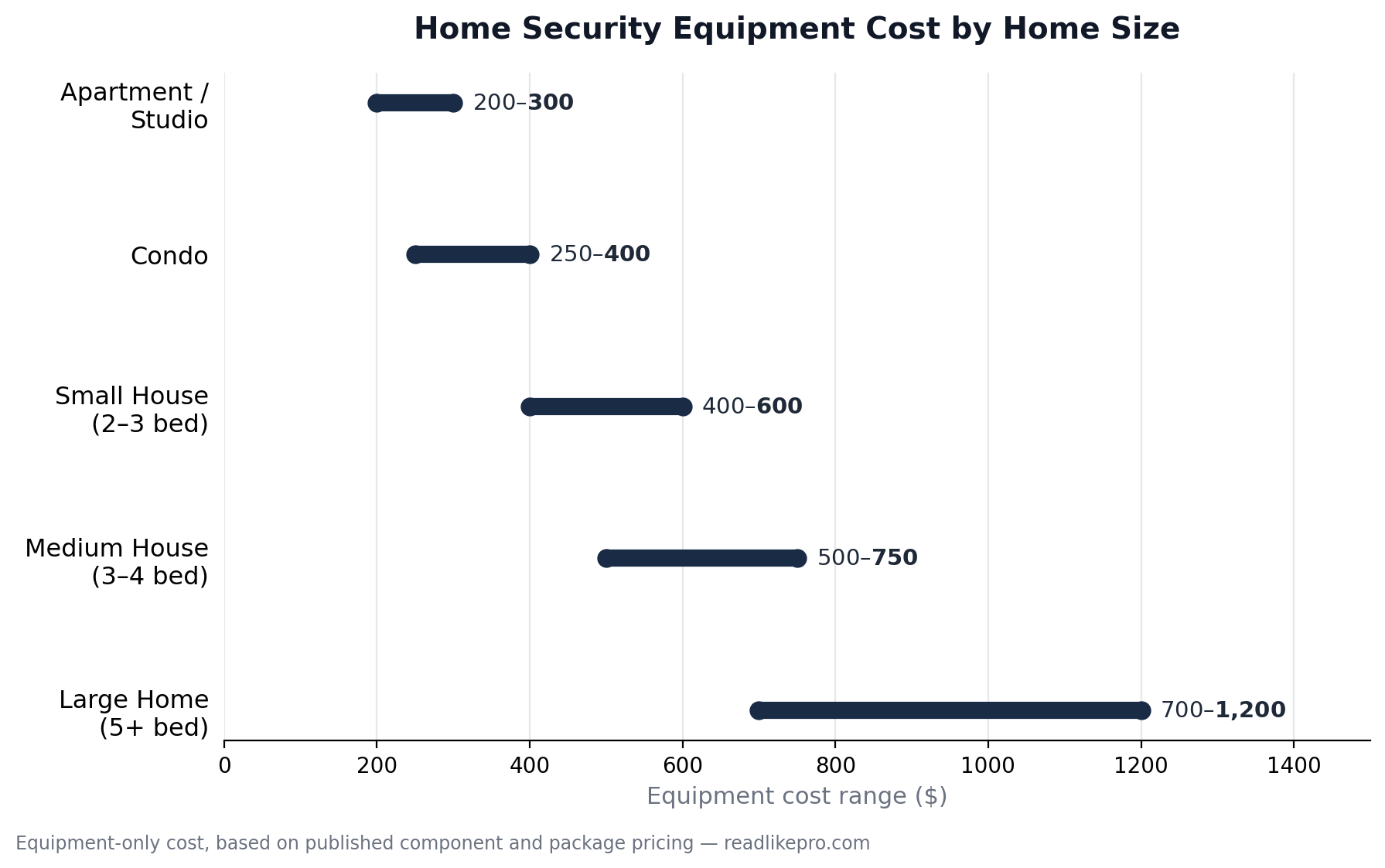
Package pricing scales with how much space and how many entry points you’re covering. Here’s what that looks like across five common living situations, based on published component and package pricing:
| Home Type | Typical Equipment Cost | Notes |
|---|---|---|
| Apartment / studio | $200–$300 | 1–2 entry points; hub, keypad, 1–2 entry sensors, sometimes a video doorbell for package alerts |
| Condo | $250–$400 | Similar footprint to an apartment but often one extra entry point (balcony door, garage access) |
| Small house (2–3 bed) | $400–$600 | 3–4 entry sensors, 1 motion sensor, often one outdoor camera |
| Medium house (3–4 bed) | $500–$750 | Full perimeter coverage, 1–2 cameras, smoke/CO detector added |
| Large home (5+ bed / multi-story) | $700–$1,200+ | Multiple motion sensors, 2+ outdoor cameras for perimeter coverage, often a smart lock and expanded keypad access |
Apartment or condo, 1–2 entry points. A basic kit with a hub, keypad, and a couple of entry sensors — SimpliSafe’s entry-level Foundation package is priced at $250.96, which covers this case reasonably well. Add a video doorbell (SimpliSafe’s runs $169) if package theft is a concern, and you’re still under $450 total before monitoring.
Standard 2–3 bedroom house. This is where most homeowners land, and it usually means covering three or four entry points plus one motion sensor — the mid-tier packages from most brands (SimpliSafe’s Hearth, at $437.91, is a reasonable example) are built around exactly this footprint. Adding one outdoor camera (commonly $150–$300 depending on resolution and features, per Forbes Home’s component research) pushes the realistic total closer to $600–$700.
Larger home, 4+ bedrooms or multiple stories. More entry points means more sensors, and multi-story homes usually want at least two outdoor cameras for full perimeter coverage. Packages built for this scale — SimpliSafe’s Knox or Beacon tiers, for example, run $520.87 to $733.90 — plus the option to add smart locks or extra motion coverage as needed.
These are equipment-only figures. Add your monitoring plan on top based on how hands-on you want to be — self-monitoring, standard professional monitoring, or a premium plan with AI detection and faster response.
Wired vs. Wireless Security System Cost Comparison
This decision affects your upfront cost more than almost any other choice you’ll make.
| Wired System | Wireless System | |
|---|---|---|
| Installation | Professional required, often with an electrician | DIY or professional, typically 30–60 minutes |
| Installation cost | Can involve running wiring through walls — costs vary significantly by home layout | $0 (DIY) or $99–$299 (professional) |
| Equipment cost | Often similar or slightly higher per device | Comparable, occasionally cheaper for entry-level kits |
| Reliability | More resistant to signal interference, less vulnerable to jamming | Depends on Wi-Fi/cellular signal strength |
| Portability | Fixed to the property — can’t take it when you move | Most systems can be uninstalled and reinstalled elsewhere |
Wired systems require professional installation and sometimes a licensed electrician, since the process typically involves running wiring through walls to connect equipment. Wireless systems, by contrast, are easier to install and can usually be controlled through a smartphone app, though signal strength becomes the main variable affecting reliability, and Forbes Home’s research puts installation costs for the systems they reviewed anywhere from free to $299, averaging around $150 among companies that charge for it.
For most homeowners today, the practical answer is straightforward: wireless has become the default because it’s cheaper to install and doesn’t lock you into a property. Wired setups still make sense for new construction, where the wiring goes in during the build anyway, or for homeowners who specifically want a system that’s harder to disable by cutting a wireless signal.
Cost by Installation Type: DIY vs. Professional
Installation type is one of the biggest single levers on your total cost, so it’s worth breaking out on its own rather than folding into the equipment discussion.
| DIY Installation | Professional Installation | |
|---|---|---|
| Typical cost | $0 | $99–$199 (up to $299 for complex setups) |
| Time to install | 30–90 minutes | Scheduled appointment, usually same-day |
| Placement accuracy | Depends on the homeowner following the setup guide | Technician verifies coverage and placement |
| Available with | SimpliSafe, Ring, Abode, Frontpoint, ADT Self Setup | ADT Pro Install, Vivint, most contract-based providers |
| Contract likelihood | Low — most DIY brands are month-to-month | Higher — professional install is often bundled with a multi-year monitoring agreement |
DIY saves you the install fee outright and keeps you off a long-term contract in most cases. The trade-off is real, though: improperly placed sensors or a poorly angled camera can leave coverage gaps you won’t discover until they matter. Professional installation costs more, but a technician checking placement before they leave reduces the odds of a blind spot at your actual weak point — the side door nobody thought to cover, or a motion sensor angled to miss half the room.
If you’re reasonably comfortable following a setup guide and your home has a straightforward layout — a handful of doors and windows, no unusual sightlines — DIY is a legitimate way to save $100–$300 without a meaningful security trade-off. Larger or oddly-shaped homes are where professional placement earns its cost back.
Self-Monitoring vs. Professional Monitoring: The Real Cost Gap
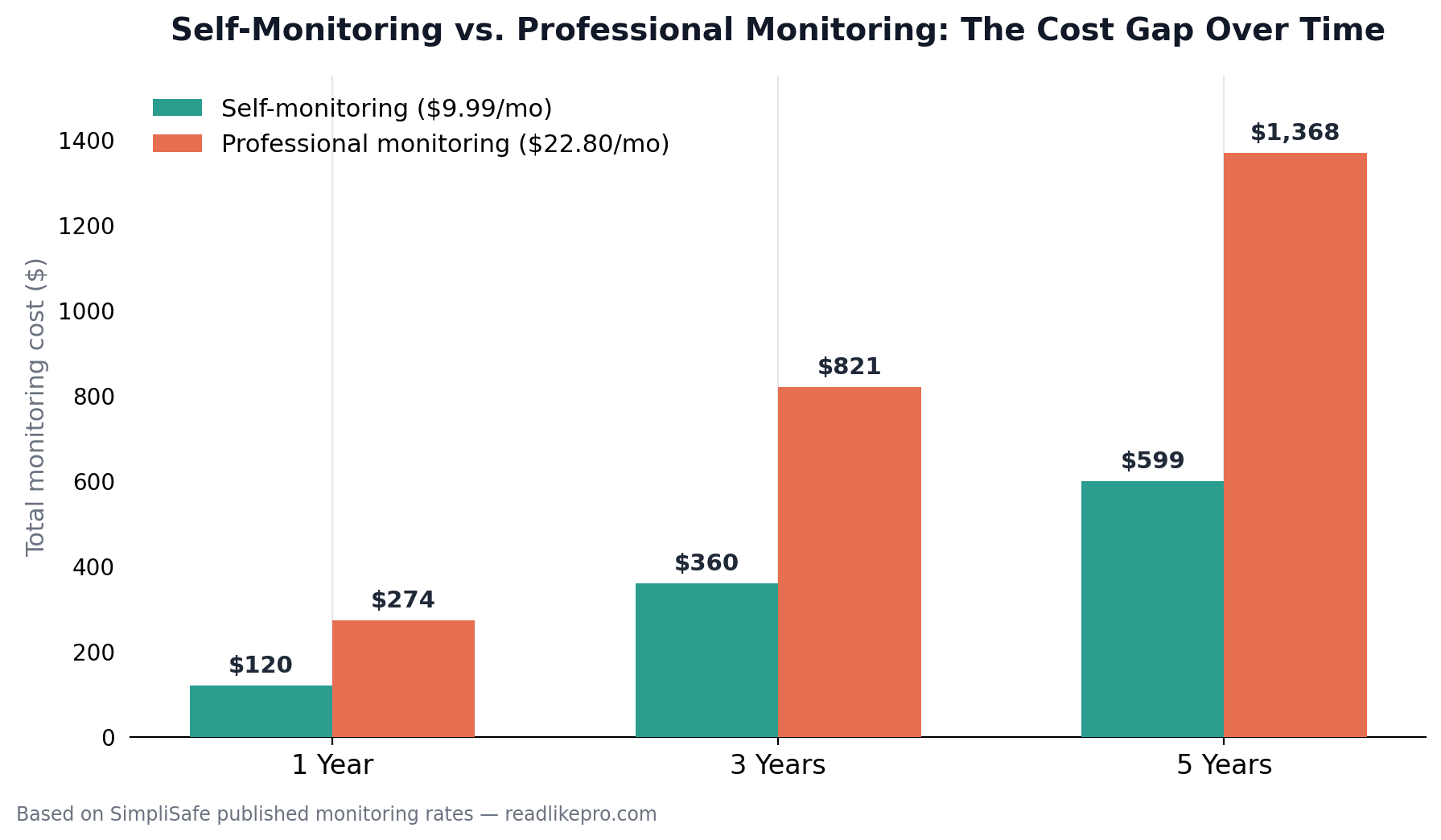
This is the single biggest lever on your 3-to-5-year total — bigger than equipment, bigger than install type. Using SimpliSafe’s published rates as a clean, single-brand comparison (self-monitoring at $9.99/month vs. standard professional monitoring at $22.80/month):
| Self-Monitoring | Professional Monitoring | |
|---|---|---|
| Monthly cost | $9.99 | $22.80 |
| 1-year total | $119.88 | $273.60 |
| 3-year total | $359.64 | $820.80 |
| 5-year total | $599.40 | $1,368.00 |
Over five years, the gap is nearly $770 — more than the cost of a mid-tier equipment package on its own. That’s not an argument against professional monitoring; a monitoring center that dispatches emergency services while you’re asleep or traveling is worth something real. It’s an argument for being deliberate about which one you’re actually paying for, rather than defaulting to whichever plan a checkout flow nudges you toward.
Self-monitoring makes the most sense if you’re usually home or reachable, comfortable being the one who calls 911, and mainly want alerts and video access rather than a dispatch service. Professional monitoring earns its cost for anyone who travels regularly, has a home that’s frequently empty during the day, or simply wants one less thing to be responsible for during an actual emergency.
What Actually Drives the Price
Beyond install type and monitoring tier — already covered above — two more factors move the number:
Monitoring tier, not equipment, over the long run. Over a 3–5 year window, monitoring fees usually outweigh what you paid for the hardware. A $50 difference in equipment barely matters. A $10/month difference in monitoring adds up to $360–$600 over three years.
Camera count and quality. Cameras are the single biggest equipment cost driver — individual units range from around $20 for a basic door/window alarm up to $300 for a premium outdoor camera, per Forbes Home’s pricing research. Every camera you add also usually adds a few dollars a month if you want cloud video storage.
Hidden Costs Homeowners Often Miss
These rarely show up in the big “$X to $Y” range at the top of a cost guide, but they change your real total:
- Alarm permits. Many cities require one for a monitored system, usually a small annual fee — check your local municipality before you sign up for monitoring.
- False alarm fines. If a false alarm triggers a dispatch, some jurisdictions charge a penalty, occasionally running into the hundreds of dollars for repeat incidents.
- Activation fees. Some providers charge $50–$100 to activate monitoring, separate from the equipment or install cost — ask upfront, since it’s easy to miss during checkout.
- Cloud storage subscriptions. Camera footage often isn’t included free beyond a short window — Vivint’s own pricing notes cloud video storage can add $5 to $15 a month on top of standard monitoring, and several DIY brands charge separately for extended video history.
- Equipment replacement. Batteries in wireless sensors typically need replacing every 1–3 years, and camera hardware itself has a practical lifespan of 3–5 years before image quality or connectivity issues make an upgrade worthwhile — a cost that almost never appears in an initial quote.
- Contract cancellation fees. Contract-based systems (36–60 months is common) often carry an early termination fee. DIY systems are usually month-to-month with no penalty.
None of these are large individually, but stacked together they’re often the difference between the number you expected to pay and the number on your first bill.
Ways to Reduce Home Security Costs
A few genuinely useful levers, in rough order of impact:
Buy equipment outright instead of financing it. Financed equipment tied to a monitoring contract almost always costs more over time, since the financing rate gets folded into your monthly fee rather than shown separately.
Choose self-monitoring if you’re realistically going to use it. The gap shown above — nearly $770 over five years for one brand alone — is real money if you’re someone who’d actually respond to app alerts.
Install it yourself. Skipping professional installation saves $99–$299 outright, and most DIY systems are genuinely simple enough for an average homeowner to place correctly with the included guide.
Buy during sales windows. Black Friday, Prime Day, and individual company anniversaries commonly bring meaningful equipment discounts across DIY brands — timing a purchase around one of these can meaningfully cut the upfront number.
Build a custom system instead of a premade bundle. Most brands let you build à la carte. Premade packages often include a device or two you don’t actually need for your layout — skipping those trims real cost without cutting coverage.
Ask about the insurance discount before upgrading tiers. If a basic monitored plan already qualifies you for a homeowners insurance discount, a pricier premium tier may not add proportional value — check with your insurer before assuming you need the top plan.
Avoid unnecessary cloud storage. If you rarely need to look back at old footage, a shorter storage window or skipping cloud storage on a secondary camera can shave a few dollars off the monthly bill without affecting core security.
Home Insurance Discounts for Security Systems
This is the part of the cost equation most homeowners forget to calculate, and it can meaningfully change your real monthly number.
Typical savings. Homeowners insurance discounts for a monitored security system generally fall in the 5–20% range, depending on the insurer and the level of monitoring, according to NerdWallet’s research. Some providers point to discounts as high as 30% for more comprehensive systems that include environmental sensors like water and smoke detection, though that figure varies by insurer and isn’t universal — treat it as a ceiling, not an expectation.
Which systems qualify. Discounts are typically tied to professional monitoring specifically, not just owning hardware — self-monitored setups often don’t qualify on their own, since insurers want the guarantee that someone is watching around the clock. Adding monitored smoke, CO, and water sensors alongside intrusion detection tends to unlock the larger end of the discount range, since it reduces risk across more categories than burglary alone.
How to actually get it. The discount isn’t automatic. You typically need to call your insurer, confirm what level of monitoring qualifies, and provide documentation — often a monitoring certificate the security company can email you. NerdWallet notes that SimpliSafe’s Core monitoring plan, for example, gives customers access to a certificate that can be emailed directly to an insurance agent for a possible 5–20% discount, which is a useful model for what most providers offer.
Rough ROI. If your monitoring plan costs $25/month and your insurer knocks 10% off a $1,200 annual policy, that’s $10/month back — cutting your effective monitoring cost roughly in half. It’s not going to make the system free, but it’s a real offset that most people never bother to claim, and it’s worth calling your insurer before you finalize which monitoring tier to buy.
Buy Outright vs. Financing Equipment
Most brands now offer some version of equipment financing, usually through a third-party partner like Affirm. It’s worth understanding what that actually costs before choosing it over paying upfront.
SafeWise’s own breakdown of SimpliSafe’s Affirm financing found that short-term plans — paid off every two weeks over about two months — can avoid interest entirely, but standard monthly repayment options spread across 6 or 12 months carried interest rates north of 22%, which is a meaningful cost added on top of the equipment price for the convenience of spreading payments out.
The same logic applies to contract-bundled providers like Vivint or ADT: when equipment is advertised as “free” or heavily discounted with a multi-year agreement, that cost hasn’t disappeared — it’s built into a higher monthly monitoring fee instead. Vivint’s own example illustrates this directly: financing $1,500 in equipment over 36 months at 0% APR still adds roughly $42/month to the total bill, on top of $25–$60/month for monitoring.
The practical takeaway: 0% APR financing genuinely does save money over paying interest, if you can find it and qualify. Anything above that — the 22%+ rates SafeWise found on standard Affirm terms, for instance — usually costs more than simply saving up and buying the equipment outright, even if it takes a few extra weeks to get the system installed.
Frequently Asked Questions
Which brand has the lowest total cost over 5 years? Among the six compared here, Abode’s free self-monitoring tier and Ring Alarm’s $19.99/month no-contract monitoring both come in well below contract-based providers like ADT or Vivint over a 5-year window, mainly because there’s no long-term monitoring commitment forcing a higher tier.
Does a home security system cost more in an apartment than a house? No — apartments and condos are typically the cheapest scenario to secure, usually $200–$400 in equipment, since fewer entry points mean fewer sensors and often no need for a large camera array.
Is a wired or wireless system cheaper to install? Wireless is almost always cheaper to install, since it usually skips the electrician and wall-wiring work that wired systems require. Wired systems can cost more upfront but don’t rely on Wi-Fi or battery power to stay online.
How much does it cost to add a camera to an existing system? Individually, outdoor cameras typically run $100–$300 and indoor cameras $50–$150, depending on resolution and features — plus a few dollars a month if you want cloud video storage rather than relying on live-view only.
Do all security systems require a contract? No. SimpliSafe, Ring Alarm, and Abode are contract-free by default. ADT and Vivint typically require a multi-year agreement for professionally installed systems, though DIY versions of ADT (Self Setup) only require a one-month monitoring minimum.
What’s the cheapest realistic way to secure a large home? Build a custom DIY system rather than buying a premade large-home bundle — pay for entry sensors on every door and window first (the cheapest coverage per dollar), add one or two outdoor cameras for the main entrances, and skip premium indoor cameras unless you have a specific need for interior monitoring.
Can I switch security brands without buying all new equipment? Generally no. Most brands use proprietary sensors and protocols that aren’t cross-compatible — switching from Ring to Abode or SimpliSafe to Vivint typically means starting over with new hardware, which is worth factoring in before committing to a brand long-term.
How much do false alarms actually cost? It varies significantly by city and county, and can range from a warning on a first offense to a few hundred dollars for repeat false dispatches — check your local municipality’s ordinance before assuming this won’t apply to you.
Is professional installation ever actually free? Sometimes, but it’s almost always tied to signing a multi-year monitoring contract — Vivint and ADT both commonly waive the install fee this way. If you’re not planning to stay with a provider for several years, factor in whether the “free” install is worth the contract length.
Does self-monitoring qualify for a homeowners insurance discount? Usually not on its own — most insurers require professional monitoring to approve a discount, since it guarantees a documented response. If insurance savings matter to you, that’s worth weighing against the monitoring-cost gap covered earlier in this guide.
How much more does a 4K camera cost compared to standard HD? Typically $50–$150 more per unit, depending on the brand — most of that premium goes toward the higher-resolution sensor and, in many cases, better night vision and a wider field of view rather than resolution alone.

Baldeep builds and researches content sites full time. For ReadLikePro he
compiles home service pricing from contractor quotes, industry cost surveys,
and public data, then checks the numbers against more than one source before
publishing. He isn’t a licensed contractor, so every estimate here is a
research-backed range, not a quote for your specific job.

[…] decision is a separate exercise, and it’s already broken down brand by brand in our guide to what a home security system costs across five years of ownership. This page is about the other question — whether the cheaper option still protects you when it […]
[…] off for yet. If you want the bigger picture on how those monthly charges add up, our breakdown of what a home security system really costs over time walks through monitoring tiers and contract […]