

Tree removal cost is one of those numbers that swings wildly depending on who you ask anywhere from $150 to $10,000 for what sounds like the same job. The real answer depends on tree size, trunk diameter, your state, and a few cost factors most pricing guides leave out entirely.
Most homeowners pay between $400 and $1,200 to remove a single tree, according to pricing data from HomeGuide and Angi. Small trees in open yards run as low as $150. Large trees near power lines or structures can climb past $4,000 once specialized rigging and liability coverage get factored in, based on insurance-industry estimating data from Xactware via Thumbtack.
This guide breaks the tree removal cost down by size, species, and state and covers three things most cost articles skip: whether insurance covers any of it, whether you need a permit, and whether it’s tax deductible.
Average Tree Removal Cost in the U.S.
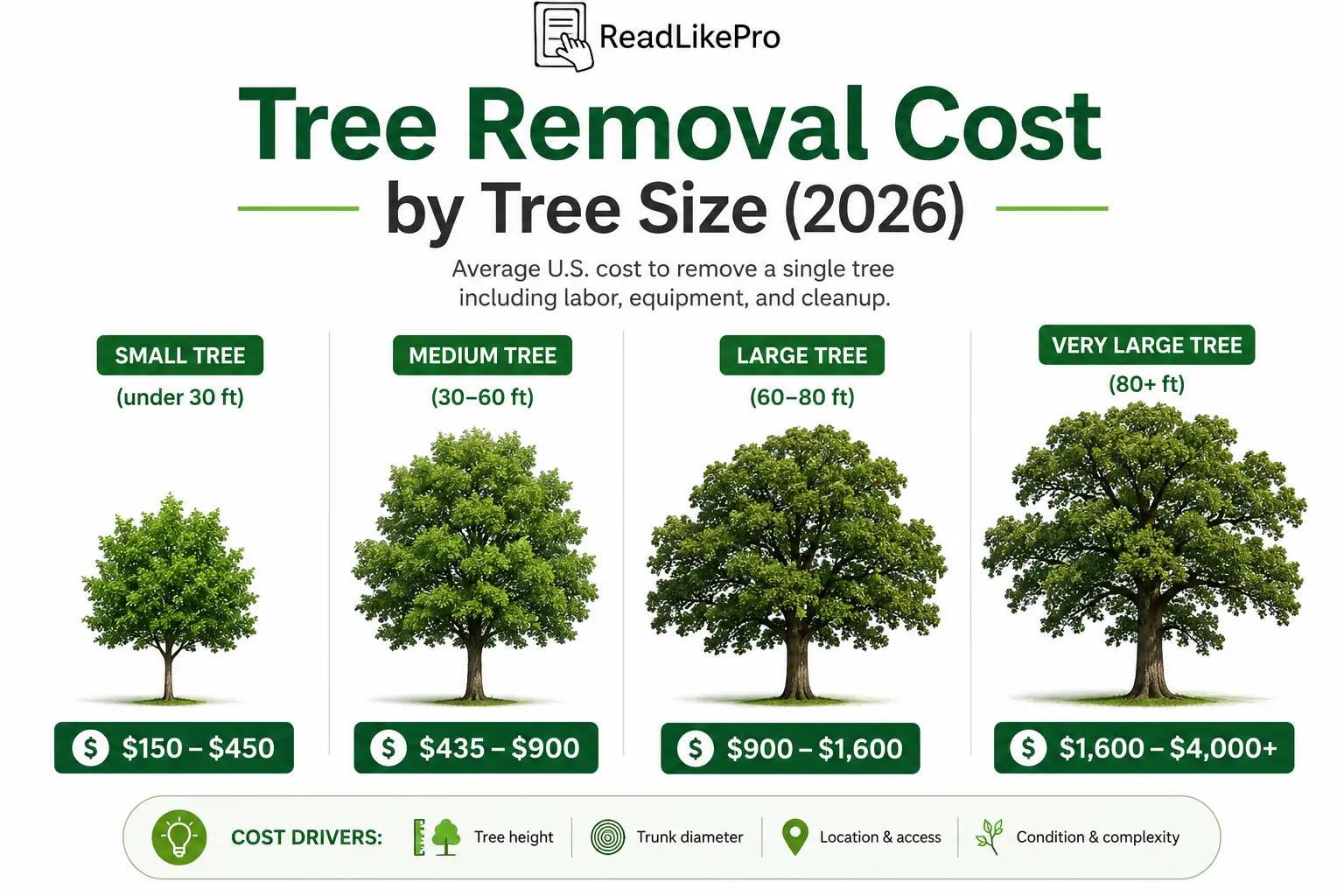
Tree removal cost estimates vary online because they come from different sources — contractor pricing data, insurance claims, and homeowner-reported quotes. Combining several gives a more accurate range than relying on just one.
| Tree Size | Typical Cost Range | What’s Included |
|---|---|---|
| Small (under 30 ft) | $150 – $450 | Felling, basic cleanup, no special equipment |
| Medium (30–60 ft) | $435 – $900 | Sectional cutting, standard debris haul-away |
| Large (60–80 ft) | $900 – $1,600 | Rigging, possible bucket truck, full cleanup |
| Very large (80+ ft) | $1,600 – $4,000+ | Crane or rigging, multi-person crew, multi-day jobs |
Some companies price by the foot instead of by size category typically $9 to $15 per foot of height, per Lawn Love. A 40-foot tree priced this way runs $360 to $600 before complications like tight access or nearby power lines get added in.
Trunk diameter matters as much as height, sometimes more, since it determines how long a crew spends cutting. Trees under 12 inches in diameter average $226 to $946. Wide-canopy trees in the 24-to-36-inch range can run past $4,000, per Xactware’s contractor pricing data.
What’s Actually in a Tree Removal Cost Quote
Most cost guides list “factors” like size and location and stop there. Here’s where the money in a typical quote actually goes:
- Labor: Crew time is usually the largest line item. It scales with how long the tree takes to safely break down — driven by height, branch structure, and how close it sits to anything that can’t be hit.
- Equipment: Bucket trucks, cranes, and chippers are expensive to mobilize. A job that needs a crane can add $300 to $1,000 or more, independent of the tree’s actual size.
- Insurance and liability: The line item most homeowners never think about — and the reason an uninsured operator can quote so much lower than a licensed company. Tree work carries one of the highest injury rates of any U.S. industry, so real liability coverage is expensive. Unlicensed crews often skip it, which keeps their price low until something goes wrong.
- Disposal and hauling: Wood and debris have to go somewhere a per-load dump fee or flat hauling rate. Letting the crew leave chips or logs on-site can lower the final bill.
- Permits: Not every removal needs one. When it does, the fee is either built into the quote or billed separately.
Tree Removal Cost by Height and Trunk Diameter
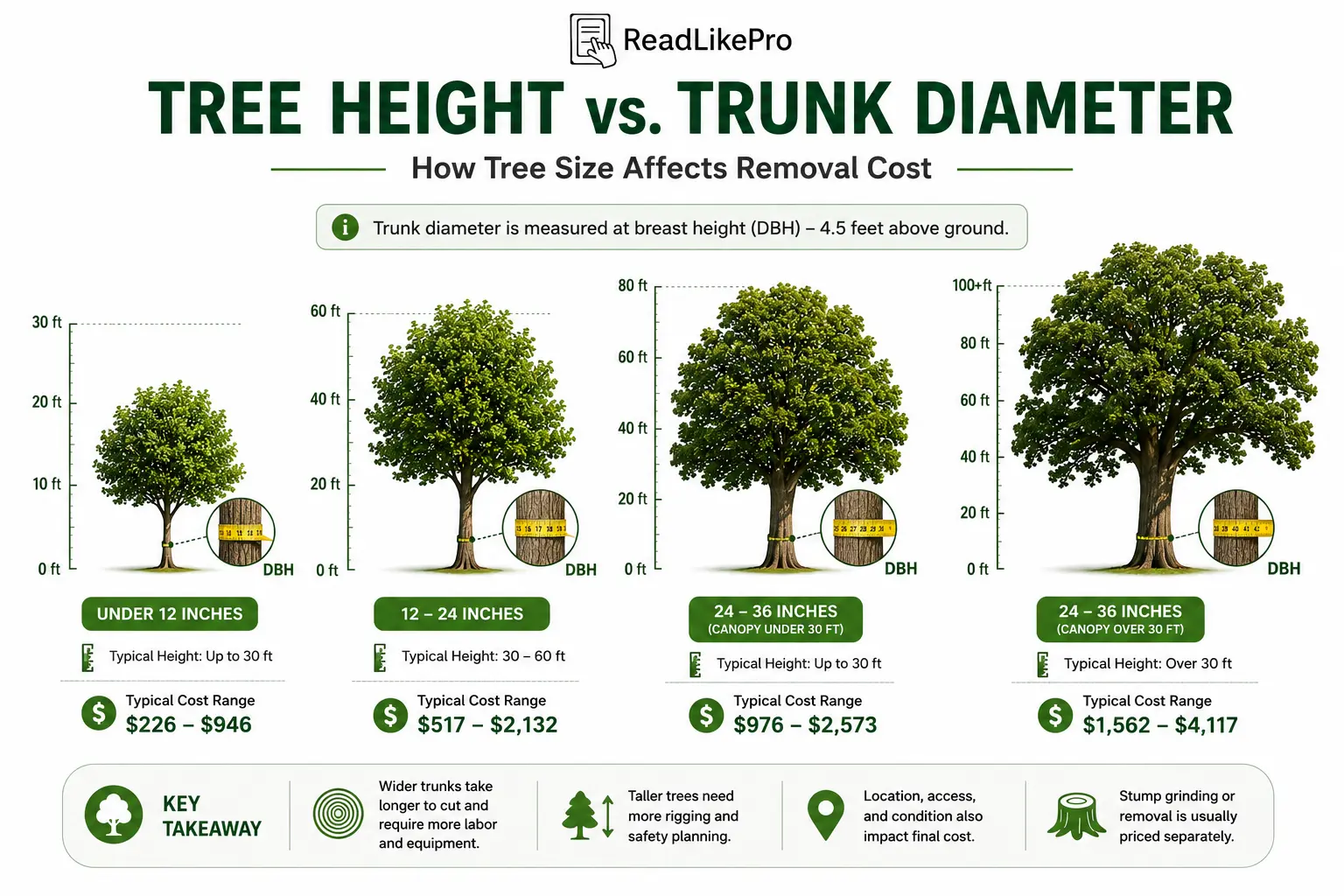
Height gets most of the attention, but trunk diameter at breast height (DBH) — measured about 4.5 feet up — is what arborists and most city ordinances actually use to classify a tree’s size.
| Trunk Diameter | Typical Cost Range |
|---|---|
| Under 12 inches | $226 – $946 |
| 12 – 24 inches | $517 – $2,132 |
| 24 – 36 inches, canopy under 30 ft | $976 – $2,573 |
| 24 – 36 inches, canopy over 30 ft | $1,562 – $4,117 |
These figures cover labor and equipment only — stump grinding is almost always priced separately. Source: Thumbtack/Xactware.
Tree Removal Cost by Species
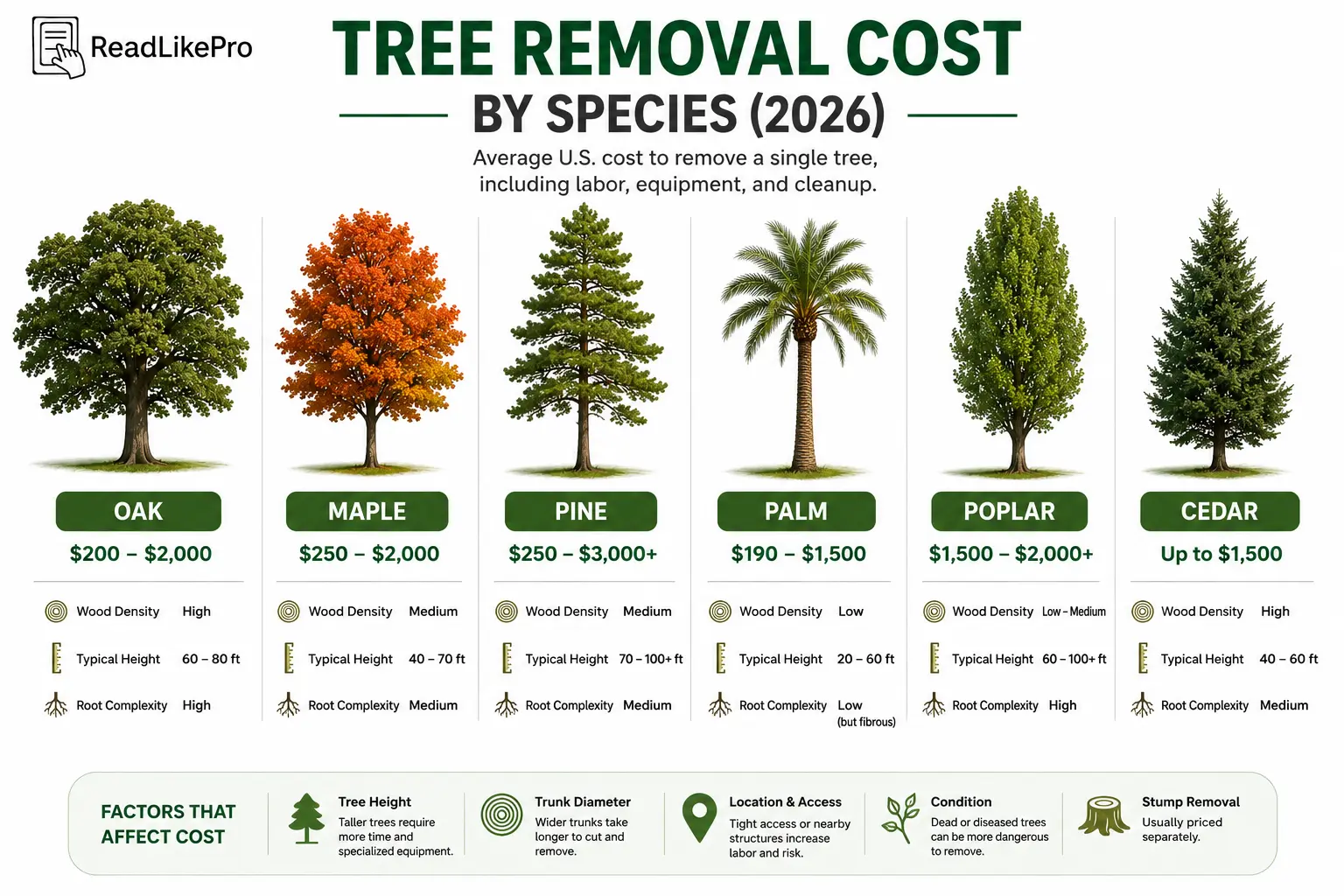
Wood density and root structure affect how long a removal takes, which is why two trees of the same height can cost very different amounts to cut down.
| Species | Typical Cost Range | Why |
|---|---|---|
| Oak | $200 – $2,000 | Dense wood, extensive root system |
| Maple | $250 – $2,000 | Wide canopy, heavy branch load |
| Pine | $250 – $3,000+ | Often very tall; price driven mostly by height |
| Palm | $190 – $1,500 | Light trunk, but fibrous stumps are slow to grind |
| Poplar | $1,500 – $2,000+ | Very tall, extensive root systems |
| Cedar | Up to $1,500 | Dense wood, often multi-trunk |
Condition matters as much as species. A diseased tree with soft wood can sometimes cost less to remove than a healthy one of the same type, since it puts up less resistance during cutting, per Angi’s cost data.
Tree Removal Cost by State
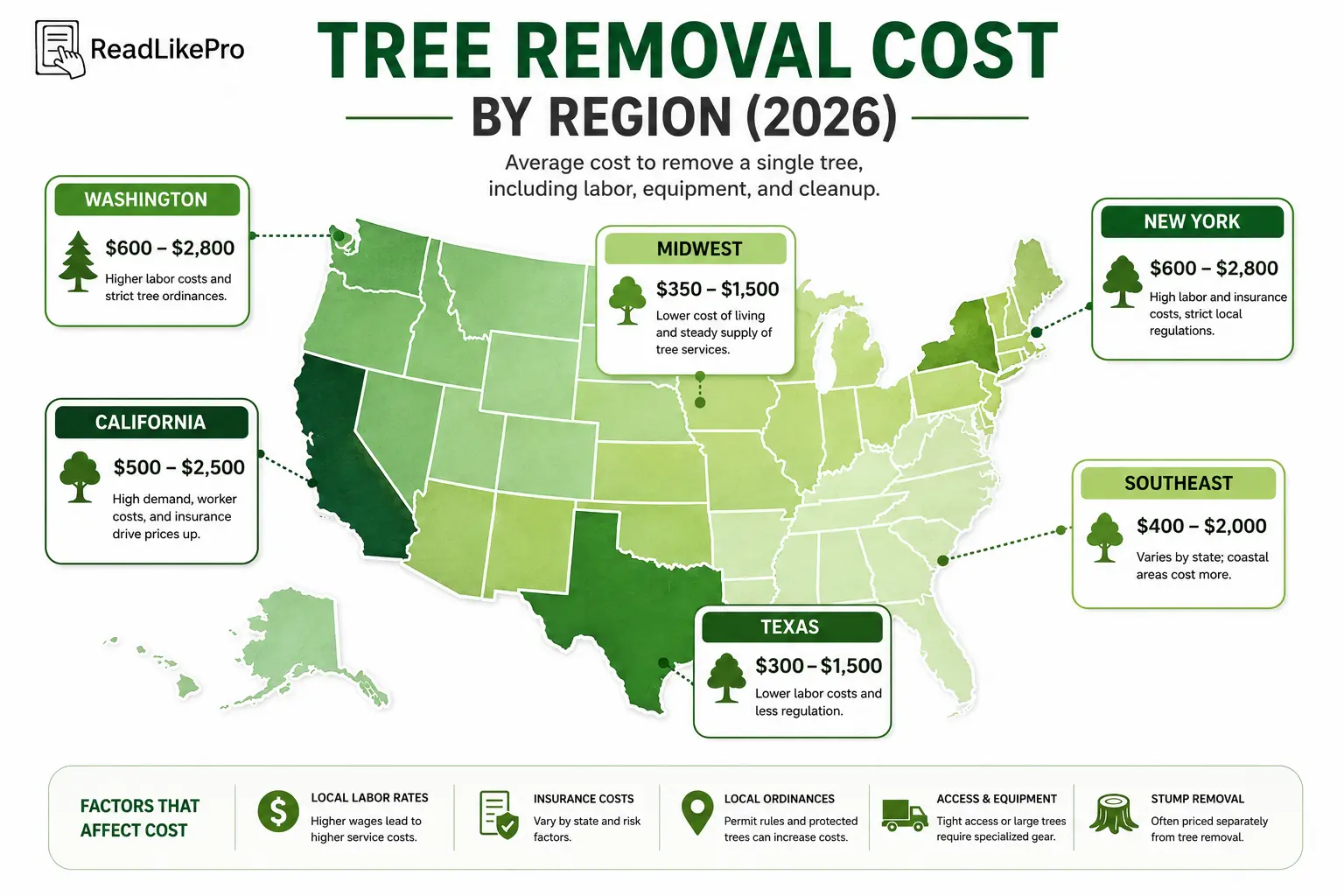
Geography affects pricing through three things: local labor rates, demand versus the number of licensed crews available, and how strict local tree ordinances are. California, New York, and Washington price above the national average; much of the Midwest and South price below it.
| Region | Typical Range for a Mid-to-Large Tree |
|---|---|
| California | $500 – $2,500 (up to $3,500 in dense urban metros) |
| New York / Washington | $600 – $2,800 |
| Texas | $300 – $1,500 |
| Midwest (Illinois, Ohio, etc.) | $350 – $1,500 |
| Southeast (Georgia, Florida, etc.) | $400 – $2,000 |
In practice: a mid-sized oak removal running $700 to $900 in rural Ohio could cost $1,500 to $2,000 for the same job near Sacramento or Seattle — same tree, higher local labor and insurance costs. Sources: California tree removal pricing and regional pricing data.
Stump Removal Cost After Tree Removal
Most tree removal quotes don’t include the stump. A quote that looks unusually low compared to others may simply be leaving it out.
| Method | Typical Cost | Notes |
|---|---|---|
| Stump grinding | $150 – $500 | Grinds 6–12″ below grade; roots decompose naturally |
| Full stump and root removal | $300 – $500+ | Needed if building or replanting in that exact spot |
| Chemical removal | $50 – $100 in materials | Takes 4–6 weeks; cheapest DIY option |
Per-inch pricing is also common, running $3 to $7 per inch of stump diameter, per HomeCostLab. Grinding is the most popular option since it’s the fastest, cheapest way to make the area usable again.
The bare patch left behind still needs reseeding and a few follow-up mows before it blends back into the rest of the yard — costs that fall under regular lawn care cost rather than tree removal.
Emergency Tree Removal Cost After a Storm
Storm-related removals change the math. Emergency crews typically charge 50% to 100% more than standard rates, with totals landing between $1,500 and $5,000, according to This Old House. That premium covers after-hours labor and the demand surge that hits every storm season.
If a tree falls on your home, call your insurance company before signing with a contractor.
Does Homeowners Insurance Cover Tree Removal Cost?
Sometimes. Coverage comes down to two questions: what caused the tree to fall, and whether it damaged an insured structure.
| Scenario | Typically Covered? |
|---|---|
| Tree falls on your house/garage due to wind, hail, lightning, or snow load | Yes, usually |
| Tree falls in your yard, no structural damage | No |
| Tree blocks your driveway or a wheelchair ramp | Often, even without structural damage |
| Preventive removal of a healthy or declining tree | No |
| Neighbor’s tree falls on your property due to a covered peril | Usually covered by your own policy |
Even covered claims are usually capped at $500 to $1,000 for debris removal, per GEICO and Progressive. On a $2,000 emergency removal, that cap can leave you covering more than half out of pocket.
Ownership of the tree generally doesn’t decide coverage. If a neighbor’s tree falls on your property due to wind or another covered peril, your own policy usually responds first, per Farmers Insurance. Proving negligence to pursue their insurer instead is possible but difficult, according to Policygenius.
Tree Removal Permit Cost and Requirements
Permit rules depend on your zip code, not your tree. Many cities have no requirement below a certain trunk diameter. Others require permits for any removal and fine homeowners who skip the process.
| City | Permit Threshold / Cost | Penalty for Skipping It |
|---|---|---|
| Atlanta, GA | Required at 6″ trunk diameter | Varies by case |
| Portland, OR | Required at 12″; fee waived since July 2025 | Up to $1,000/tree/day |
| Austin, TX | Required at 19″ | Varies by case |
| San Antonio, TX | Required at 24″ | Varies by case |
| Charlotte, NC (heritage trees) | ~$765 total (application + removal fee) | Fines plus mandatory replacement planting |
| Seattle, WA (24″+ trees) | “Fee in lieu” starting at $3,325 | Significant fines for unpermitted removal |
| San Jose, CA (heritage trees) | Permit + arborist report required | Up to $30,000 per tree |
Smaller residential trees usually need no permit. Anything labeled heritage, specimen, or protected can trigger an arborist evaluation and a real fee — sometimes a steep one — even for a healthy tree. A five-minute call to the local planning department is the only reliable way to know before booking anyone. Sources: PermitDeck, Charlotte’s tree ordinance, Seattle tree permits, and San José’s heritage tree program.
Is Tree Removal Tax Deductible?
Generally, no. Routine removal on a primary residence is a personal expense in the IRS’s eyes — the same category as mowing the lawn, per LegalClarity’s tax guidance. Three exceptions apply:
- Federally declared disasters: A tree that falls during a storm in a federally declared disaster area may qualify as a casualty loss on IRS Form 4684, subject to AGI-based limits.
- Rental or business property: Removal on a rental or other business-use property is typically a deductible business expense.
- Capital improvements: Removal tied to a documented home improvement can sometimes be added to the home’s cost basis, lowering capital gains tax when the home sells.
Wanting a tree gone for looks, or because it’s near power lines, doesn’t qualify, even if it feels urgent. Keep the invoice regardless — it supports either claim if your situation changes.
DIY Tree Removal: Is It Worth the Risk?
Doing it yourself is tempting for a tree that looks simple from the ground. The safety data says the risk isn’t intuitive.
Tree care has one of the highest injury rates of any U.S. occupation. Landscape and tree workers make up less than 1% of the workforce but account for roughly 3.5% of all workplace fatalities — about 80 worker deaths and 23,000+ chainsaw injuries treated in U.S. emergency rooms every year, per the Texas Department of Insurance. Peer-reviewed injury research covering 2018–2022 puts the broader chainsaw injury count at a similar scale, with most cases involving homeowners rather than trained crews, per published research.
- Reasonable DIY: a small, dead tree in an open yard, with proper protective gear and basic chainsaw experience.
- Call a professional: anything over roughly 12 inches in trunk diameter, leaning toward a structure, or near power lines. The savings rarely outweigh the risk, and any damage caused during a DIY removal is yours to repair.
How to Lower Your Tree Removal Cost
A few legitimate ways to bring the price down without hiring an uninsured crew or skipping a required permit:
- Get at least three quotes. Tree work pricing varies more than most home services since it’s almost entirely labor and risk assessment, not materials.
- Avoid storm season when the job isn’t urgent. Scheduling outside peak hurricane or winter-storm windows avoids the 50–100% emergency premium.
- Bundle multiple trees or services. Pruning, stump grinding, and removal booked together typically cost less than separate visits.
- Ask about keeping wood or chips on-site. Hauling is a real cost; skipping it can lower the bill.
- Check with your insurer first. If a storm-damaged tree hit a structure, a quick call before booking a contractor can clarify what’s reimbursable.
Questions to Ask Before You Hire a Tree Removal Company
Verifying these takes a few minutes and avoids the single biggest risk in this guide: an uninsured crew.
- Are you licensed, with current general liability and workers’ compensation insurance? Ask to see the certificate, not just a verbal yes.
- Is anyone on the crew an ISA Certified Arborist, especially for large or complex removals?
- Does the quote include stump grinding, debris hauling, and permit fees, or are those separate?
- Who’s responsible for damage to the lawn, driveway, or nearby structures during the job?
- Is the price fixed, or is there a change-order process if the tree turns out more complex than expected?
FAQ: Tree Removal Cost
How much does tree removal cost per foot?
Roughly $9 to $15 per foot of height before adjustments for diameter, species, and access. A 40-foot tree runs about $360 to $600 on that basis alone.
Does homeowners insurance cover tree removal?
Only when a covered peril — wind, hail, lightning, snow — causes a tree to fall on an insured structure. Preventive removal isn’t covered, and even covered claims are usually capped at $500–$1,000.
Do I need a permit to remove a tree on my property?
Depends on the city. Many places require none for small residential trees; others require one starting at 6 inches in trunk diameter, or for any protected tree. Check with your local planning department first.
Is tree removal tax deductible?
Not for routine removal on a primary residence. It can qualify as a casualty loss after a federally declared disaster, or as a business expense on rental property.
How long does tree removal take?
A few hours for a small to medium tree in an open area. Large trees needing rigging or a crane near a structure can take a full day or two.
Can I remove a tree myself to save money?
For a small, dead tree in an open yard with proper gear, yes. Past about 12 inches in trunk diameter, or near a structure or power line, hire a professional — tree care has one of the highest injury rates of any occupation.
Quick Recap: What Actually Drives Tree Removal Cost
Most single-tree removals fall between $400 and $1,200, driven more by trunk diameter and local labor costs than height alone. Before booking anyone, check three things that don’t show up in a quick search: whether insurance covers part of a storm-related removal, whether your city requires a permit, and whether the contractor’s price reflects real liability coverage. None of that changes what the tree costs to cut down. It changes who pays when something goes wrong.
Sources
- Thumbtack / Xactware — 2026 Tree Removal Cost Data
- Angi — Tree Removal Cost Guide
- HomeGuide — Tree Removal Cost by Size and Species
- This Old House — Tree Removal Pricing
- Lawn Love — Tree Removal Cost
- Bob Vila — Tree Removal Cost by Species
- GEICO — Homeowners Insurance and Tree Removal
- Farmers Insurance — Tree Removal Coverage
- Policygenius — Does Insurance Cover Tree Removal
- PermitDeck — Tree Removal Permits by City
- Heartwood Tree Care — Charlotte Tree Ordinance
- Seattle Tree Care — Permit Requirements
- City of San José — Heritage Tree Permits
- LegalClarity — Tree Removal and Tax Deductions
- Texas Department of Insurance — Tree Trimming & Removal Safety Fact Sheet
- Chainsaw-Related Injury Research, 2018–2022
- HomeCostLab — Stump Removal and Emergency Pricing

Baldeep builds and researches content sites full time. For ReadLikePro he
compiles home service pricing from contractor quotes, industry cost surveys,
and public data, then checks the numbers against more than one source before
publishing. He isn’t a licensed contractor, so every estimate here is a
research-backed range, not a quote for your specific job.