


Most people don’t have a cleaning problem. They have a sequencing problem.
They clean the wrong things first, skip the rooms that matter most, and run out of energy before the house actually looks better. Then they try again next weekend. Same result.
A daily house cleaning routine isn’t about scrubbing everything every day. It’s about knowing exactly which tasks, done in the right order, prevent buildup from turning into a real project. Once you have that locked in, cleaning stops feeling like a chore you’re always behind on.
This guide covers the full room-by-room system — what to do, when to do it, and how to structure it so it holds up on regular days, not just motivated ones. If you’re newer to building a cleaning habit altogether, start with the home cleaning tips guide first it covers why most routines fail structurally, which makes everything here land better.
Why Most Daily Cleaning Routines Fall Apart
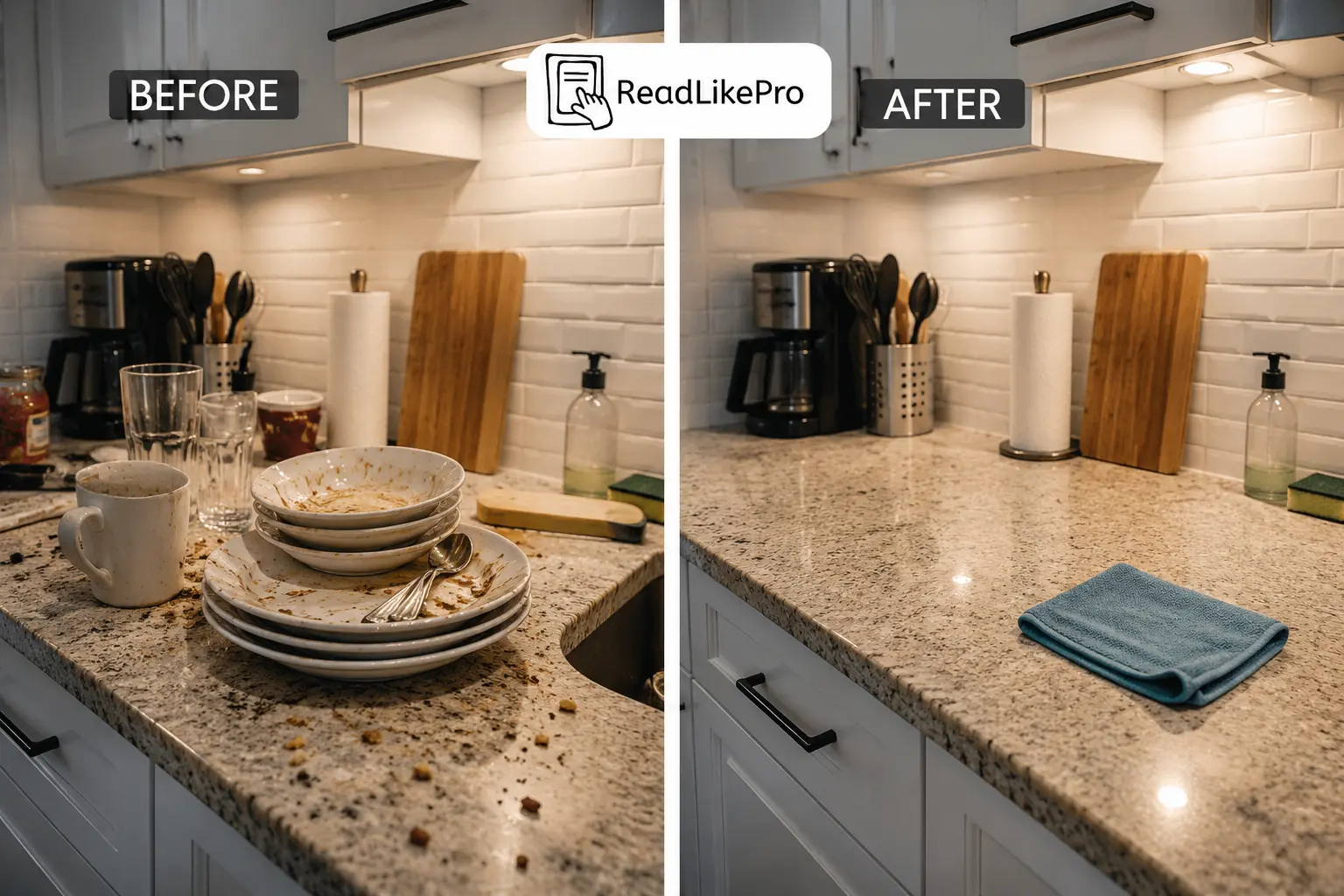
The most common version of a cleaning routine is a long checklist that looks reasonable on paper. It lasts about five days.
What breaks it isn’t laziness — it’s design. When a routine has no defined time limit, no clear stopping point, and tasks that are vague (“clean the bathroom”), it expands. You start skipping steps to finish faster. Then you start skipping days. Eventually the whole thing gets shelved until the house gets bad enough to force a real cleaning session.
There’s also the order problem. Most guides list tasks by room without explaining which ones compound fastest. A sink left unwiped for three days becomes a ten-minute job. The same sink cleaned daily takes forty-five seconds. That’s not a small difference — over a week, it’s the difference between a home that maintains itself and one that ambushes you every Sunday.
The American Cleaning Institute specifically recommends short daily sessions over longer infrequent ones — not because frequent cleaning is more thorough, but because it eliminates the buildup phase entirely. That’s the whole principle behind what follows.
That gap between intention and habit is real. A 2026 survey by the American Cleaning Institute found that 80% of Americans plan to spring clean every year — yet many admit they struggle to keep up with basic maintenance in between. Weekly cleaning recovers. Daily cleaning prevents. The difference in total time spent over a month is significant.
The Right Mindset Before You Start
Daily cleaning is maintenance, not deep cleaning. Those are two completely different activities.
Deep cleaning is quarterly. It involves the inside of your oven, behind appliances, baseboards, grout lines. It takes time and it should. That is not what you’re doing daily.
Daily cleaning is visual control. You’re managing surfaces, dishes, floors, and clutter — the things that determine whether a home feels lived-in or chaotic. They’re also the things that spiral fastest when neglected.
If you go in expecting to deep clean daily, you’ll burn out and quit. If you go in to maintain, 15 to 20 minutes covers a full house.
Why This Routine Works
The principle behind any effective daily cleaning system is maintenance over recovery.
Recovery cleaning what most people do on weekends — is reactive. You’re dealing with three or four days of accumulated mess in one session. It takes longer, feels heavier, and leaves you less likely to do it again next week.
Maintenance cleaning flips that. Small consistent effort prevents the buildup phase from starting. The American Cleaning Institute notes that homes maintained with short daily sessions require significantly less time overall compared to homes cleaned in longer infrequent sessions — because buildup multiplies the effort required, not just the time.
The other factor is psychological. A home that’s never visibly out of control is easier to maintain than one that periodically needs a reset. This isn’t just common sense — a 2024 ACI survey found that 87% of Americans report a direct boost to their mental well-being when their living spaces are clean and tidy. Once you’re at baseline, 15 minutes a day holds it there. Getting to baseline from a backlog is the only hard part — and it only happens once.
The Cleaning Pyramid
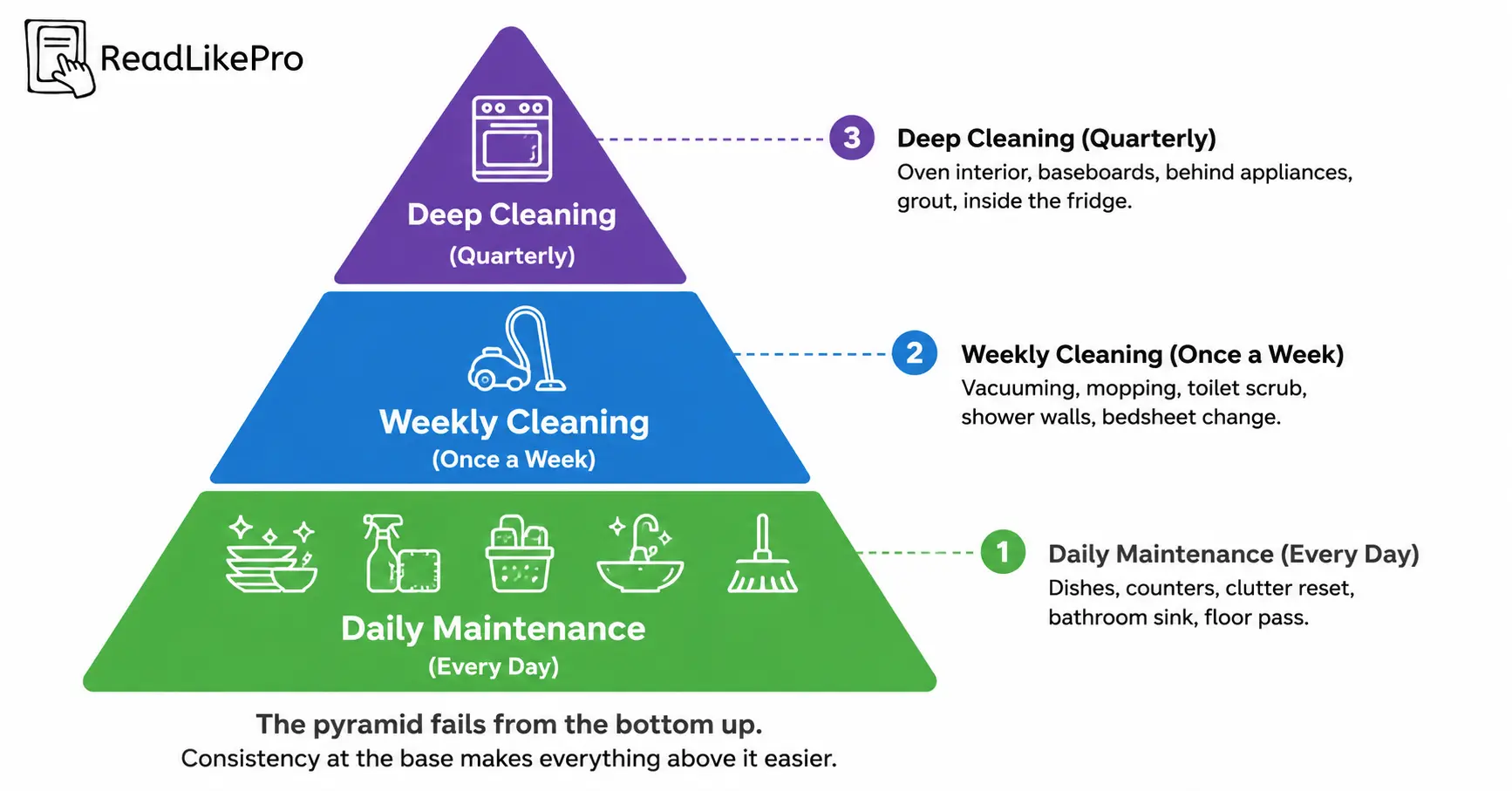
Most homes don’t fail at deep cleaning. They fail at the base.
Level 1 — Daily Maintenance (15 to 20 minutes) Dishes, counters, clutter reset, bathroom sink, floor pass. This is the foundation. Skip this consistently and every level above it costs twice as much effort.
Level 2 — Weekly Cleaning (45 to 60 minutes total across the week) Vacuuming, mopping, toilet scrub, shower walls, bedsheet change. This only stays manageable if Level 1 is running. Without daily maintenance, weekly tasks absorb the backlog from Level 1 and expand.
Level 3 — Deep Cleaning (quarterly) Oven interior, baseboards, behind appliances, grout, inside the fridge. When Levels 1 and 2 are consistent, Level 3 is genuinely short — two hours or less for a full house. When they’re not, deep cleaning becomes an all-day project most people keep deferring.
The pyramid fails from the bottom up, not the top down. This is why a daily routine — not a monthly deep clean — is the actual foundation of a clean home.
Room-by-Room Daily Cleaning Routine
Kitchen: 6 to 8 Minutes
The kitchen earns the most time in any daily routine. It’s where grease, crumbs, and food residue accumulate every single day. Skip it two days in a row and it starts affecting how the whole house smells and feels.
Dishes first. Load the dishwasher or hand-wash what you used. Don’t let dishes sit overnight if you can avoid it. An empty sink changes the energy of the whole kitchen — this sounds minor until you experience the difference consistently.
Wipe the stovetop while it’s still warm. This is the biggest time-saver in kitchen maintenance. Fresh grease takes thirty seconds to wipe. Dried, day-old grease takes five minutes and a scraper. If you cook dinner and let the stove cool without wiping it, you’ve already made tomorrow’s kitchen harder.
Counters and high-touch surfaces. Spray down the counters, the faucet handle, and anything near where you prep food. This takes two minutes. A microfiber cloth under the sink makes it frictionless — no hunting for supplies.
Trash check. If the kitchen bin is full or has food waste sitting in it, empty it now. Smells develop overnight. This isn’t optional.
Bathroom: 4 to 5 Minutes
The bathroom accumulates fast and visibly. Toothpaste on the sink, water on the mirror, hair on the floor — each of these takes thirty seconds to fix when fresh and three minutes when dried and layered.
Sink and faucet wipe. Spray the basin and faucet, wipe it down, hit the mirror if it has visible spots. Keep supplies under the sink, not in a closet down the hall. Friction kills habits.
Toilet exterior. A quick wipe around the lid, seat, and base every day takes ninety seconds. This is the task people defer the longest and then have to deal with once it’s past easy.
Floor check. Hair on bathroom floors is a daily accumulator. A quick dry sweep or paper towel pass keeps it from matting into the grout. Takes one minute.
You are not scrubbing the toilet bowl every day. That’s a weekly task. Daily bathroom upkeep is surface-level and fast.
Living Room: 3 to 4 Minutes
This room doesn’t get dirty the way kitchens and bathrooms do. It gets cluttered.
Clutter reset. Return everything to where it belongs. Remote, shoes, jackets, mail, cups from earlier — walk through once and put things back. This is not organizing. Organizing involves decisions. Resetting just means returning things to known spots.
Cushion and surface pass. Straighten throw pillows, stack any books or magazines, wipe the coffee table if there are rings or crumbs. This takes two minutes.
Visible floor pass. If there are visible items on the floor — pet toys, kids’ stuff, dropped things — pick them up now. You’re not vacuuming daily unless you have pets with significant shedding.
Bedroom: 2 to 3 Minutes
Make the bed. This is the single most impactful daily task per minute spent. A made bed makes the whole bedroom feel ordered even when nothing else is done. It takes ninety seconds.
Clothes off the floor or chair. The bedroom chair that collects clothes is universal. Either hang what’s clean, put what’s dirty in the hamper, or fold and put things away. Don’t let it build for more than one day.
Surface wipe only if needed. Nightstand, dresser top — do a thirty-second dust wipe every two or three days, not necessarily daily.
Entryway and High-Traffic Floors: 2 Minutes
Shoe and bag reset. Shoes by the door pile up fast in families. One pass to put them where they belong prevents the entryway from becoming a permanent obstacle course.
Quick sweep. The entryway and kitchen floor are the two highest-debris areas daily. A cordless vacuum or broom pass across these two spots takes two minutes and makes the home feel clean at the points people actually walk through.
Daily Cleaning Checklist for every area
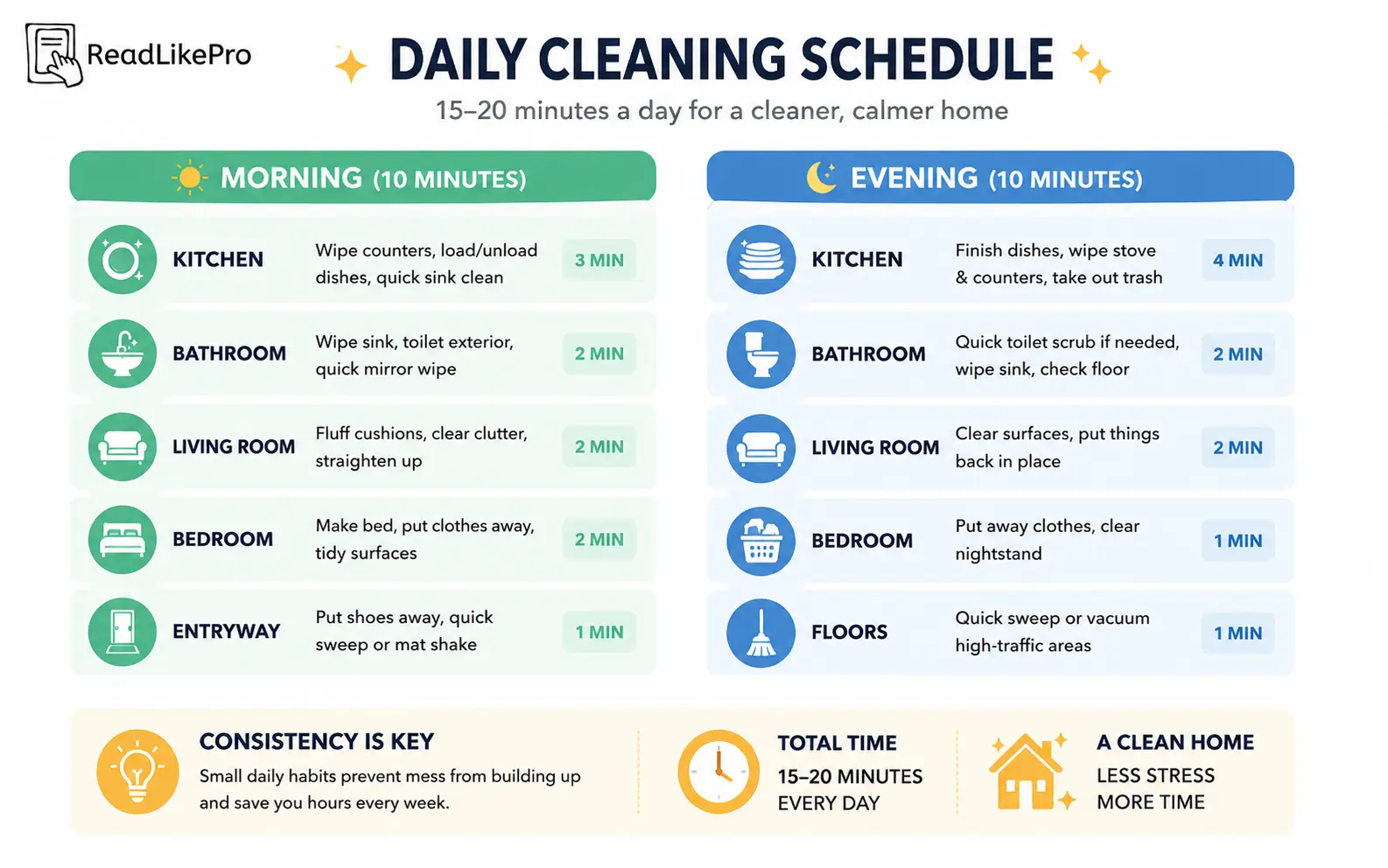
| Room | Daily Tasks | Time |
|---|---|---|
| Kitchen | Dishes/dishwasher, wipe counters, wipe stovetop, trash check | 6 to 8 min |
| Bathroom | Wipe sink and faucet, toilet exterior, floor hair check | 4 to 5 min |
| Living Room | Clutter reset, cushion straighten, surface wipe if needed | 3 to 4 min |
| Bedroom | Make bed, clothes off floor or chair | 2 to 3 min |
| Entryway + Floors | Shoe reset, sweep kitchen and entryway floor | 2 min |
Total: 17 to 22 minutes for most homes.
Save this or screenshot it for the first two weeks. After that, the sequence runs automatically.
Daily Cleaning Schedule by Time of Day
The most effective approach is splitting tasks by when they naturally occur — not doing everything in one block at night when you’re tired.
Morning (5 to 7 minutes)
- Make the bed
- Quick bathroom wipe (sink, mirror)
- Rinse any breakfast dishes or load them
- Entryway sweep if you’re heading out
During the Day or After Cooking (3 to 4 minutes)
- Wipe stovetop while still warm
- Clear and wipe kitchen counters
- Load or hand-wash lunch dishes
Evening (8 to 10 minutes)
- Clutter reset in living room and kitchen
- Finish dishes from dinner
- Bathroom quick pass
- Empty kitchen trash if needed
- Floor check — entryway and kitchen
This split approach means you’re never doing more than ten minutes in one sitting. It also prevents the evening pile-up where everything feels like too much because it’s all waiting at once.
How Long Should This Actually Take?
For a standard 2-bedroom or 3-bedroom home:
| Home Type | Daily Routine Time |
|---|---|
| Studio or 1-bedroom | 10 to 12 minutes |
| 2-bedroom apartment | 13 to 16 minutes |
| 3-bedroom house | 16 to 20 minutes |
| 3+ bedrooms with kids or pets | 20 to 25 minutes |
These are maintenance estimates, not deep clean times. If you’re starting from a backlog, add ten to fifteen minutes for the first few sessions until the house reaches baseline.
What to Add Weekly on Top of the Daily Routine
Your daily routine covers surfaces, clutter, and high-frequency areas. Weekly tasks go one level deeper without turning into a full cleaning day.
Monday — Vacuum all carpeted rooms and rugs (prevents dirt from embedding in fibers over the week)
Wednesday — Mop the kitchen and bathroom floors (hard floors need more than a daily sweep to stay clean)
Friday — Full toilet scrub inside the bowl, wipe shower walls and door (Friday means you head into the weekend with a clean bathroom)
Sunday — Change bedsheets, dust ceiling fans and blinds, wipe mirrors in all rooms
None of these take more than fifteen minutes individually. Together they make up for what the daily routine doesn’t cover.
Supplies That Actually Get Used
The most common supply mistake is owning too many products. Under-sink cabinets packed with seven different cleaners don’t make cleaning more thorough — they add decision friction before you even start. You open the cabinet, see the options, can’t decide, and walk away. That’s not laziness either. That’s poor supply design.
For a daily routine, you need:
- One multi-surface spray — a pH-neutral formula covers counters, sinks, stovetop, and mirrors without damaging most surfaces
- Microfiber cloths — more effective than paper towels on most surfaces, washable, and about $1 each in bulk
- A cordless stick vacuum or small broom — for daily floor passes without dragging out a full vacuum
- Dish soap — for hand-washing, obviously
- Toilet brush and a mild bowl cleaner — for the weekly bowl scrub, not daily
That’s genuinely it. Specialty cleaners for granite or stainless steel can be added if you have those surfaces, but for the daily routine, one good multi-surface product handles everything.
Cleaning Routine Adjustments for Different Households
If you have kids at home: Add a toy reset to the living room clutter pass. Keep a small bin in the main living area where things get dropped at the end of the day. Floor clutter with kids is daily and fast-moving — the bin approach beats individual returns.
If you have pets: Daily lint roll or handheld vacuum on your main seating is non-negotiable. Pet hair embeds in fabric within 24 hours and becomes a weekly problem if not caught daily. For dogs especially, add a paw wipe by the door.
If you live alone: The daily routine is faster, but you’re also the only one doing it. Batch the bathroom and bedroom into a single pass on one end of the day — combined it’s under six minutes.
If you rent and have limited storage: Supply placement matters even more. A small caddy that lives under each bathroom or kitchen sink means supplies are always at the point of use. Don’t rely on one central cleaning closet.
The Surfaces That Matter Most
Not all surfaces need daily attention. According to the EPA’s guidance on indoor air quality, kitchens and bathrooms are among the most hygiene-sensitive areas in any home which is exactly why this routine prioritizes them above everything else.
The surfaces worth hitting daily:
- Kitchen counters and stovetop
- Bathroom sink and faucet (hand-contact point)
- Toilet exterior (seat and handle)
- Kitchen trash area
Everything else — walls, baseboards, interior cabinets, appliance exteriors — belongs on a weekly or monthly schedule.
How to Build the Habit When Motivation is Low
Motivation is unreliable. The days you feel like cleaning, you’d clean anyway. The routine needs to work on the days you don’t.
Attach it to something that already happens. Right after dinner is cleaned up. Right after your morning coffee. Right before you sit down for the night. Linking the cleaning window to an existing action means you stop relying on remembering to start.
Set a hard stop. Fifteen minutes on a timer. When it goes off, you’re done — even if the list isn’t complete. This removes the open-ended nature of cleaning that makes people avoid starting.
Do the kitchen last in your evening session, not first. This sounds counterintuitive given how much time the kitchen needs — but saving it for last means it always gets done even when you cut the session short. The bedroom and living room can slide on hard days. The kitchen cannot.
If you’re still building the baseline or the mess has gotten ahead of you, it may be worth knowing what professional cleaning actually costs before writing it off. The Cleaning Cost Calculator gives you real 2026 US pricing by home size and service type — useful context even if you never plan to hire anyone.
What Professionals Know That Most Guides Skip
Professional house cleaners work top to bottom and dry to wet. It sounds obvious but most home cleaning guides don’t mention it.
Top to bottom means dusting high surfaces before sweeping floors — so the dust and debris fall down and get swept up in the final pass, rather than landing on a floor you already cleaned.
Dry to wet means dry dusting or sweeping before any spray-and-wipe work. Wet surfaces collect dust. If you spray the counter and then wipe nearby shelves, you’re dragging dry particles into the wet surface.
These aren’t complicated principles — they’re just sequencing rules that commercial cleaners follow automatically. Interestingly, the same logic applies at scale in workplace settings. If you manage a home office or run a small business, the professional office cleaning tips guide breaks down how these systems work for shared spaces — including color-coded tools and high-touch surface protocols that home cleaners can borrow directly.
For a daily home routine, it all translates simply: do the clutter reset and dry surface pass before any spraying. Do the floors last.
Common Mistakes That Extend Cleaning Time
Cleaning the same surface twice. This happens when the routine has no fixed order. You wipe the stovetop, cook something an hour later, and forget you already cleaned it. Sequence solves this — same order, every time.
Starting in the wrong room. The bedroom feels calming to start with. It’s quiet, contained, and satisfying to make. But it has the least visual impact. Start where visitors and family members see first — entry, living room, kitchen. That’s where perceived cleanliness is built or lost.
Using the wrong tools for daily tasks. A full-size vacuum is too much friction for a daily floor pass. Nobody drags it out every evening. A broom or cordless handheld gets used because it takes thirty seconds to grab and put away. Tool choice determines whether the habit survives.
Treating all rooms equally. Guest bedrooms, home offices, rarely-used dining rooms — these don’t need daily attention. A twice-weekly pass is enough. Spreading daily effort across low-use rooms means high-use rooms get less time than they need.
Frequently Asked Questions
What is a realistic daily cleaning routine for a house? A daily routine for most homes runs 15 to 20 minutes and covers the kitchen (dishes, counters, stovetop), bathroom sink and surfaces, living room clutter reset, bedroom bed-making, and a floor pass in high-traffic areas. Deep cleaning tasks like toilets, vacuuming, and mopping shift to a weekly schedule on top of this.
What order should I clean the house daily? Top to bottom, high-traffic areas first. Start with the living room clutter reset, move through the kitchen, then hit the bathroom. Leave floors for last so any debris from earlier tasks gets caught in the final sweep. This is the same sequencing logic professional cleaners use — the professional office cleaning guide covers how commercial crews apply it in shared spaces if you’re curious how it scales.
How do I keep my house clean without spending all my time on it? Maintenance is the key concept — preventing buildup rather than recovering from it. Daily 15-minute sessions hold a home at a consistent baseline. Once you’re at baseline, it never gets bad enough to require a real cleaning session. That’s where the time savings compound. The home cleaning tips guide goes deeper on why routines structurally fail and how to fix them for good.
What should be cleaned every day without exception? Kitchen dishes and counters, bathroom sink, and a living space clutter reset. These three areas accumulate daily regardless of how carefully you live. Everything else has more flexibility.
Why do I clean but the house still looks dirty? Usually a sequencing issue or the wrong tasks. If you’re vacuuming but not wiping surfaces, the surfaces dominate what you see. If you’re wiping but not dealing with clutter, the visual disorder overrides the cleanliness. The clutter reset and kitchen are the highest-impact tasks for perceived cleanliness.
How often should I deep clean each room? Kitchen and bathrooms benefit from a deeper clean monthly — oven interior, toilet scrub, shower grout, inside the fridge. Bedrooms and living areas quarterly. If you maintain the daily and weekly routine consistently, deep cleans are short because there’s no real buildup to address.
The Bottom Line
A daily house cleaning routine works when the tasks are specific, the time is bounded, and the order makes sense. Not because you’re cleaning everything every day — because you’re hitting the right surfaces, in the right sequence, before buildup starts.
The kitchen gets six to eight minutes. The bathroom gets four to five. The rest of the house takes under ten combined. Around twenty minutes total. That’s less time than most people spend deciding what to watch.
Do it at the same time each day. Stop when the time’s up. Within two weeks it becomes automatic — not because you’re more motivated, but because the structure is tight enough that motivation stops being the deciding factor.
Start tonight. Pick one room then do the next.