

If you’ve been pricing out a new kitchen, you already know the frustration. Every website throws a different number at you, and none of them seem to agree. The honest answer about a kitchen remodel and cost is that there isn’t one price. There’s a range, and where you land inside it comes down to a handful of choices you actually control.
In 2026, most homeowners spend somewhere between $15,000 and $75,000, with the national average landing around $27,000, according to project cost data from Angi and HomeAdvisor’s remodel research. That’s a wide spread for a reason. A weekend-style refresh and a full gut-and-rebuild are both technically “kitchen remodels,” and they’re priced worlds apart.
This guide breaks down what you’ll really pay, by size, by scope, by state, and by where the money actually goes, plus a budget framework you can copy.
Quick answer: A typical 2026 kitchen remodel runs $27,000–$35,000. Minor refreshes start near $15,000, mid-range projects land at $30,000–$50,000, and high-end renovations climb past $60,000–$100,000+. Expect roughly $75–$250 per square foot.
Kitchen Remodel Cost Calculator (2026)
Plug in your kitchen size, finish level, and state to get an itemized estimate in seconds — cabinets, counters, labor, the works, plus a built-in contingency line. Use it as a starting point, then get local quotes to lock in real numbers.
Kitchen Remodel Cost Calculator
Set your kitchen size, finish level, and state for an itemized estimate — including a contingency buffer most calculators skip.
Planning estimate based on 2026 national and state cost data. Your actual price depends on materials, layout changes, and local labor — get 2–3 itemized quotes before you budget.
Kitchen Remodel Cost by Size
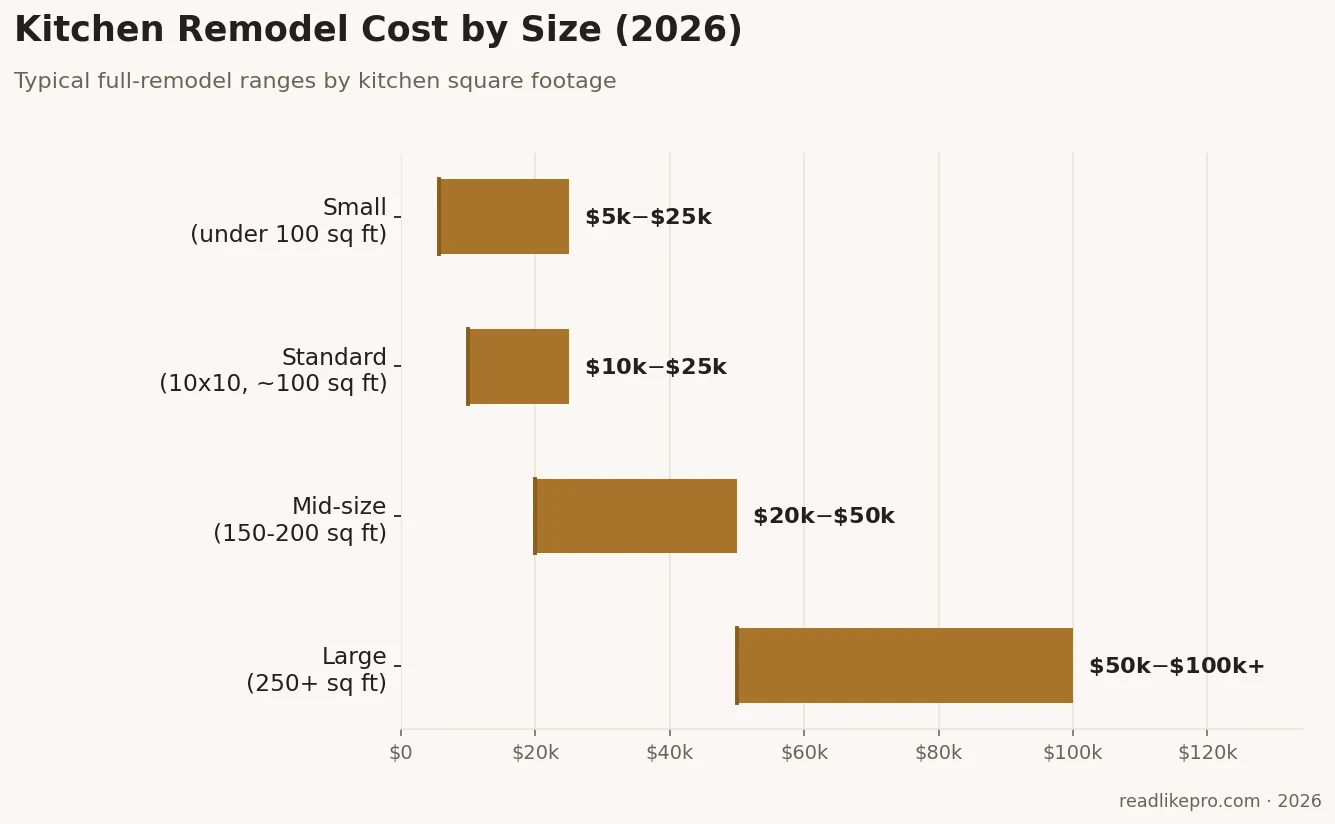
Square footage is one of the biggest levers on your final bill. A bigger kitchen doesn’t just need more cabinets it needs more flooring, more countertop, more lighting, and more labor hours to tie it all together. Here’s how the cost scales as the room grows.
| Kitchen size | Square footage | Typical 2026 cost range |
|---|---|---|
| Small | Under 100 sq ft | $5,600 – $25,000 |
| Standard (10×10) | ~100 sq ft | $10,000 – $25,000 |
| Mid-size | 150–200 sq ft | $20,000 – $50,000 |
| Large | 250+ sq ft | $50,000 – $100,000+ |
Small kitchens (under 100 sq ft)
What most homeowners don’t realize is that smaller doesn’t always mean cheaper per square foot. Fixed costs — permits, appliance delivery, a plumber’s minimum call-out — don’t shrink just because the room does. A cosmetic refresh on a small kitchen might run $5,000–$12,000, while a full gut still lands in the $15,000–$25,000 range.
The 10×10 kitchen
The 10×10 is the industry’s reference point, a 100-square-foot layout used to standardize quotes. Sweeten’s renovation data pegs a full 10×10 remodel at $10,000–$25,000, with the national average hovering near $15,000.
One thing that trips people up: the “linear foot” pricing some cabinet showrooms quote for a 10×10 rarely reflects what you’ll actually pay once labor, counters, and appliances are added. Treat showroom-linear-foot numbers as a floor, not a forecast.
Large kitchens (250+ sq ft)
This is where costs start to climb in a hurry. Once you’re adding chef-grade appliances, custom millwork, and an island with its own plumbing, big kitchens routinely push into the $80,000–$120,000+ range. Houzz notes that kitchens over 250 square feet can reach about $75,000 for the remodel alone.
Kitchen Remodel Cost by Scope: Minor, Mid-Range, and Luxury
Size tells you part of the story. Scope, how much you’re actually changing, tells you the rest.
Minor remodel ($15,000–$25,000)
You keep the existing layout. No walls move, no plumbing relocates. The work is surface-level but high-impact: fresh paint, new cabinet doors or a reface, updated hardware, a tile backsplash, a modern sink and faucet, maybe new countertops.
Here’s the surprising part. A minor remodel often delivers the best return of any interior project — full stop. The 2025 Cost vs. Value Report from Zonda found a minor kitchen remodel recoups roughly 113% of its cost nationally, the only interior project to crack the report’s top five. In plain terms, a well-chosen refresh can pay for itself.
Mid-range remodel ($30,000–$50,000)
This is where most homeowners land. New cabinets (usually semi-custom), new countertops, new flooring, a full appliance package, and updated lighting. The layout mostly stays put, though a small reconfiguration isn’t unusual.
Luxury / full gut ($60,000–$100,000+)
Walls come down. Plumbing and electrical move. You’re choosing custom cabinetry, natural stone, professional ranges, and integrated smart features. In high-cost markets, a complete luxury kitchen can sail past $150,000, though full gut renovations rarely recoup more than about half their cost at resale.
Where Your Money Actually Goes
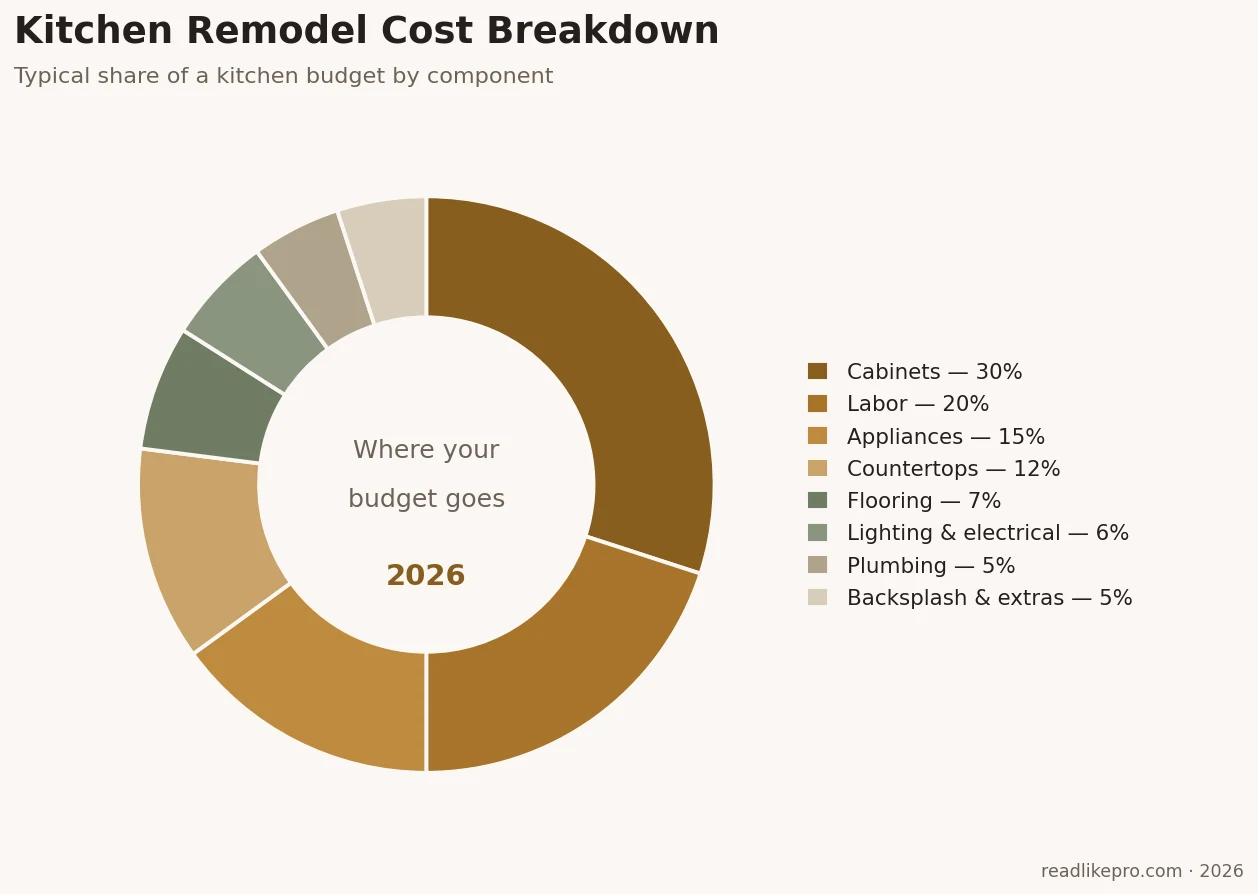
Before you collect a single quote, it pays to know roughly how a kitchen budget breaks down. The typical split makes it obvious when a bid is out of line — and shows you exactly where to trim if the total comes in high. The data consistently shows that cabinetry remains the single biggest expense in most kitchen remodels, with the rest falling into fairly predictable shares (though your mix shifts with scope).
| Component | Share of budget | Notes |
|---|---|---|
| Cabinets | 25–35% | Almost always the single biggest line item |
| Labor | 20% | Higher for gut jobs with plumbing or electrical moves |
| Appliances | 15% | Pro-grade ranges and panel-ready fridges spike this |
| Countertops | 10–15% | Quartz and natural stone run $50–$150/sq ft |
| Flooring | 7% | LVP keeps costs down; tile and hardwood add up |
| Lighting & electrical | 5% | Recessed lighting and new circuits add labor |
| Plumbing | 5% | Moving the sink or adding an island line costs more |
| Backsplash, hardware, extras | remainder | Small numbers that quietly add up |
Cabinets are the lever. Because they eat a quarter to a third of the budget, the single biggest decision you’ll make is custom versus semi-custom versus stock. Refacing existing boxes instead of replacing them can save thousands while still transforming the look.
Why Kitchen Remodel and Cost Climbed in 2026
If you priced a kitchen three or four years ago and are pricing again now, the sticker shock is real. Some homeowners are paying close to double what comparable projects cost in the early 2020s. Three forces are driving the kitchen remodel and cost increases this year:
- Labor shortages. Skilled trades remain in short supply, and installation rates have risen accordingly.
- Cabinet tariffs. Trade policy has kept imported cabinet prices elevated, and domestic manufacturers have largely held their margins rather than undercutting.
- Feature demand. Induction cooking, smart appliances, and upgraded lighting all add electrical work and parts that weren’t standard a few years back.
There’s also a timing wrinkle worth knowing. With another tariff step expected in 2027, some industry watchers anticipate a demand surge in late 2026 as homeowners rush to beat the increase. If your project is flexible, earlier in the year may mean shorter contractor waitlists.
Kitchen Remodel Cost by State
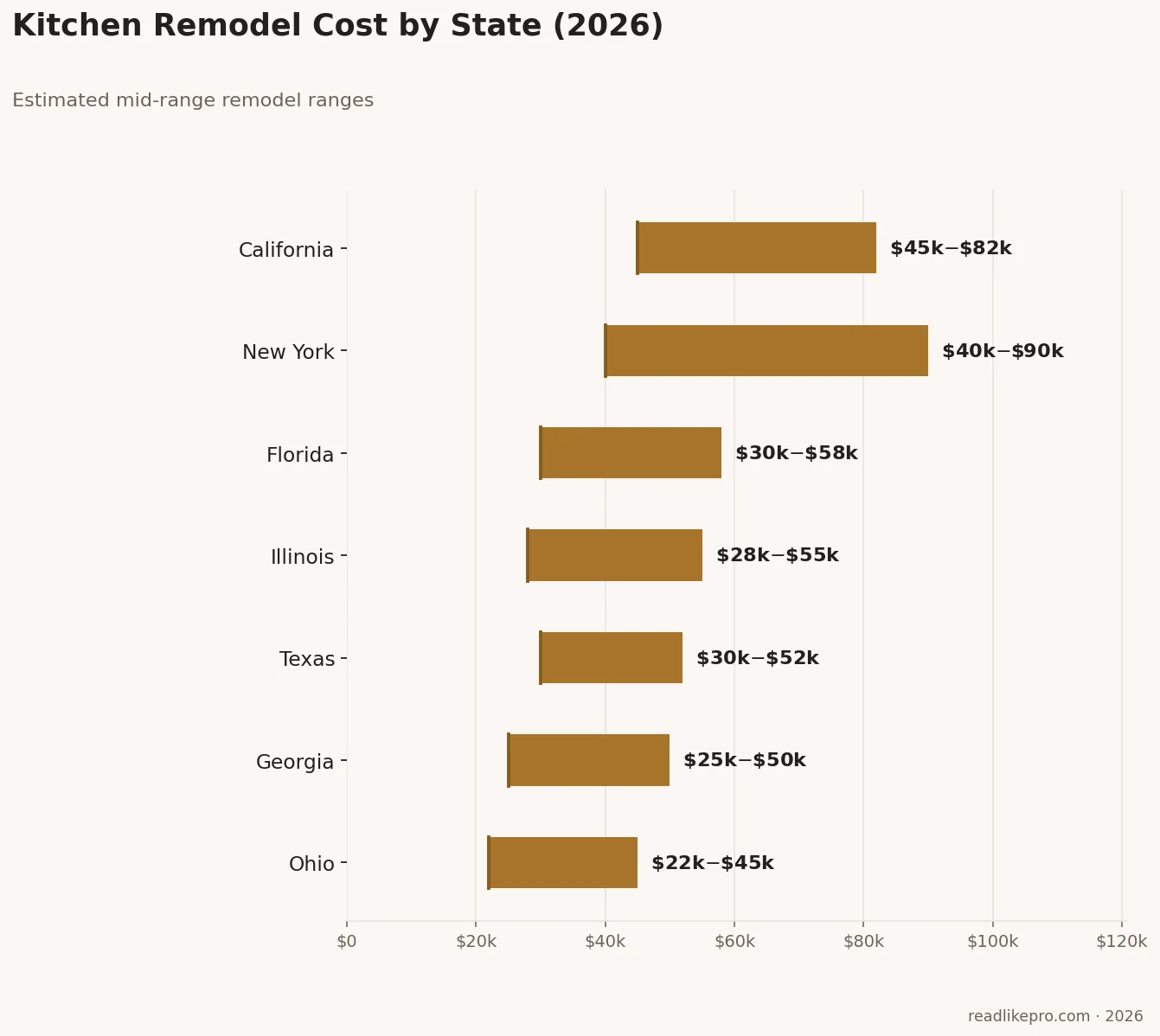
National averages are a starting point, but your zip code can swing the final number by 30% or more. Labor rates, permitting, and material expectations all shift regionally. The figures below are estimated 2026 planning ranges for seven major states; treat them as a baseline, then get local quotes.
| State | Mid-range remodel (est.) | What drives it |
|---|---|---|
| California | $45,000 – $82,000 | Highest labor rates in the country; LA/SF run well above average |
| Texas | $30,000 – $52,000 | Strong value; Austin runs priciest of the major metros |
| Florida | $30,000 – $58,000 | Miami higher; coastal hurricane-rated upgrades add cost |
| New York | $40,000 – $90,000+ | NYC co-op and condo rules add permitting complexity |
| Illinois | $28,000 – $55,000 | Chicago commands a premium over downstate |
| Ohio | $22,000 – $45,000 | Among the more affordable labor markets |
| Georgia | $25,000 – $50,000 | Atlanta high-end projects start near $74,000 |
For context, Sweeten reports high-end Atlanta kitchens starting around $74,000, which shows how fast premium scope moves the number even in a mid-cost market. If you’re in any of these states, two or three local bids will tell you far more than any national average.
How Long Does a Kitchen Remodel Take?
Budget gets the headlines, but timeline catches people off guard. A cosmetic refresh that doesn’t touch the layout can wrap in 1–3 weeks. A mid-range remodel with new cabinets and counters usually runs 5–8 weeks. A full gut, with plumbing and electrical moves, permitting, and custom cabinetry lead times, commonly takes 8–12 weeks or more.
The single biggest delay isn’t the work itself. It’s waiting on materials. Custom cabinets in particular can carry lead times of six to ten weeks, so order early and don’t let demo start until the big-ticket items have a confirmed delivery date.
How to Budget for a Kitchen Remodel
A good budget isn’t just a total. It’s a total with guardrails. Three rules keep most homeowners out of trouble.
1. Tie your budget to your home’s value. The old guideline says spend 5–15% of your home’s current value on a kitchen. For a $400,000 home, that’s $20,000–$60,000. In 2026, many full-featured renovations push closer to 15–25%, as homeowners accept that trade for better storage and smarter layouts. Just don’t over-improve for your neighborhood; spend past 15% and you may not recoup it at resale.
2. Always build a contingency. Add 10–20% on top of your estimate. Older homes hide problems, like rotted subfloor, failing plumbing, or outdated wiring that no longer meets code. If your home is older, it’s worth learning the warning signs that your wiring needs updating before demo day, because that’s exactly the kind of surprise that blows up a kitchen budget. A 10–20% cushion is what keeps the project moving when the demo crew finds one.
3. Get itemized bids, not lump sums. Ask every contractor to break out cabinets, countertops, labor, and trades separately. It’s the only way to compare quotes fairly, and the fastest way to spot padding. Permits alone can run $460–$2,770 depending on how much electrical and plumbing work is involved, so make sure they’re accounted for in writing.
Is a Kitchen Remodel Worth It? ROI in 2026
Cost is only half the story — the other half is what you get back. The kitchen is consistently one of the highest-return rooms in the house. Most homeowners recoup 60–75% of a full remodel at resale, and minor cosmetic updates do even better: the 2025 Cost vs. Value Report put a minor kitchen remodel at roughly 113% recouped nationally, the strongest ROI of any interior renovation. That said, the exact figure swings a lot by market.
The counterintuitive part? The cheaper project often pays back a higher percentage. If resale value is your main goal, a sharp, well-chosen refresh usually beats a full gut on pure return. If you’re remodeling for daily quality of life, the bigger project earns its keep in years of better cooking and living instead.
One more value lever worth a mention: swapping to ENERGY STAR–certified appliances trims utility bills over time and is a small but genuine selling point when you list.
Smart Ways to Lower Your Kitchen Remodel Cost
You don’t have to spend big to land a kitchen you love. A few moves stretch a budget without making the result look cheap:
- Keep the layout. Moving plumbing and gas lines is where budgets balloon. Work with your existing footprint.
- Reface, don’t replace. If your cabinet boxes are solid, new doors and hardware can transform the look for a fraction of replacement cost.
- Mix your splurges. Put money into the one or two things you touch daily, like counters and the faucet, and save on the rest.
- Choose quartz over rare natural stone. You get durability and a premium look without the top-tier price.
- Buy appliances off-season. Holiday weekends and end-of-year clearances genuinely move pricing.
- Get three bids. The spread between contractors on an identical scope can be thousands of dollars.
Frequently Asked Questions
What is the average kitchen remodel and cost in 2026? The national average is around $27,000, with most projects between $15,000 and $75,000. Minor refreshes start near $15,000, mid-range remodels run $30,000–$50,000, and luxury projects exceed $60,000.
How much does a 10×10 kitchen remodel cost? A full 10×10 (100 sq ft) remodel typically costs $10,000–$25,000, with a national average near $15,000, depending on materials and whether you change the layout.
What’s the most expensive part of a kitchen remodel? Cabinets, almost always. They consume 25–35% of a typical budget. Labor on a full gut, including plumbing, electrical, and drywall, is the next biggest chunk.
Is $30,000 enough for a kitchen remodel? For most standard-size kitchens, yes. $30,000 puts you in solid mid-range territory: new cabinets, countertops, flooring, and appliances, as long as you keep the existing layout.
Why is the kitchen remodel and cost higher in 2026? Three reasons: ongoing skilled-labor shortages, tariff pressure on cabinet prices, and rising demand for features like induction cooking and smart appliances that add electrical and material costs.
Does a kitchen remodel increase home value? Yes. Homeowners typically recoup 60–75% of a full remodel, and minor cosmetic updates can recoup nearly all, or even more than, their cost at resale.
How much should I set aside for surprises? Plan a 10–20% contingency on top of your estimate, especially in older homes where hidden wiring, plumbing, or subfloor issues are common.
Your Kitchen Remodel Budget at a Glance
The bottom line, boiled down to what you’ll actually do next:
- Set your tier first. Minor ($15k–$25k), mid-range ($30k–$50k), or luxury ($60k+). It anchors every other decision.
- Estimate by size. Multiply square footage by your tier’s per-square-foot rate, then add 15–20%.
- Check your state. Local labor can swing your total by a third, so use the state table, then get local bids.
- Protect the budget. Keep 10–20% in reserve, tie spend to 5–15% of home value, and demand itemized quotes.
- Spend where it shows. Counters and a good faucet get used daily; save on the things you don’t touch.
A kitchen remodel is a big number no matter how you slice it. But a clear budget, a realistic tier, and three honest bids turn it from a guessing game into a plan you can actually hold to.
Sources
- Angi — Kitchen remodel cost guide (2026 data)
- HomeAdvisor — Cost to remodel a kitchen
- Houzz — Cost to remodel a kitchen
- Sweeten — 10×10 kitchen remodel cost
- Sweeten — Kitchen renovation cost in Atlanta
- Zonda — 2025 Cost vs. Value Report
- ENERGY STAR — Energy-efficient products

Baldeep builds and researches content sites full time. For ReadLikePro he
compiles home service pricing from contractor quotes, industry cost surveys,
and public data, then checks the numbers against more than one source before
publishing. He isn’t a licensed contractor, so every estimate here is a
research-backed range, not a quote for your specific job.