

Ask three companies to quote the same yard and you’ll often get three different numbers, sometimes $40 apart. That’s the first thing to understand about lawn care cost: it isn’t a fixed rate, and the differences usually have clear reasons behind them.
According to 2026 pricing data, most US homeowners pay between $30 and $85 for a standard mowing visit, with a national average near $50. Recurring service tends to run $100 to $400 a month, and a full plan that adds fertilization and weed control climbs to $300 to $600. Across a full year, a quarter-acre lawn typically costs $1,000 to $2,800 to maintain, though warm, year-round states and high-wage cities sit well above that.
This guide lays out the real numbers, by service and by state, and compares the choices most homeowners are weighing: a national company like TruGreen versus a local one like Lawn Doctor, and handling the work yourself versus hiring it out.
2026 Lawn Care Cost by Service
The table below covers typical 2026 ranges for a quarter-acre to half-acre suburban lot. One-time jobs generally cost 50% to 100% more than the same service booked on a recurring schedule, since the crew can’t spread travel and setup time across regular visits.
| Service | Typical 2026 Cost | Notes |
|---|---|---|
| Standard mowing (per visit) | $30 – $85 | Mow, trim, edge, blow |
| Mowing (per hour) | $25 – $68 | Used for overgrown / one-time jobs |
| Full-service monthly plan | $100 – $400 | Mowing-focused, light add-ons |
| Premium monthly plan | $300 – $600 | Adds fertilization + weed control |
| Fertilization (per treatment) | $65 – $100 | $260 – $600 for a full year |
| Weed control (per treatment) | $50 – $125 | Often bundled with fertilizer |
| Core aeration | $100 – $300 | Once or twice a year |
| Dethatching | $75 – $300 | As needed, not every season |
| Overseeding / reseeding | $300 – $1,350 | Pairs well with aeration |
| Leaf removal | $150 – $700 | Seasonal, size-dependent |
| Overgrowth / first-cut surcharge | $25 – $75+ | Can double the rate if very tall |
Angi’s 2026 mowing data reports an average visit of about $123 once larger and more complicated yards are included, with most jobs falling between $49 and $203. Smaller, simpler lawns land closer to the $30 to $50 end.
Lawn Care Cost by State (2026 Comparison)
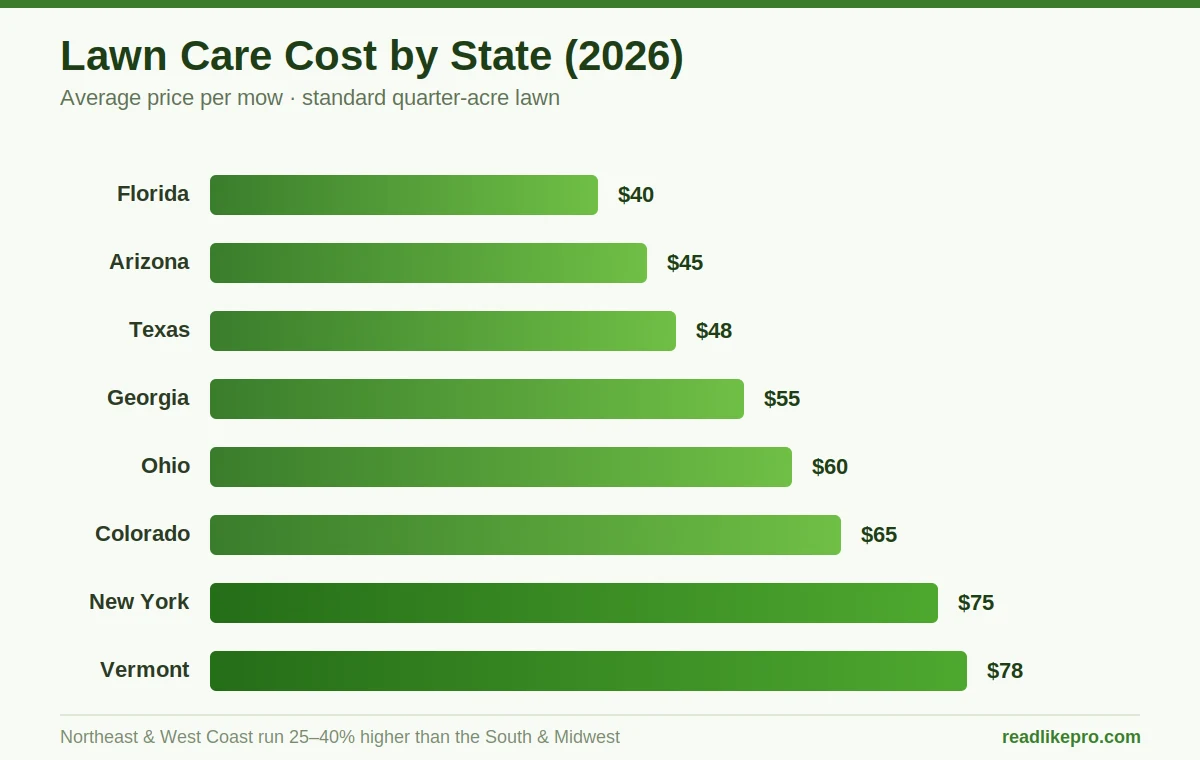
Where you live changes the price more than almost anything else. A quarter-acre lawn in Arizona averages around $45 per mow, while a similar property in Vermont runs closer to $78. The gap comes down to two factors: how much local labor costs, and how long the grass actually grows each year.
Homeowners in the Northeast and on the West Coast generally pay 25% to 40% more than those in the South and Midwest, because crews, fuel, insurance, and wages all cost more in those markets. A landscaping worker earns a median of about $18.82 an hour nationally, but closer to $26 in San Francisco, and that flows straight into the quote.
Warm states tell a different story. Florida and Texas often have lower per-visit prices but higher annual totals, simply because the grass needs roughly 40 cuts a year instead of the 25 a Midwest lawn might get. Lower price, more visits, bigger yearly bill.
The figures below are representative 2026 averages. Per-visit numbers assume a standard quarter-acre lawn, and annual estimates assume regular mowing through the local season. Your own price will shift with city and lot size.
| State | Region | Avg. per mow | Est. annual (mowing) |
|---|---|---|---|
| Arizona | Southwest | ~$45 | $1,300 – $2,200 |
| Texas | South | $40 – $55 | $1,400 – $2,400 |
| Florida | Southeast | $30 – $50 | $1,600 – $3,500 |
| Georgia | Southeast | $40 – $70 | $1,300 – $2,200 |
| North Carolina | Southeast | $40 – $70 | $1,300 – $2,300 |
| Ohio | Midwest | $45 – $75 | $1,000 – $1,800 |
| Illinois | Midwest | $45 – $80 | $1,100 – $1,900 |
| Colorado | Mountain West | $50 – $80 | $1,200 – $2,100 |
| New York | Northeast | $60 – $90+ | $2,000 – $3,500 |
| New Jersey | Northeast | $60 – $95 | $2,000 – $3,400 |
| Massachusetts | Northeast | $65 – $95 | $1,800 – $3,200 |
| Vermont | Northeast | ~$78 | $1,700 – $3,000 |
| Washington | Pacific NW | $60 – $90+ | $2,000 – $3,500 |
| California | West Coast | $60 – $90+ | $2,000 – $3,500 |
State figures reflect 2026 market ranges drawn from LawnStarter’s lawn care cost study and regional pricing data. Vermont’s high average is shaped partly by large lots, the state’s average yard tops 29,000 square feet, and a short, costly season.
Lot size matters, but it’s worth remembering it isn’t the whole picture. Two yards with identical square footage can price very differently depending on slopes, garden beds, sprinkler heads to mow around, and how far the crew travels between stops.
TruGreen vs. Lawn Doctor: Cost Comparison
For homeowners choosing between the two best-known national names, the decision usually comes down to price versus consistency. TruGreen is the larger company, with standardized plans and the widest coverage, and its annual programs run $450 to $2,000. Lawn Doctor operates as locally owned franchises, tends to cost less at $300 to $900 a year, and leaves more room to customize.
Both cover the same core work, fertilization, weed control, aeration, seeding, and optional pest treatments. The differences are in structure, price, and how local the service feels.
| Feature | TruGreen | Lawn Doctor |
|---|---|---|
| Annual cost (≈5,000 sq ft) | $450 – $2,000 | $300 – $900 |
| Per treatment | $65 – $225 | $50 – $100 |
| Visits per year | 7 – 9 | 6 – 8 |
| Business model | National, standardized pricing | Locally owned franchises |
| Customization | Tiered pre-set plans | More flexible, local plans |
| Organic option | TruNatural (100% natural) | Custom organic on request |
| Guarantee | Healthy Lawn Guarantee | Free reapplication / refund* |
| Coverage | Nationwide | Franchise-dependent |
| Watch-outs | Intro rate jumps at renewal; auto-enrolls for next year | Quality varies by franchise |
*Lawn Doctor’s reapplication guarantee usually applies to annual-program customers with yards up to 5,000 square feet.
TruGreen makes sense for homeowners who want broad availability and a hands-off program they don’t have to think about. One thing to confirm before signing: the first-visit price is typically a discounted introductory rate, so ask what the renewal will actually cost. Lawn Doctor tends to win on price and flexibility, with the trade-off that service quality depends on the particular franchise serving your area. Since quotes from both are free, getting two is the easiest way to see which fits your lawn and budget.
DIY vs. Professional Lawn Care Cost
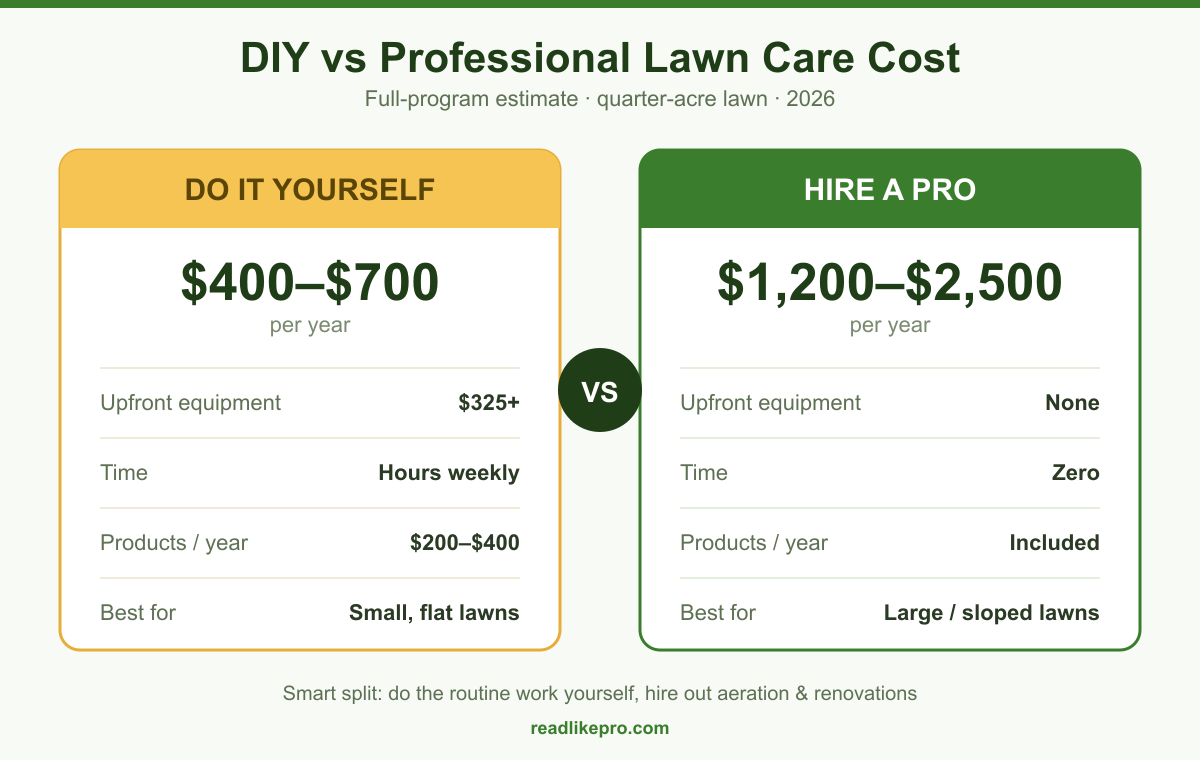
Doing the work yourself is cheaper on paper. Public pricing data puts a full DIY program for a quarter-acre lawn at roughly $400 to $700 a year, while the same program handled professionally runs $1,200 to $2,500. The gap narrows once you account for equipment, time, and the few jobs that genuinely need a pro.
| Factor | DIY | Professional |
|---|---|---|
| Annual cost (¼-acre, full program) | $400 – $700 | $1,200 – $2,500 |
| Product cost per year | $200 – $400 | Included in plan |
| Upfront equipment | $325+ (mower); up to $3,000 for riding | None |
| Fertilizer per application | ~$35 bag (covers 5,000 sq ft) | $64+ |
| Pre-emergent herbicide | ~$30 bag (3 months) | $90+ |
| Time commitment | Several hours weekly in season | Zero |
| Best for | Small, flat lawns; hands-on owners | Large/sloped lawns; busy schedules |
DIY pays off most on the routine, low-skill tasks. Mowing a small flat lawn, spreading fertilizer, and applying pre-emergent in spring are inexpensive to handle yourself. A $35 bag of fertilizer covers the same area a pro charges $64 or more to treat, and a battery mower in the $400 range often pays for itself within a season on a small lot.
Professionals earn their cost on specialty work. Core aeration is a good example: commercial equipment pulls deeper, more even plugs than a homeowner rental, and the price difference is modest. Dethatching a large lawn, installing sod, and full renovations also lean professional, since they call for real equipment and some technique to do well.
For most homeowners, the practical split is to do the recurring tasks and hire out the once-a-year jobs. A DIY-heavy owner can run a solid program for $400 to $700 annually and still bring in a crew for the fall aeration and overseed. Bundling is where pros are genuinely competitive, an aerate, overseed, and starter-fertilizer visit booked together runs $320 to $380, compared with about $430 buying each service on its own.
What Drives Your Lawn Care Cost
Two homes on the same street can get quotes $30 apart, and it’s rarely about one company overcharging. Five factors account for most of the variation.
Lawn size and the tier effect
Size is the biggest driver, but most companies don’t price by exact square footage. They use size tiers, which means moving from 4,900 to 5,100 square feet can bump you into the next bracket and raise the price on every visit, even though the lawn barely changed. If your yard sits near a bracket line, it’s worth asking where the tiers fall.
Location
Geography swings the price hard. Research from across thousands of US cities shows the same lawn that costs $45 in San Antonio can run $90 in Seattle, roughly double, for identical work. As a general rule, Northeast and West Coast markets price 25% to 40% above the South and Midwest.
Service frequency
Frequency affects price in a way that runs against intuition. Weekly mowing costs less per visit because the grass stays short and quick to cut, while biweekly service costs 20% to 30% more each visit. Per month, though, biweekly can come out cheaper because you’re paying for half as many cuts. Grass type and growing season usually decide which makes sense, Bermuda in Texas may need weekly summer cuts, while a cool-season lawn up north can stretch to biweekly.
Grass condition
A neglected lawn costs more to bring back. Grass over 6 to 8 inches usually needs an extra pass, and anything over 10 to 12 inches can double the rate. Most companies also add a first-cut fee of $25 to $75 on a new account. These aren’t gimmicks, they reflect the extra time, bagging, and blade wear an overgrown lawn demands.
Terrain and obstacles
Slopes, tight corners, flower beds, tree roots, and play equipment all slow a crew down, and labor time is what the bill is built on. An open, square lawn will always quote lower than a same-sized yard broken up by obstacles, often by 10% to 25%.
How to Get a Fair Quote
A few simple habits separate homeowners who pay a fair rate from those who overpay or hire the wrong crew.
- Get two to three quotes. Prices for the same lawn vary widely, and comparison is the only way to know what’s reasonable in your area.
- Treat very low bids with caution. A $25 quote for a quarter-acre often signals an uninsured operator, which matters because their injury or property damage can become your problem. Ask for proof of insurance.
- Get the scope in writing. Standard mowing covers mow, trim, edge, and blow. Bagging clippings ($10 to $25 extra), leaf removal, and fertilization are usually separate line items.
- Don’t pay in full upfront. Established companies don’t need the entire bill before the work is finished.
- Choose the operator you trust over the cheapest number. Reliability and insurance are worth a few dollars more.
Frequently Asked Questions About Lawn Care Cost
How much does lawn care cost per month?
Most homeowners pay $100 to $400 a month for recurring lawn care in 2026. Basic weekly mowing on a quarter-acre lot lands around $140 to $260, while full-service plans with fertilization and weed control run $300 to $600.
Which state has the most expensive lawn care?
Northeast and West Coast states are the priciest. Vermont averages about $78 per mow, driven by short seasons and large lots, and high-cost metros in New York, Washington, and California regularly push annual bills past $2,500. Arizona and much of the South sit at the low end, near $45 per mow.
Why are lawn care quotes so different for the same yard?
The usual causes are size tiers, region, frequency, and what’s included. One crew bundles edging and bagging while another charges separately, or one prices your lawn in a higher bracket. A written scope makes competing quotes easier to compare.
Is TruGreen or Lawn Doctor cheaper?
Lawn Doctor is typically cheaper, around $300 to $900 a year versus TruGreen’s $450 to $2,000. TruGreen offers broader coverage and standardized national plans, while Lawn Doctor’s local franchises tend to allow more customization. Comparing quotes from both is the safest approach.
Is DIY lawn care really cheaper than hiring a pro?
In dollars, yes, roughly $400 to $700 a year compared with $1,200 to $2,500. That figure leaves out your time and equipment, though. DIY suits small, flat lawns and hands-on owners best. For most people, the better value is handling routine tasks and hiring out specialty work like aeration.
What hidden fees should I watch for?
The common ones are first-cut and overgrowth surcharges, bagging and haul-away fees, travel fees for out-of-area homes, and renewal rates on annual programs that climb above the introductory price. Ask about each before you sign.
Can I lower my lawn care cost without hurting the lawn?
Yes. Bundle services into a single plan rather than buying piecemeal, keep a consistent mowing schedule to avoid overgrowth fees, take advantage of annual prepay discounts, and handle the easy tasks yourself. Most of the savings come from consistency rather than from chasing the lowest quote.
Key Takeaways
A standard mow runs $30 to $85 per visit, but the monthly and annual totals are the numbers worth budgeting around. Location drives much of the difference, the same lawn can cost roughly twice as much in Seattle as in San Antonio. Less frequent mowing costs more per visit yet can cost less per month, so the right schedule depends on your grass.
Among the national options, Lawn Doctor usually comes in cheaper while TruGreen offers wider coverage and more consistency. For the work itself, most homeowners get the best value by doing routine tasks and hiring out specialty jobs like aeration. Whatever route you take, gather two or three quotes, confirm insurance, and get the scope in writing. A healthy lawn comes down to consistency, and a fair price comes down to knowing what you’re looking at.
Related Cost Guides
Pricing out other parts of the house? These guides break down real 2026 numbers the same way:
- Roof Leak Repair Cost: What You’ll Actually Pay in 2026
- Kitchen Remodel Cost in 2026: Real Prices by Size, Tier, and State
Sources
- Angi: Lawn Mowing Cost (2026 Data)
- Angi: Lawn Mowing Price Guide (2026 Data)
- LawnStarter: How Location Impacts Lawn Care Costs

Baldeep builds and researches content sites full time. For ReadLikePro he
compiles home service pricing from contractor quotes, industry cost surveys,
and public data, then checks the numbers against more than one source before
publishing. He isn’t a licensed contractor, so every estimate here is a
research-backed range, not a quote for your specific job.


[…] Recurring maintenance is a different purchase from installation. Mowing plans, fertilization schedules, and seasonal service price per visit and per season, not per square foot — we break that pricing model down separately in our lawn care cost guide. […]