
A client walks into your office for the first time. The reception desk has coffee rings on it. The air smells faintly stale. Nobody says anything, but you can see it register on their face.
That’s the thing about office cleanliness — nobody compliments you for it, but everyone notices the absence of it. And it’s not just about appearances. A clean workplace affects how employees feel walking in every morning, how long they stay healthy during cold and flu season, and yes, whether a prospective client decides to sign.
This guide covers the professional office cleaning tips that commercial cleaning crews actually rely on — not generic “wipe your desk” advice, but the systems, schedules, and small habits that separate a genuinely well-maintained office from one that just looks fine until you look closer.
Why Office Hygiene Deserves More Than an Afterthought
Most businesses spend real money on hiring, software, and marketing, then treat cleaning as whatever’s left in the budget. That’s backwards, and the research on workplace hygiene backs that up.
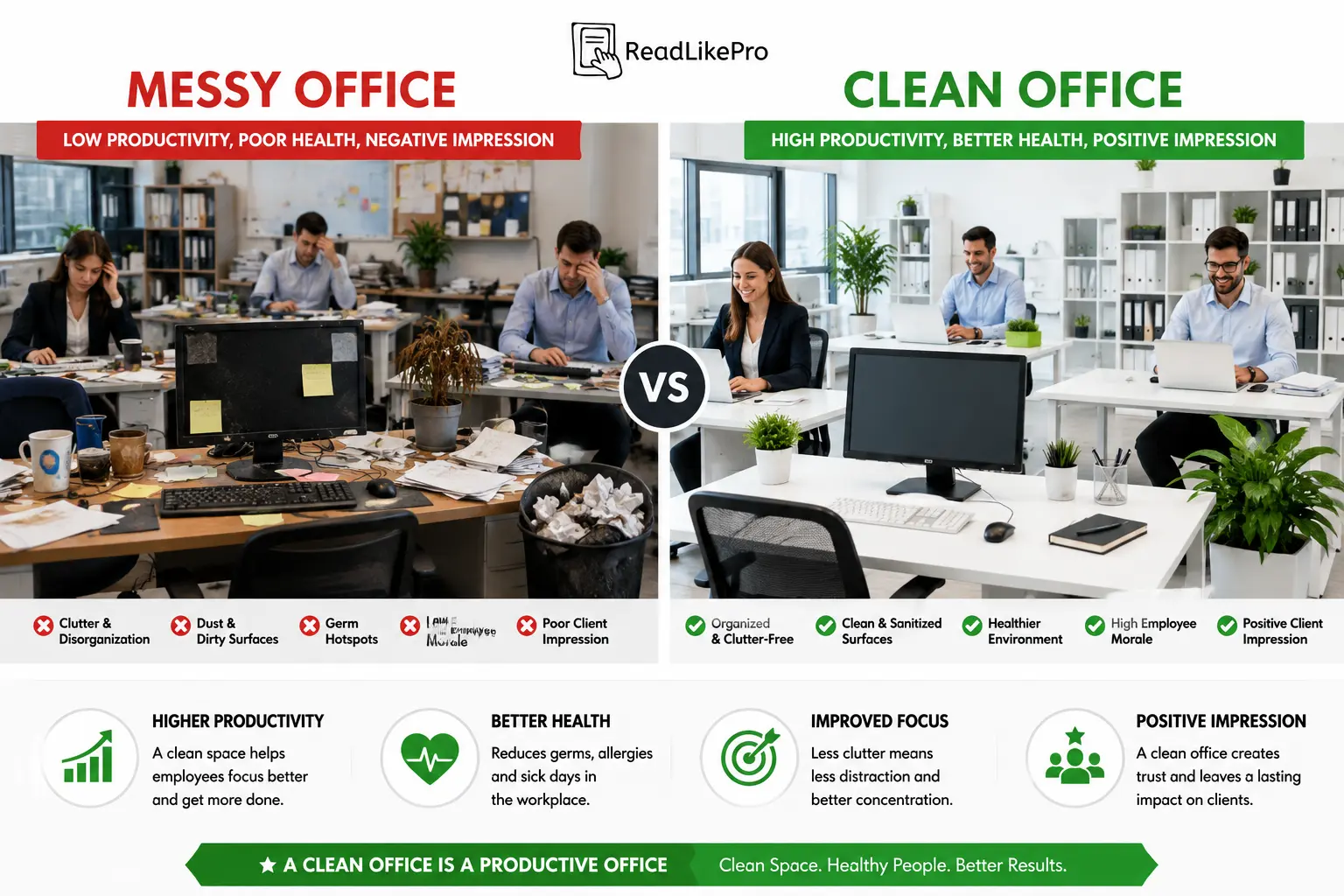
The CDC’s guidance on cleaning and disinfecting is fairly direct about this: high-touch surfaces should be cleaned regularly, and disinfecting becomes especially important once someone in the space is sick or at higher risk of getting sick. In an office where ten or fifty people are touching the same door handles, coffee machine buttons, and shared keyboards every day, that’s not a minor detail — it’s the whole game.
There’s also a productivity angle that doesn’t get talked about enough. Princeton’s Neuroscience Institute studied how visual clutter affects focus, and the short version is that a disorganized environment competes for attention in a way that wears down concentration over time. So a messy office isn’t just an eyesore for visitors — it’s quietly working against your own team’s concentration every hour they’re in it.
Put those two things together and the case for a real office hygiene routine writes itself: fewer sick days, sharper focus, and a space that doesn’t make anyone — employee or client — feel like an afterthought.
Build a Cleaning Schedule, Not a Cleaning Emergency
The difference between an amateur approach and a professional one comes down to timing. Amateur cleaning happens when something looks dirty. Professional cleaning happens on a schedule, before it gets to that point.
Here’s the three-tier structure most commercial cleaning companies build their service plans around:
Daily
- Empty waste bins and replace liners
- Wipe down desks, keyboards, phones, and shared equipment
- Clean and restock restrooms
- Sweep or vacuum the reception area and main walkways
- Disinfect door handles, light switches, and elevator buttons
- Wipe kitchen counters and sink
Weekly
- Mop hard floors
- Vacuum carpeted areas
- Clean glass surfaces and mirrors
- Dust baseboards, window sills, and equipment tops
- Deep-clean the microwave and refrigerator shelves
Monthly
- Professional carpet cleaning or steam extraction
- Clean HVAC vents and replace filters
- Sanitize behind and underneath furniture
- Wash interior windows
- Check for leaks, mold, or other maintenance issues
If you outsource cleaning, get this written into the contract. A surprising number of disputes between businesses and their cleaning vendors come down to vague scope — “weekly cleaning” can mean very different things depending on who you ask.
8 Professional Office Cleaning Tips Worth Building Into Your Routine
1. Start with high-touch surfaces, every single day
If you only have ten minutes, this is where they go. Door handles, elevator buttons, shared keyboards and mice, conference room armrests, coffee machine buttons — these get touched by dozens of different hands daily, which makes them the fastest route for germs to move through an office.
A disinfecting wipe-down once a day covers most of it. During cold and flu season, twice a day is worth the extra few minutes.
2. Use color-coded cleaning tools
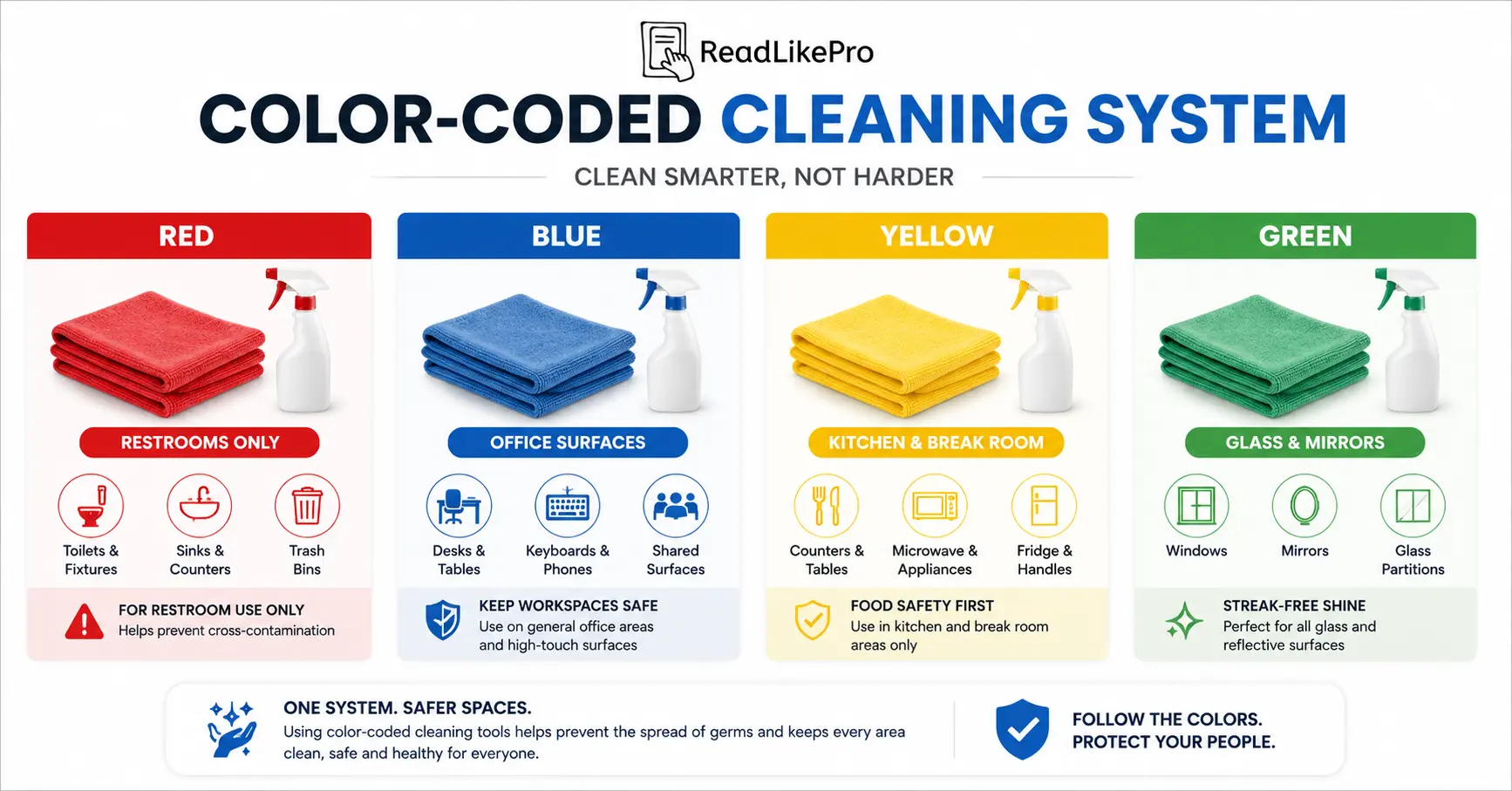
This is a simple system that most in-house cleaning routines never bother with, but professional janitorial crews use it constantly: assign different colored cloths to different zones so nothing cross-contaminates.
- Red — restrooms only
- Blue — general office surfaces
- Yellow — kitchen and break room
- Green — glass and mirrors
It sounds minor, but it’s the difference between a system and a single rag doing everything, restroom included.
3. Match the cleaning product to the surface
One all-purpose spray for everything is one of the most common mistakes in office cleaning — it underperforms on some surfaces and damages others. Laminate desks need a different approach than glass partitions, and keyboards should never get a liquid spray directly (compressed air and isopropyl alcohol wipes are the safer route).
When choosing disinfectants specifically, EPA’s registry of reviewed disinfectant products is worth checking if you want confidence that what you’re buying actually does what the label claims.
4. Don’t underestimate your carpets
Carpets quietly hold onto allergens, dust, and odors long before they look dirty to the eye. A reasonable standard: vacuum high-traffic areas daily, individual offices two to three times a week, and bring in professional extraction every three to six months. Spot-treat spills immediately — once they set, they’re far harder to fully remove.
Carpets aren’t the only place dirt hides, either — if you’re building cleaning habits from scratch, our beginner’s guide to home cleaning covers the same room-by-room logic for residential spaces.
5. Take the kitchen seriously
Most people assume the restroom is the dirtiest spot in an office. It’s usually not. Shared kitchens — the sink, the microwave, the fridge handle — get touched constantly and cleaned rarely.
A workable routine: wipe counters and appliance exteriors daily, clean the microwave interior daily (food splatter accumulates fast), and clear out anything past its date from the fridge weekly. A friendly posted reminder near the sink asking people to rinse their own dishes does more than you’d expect — it turns cleanliness into shared ownership instead of a constant management headache.
6. Don’t ignore air quality
Cleaning routines tend to focus entirely on visible surfaces, but indoor air quality has a direct effect on how people feel and concentrate at work. Replacing HVAC filters on schedule, cleaning vents quarterly, and adding a HEPA purifier in poorly ventilated rooms are all low-effort, high-impact moves that rarely make anyone’s checklist.
7. Handle electronics the right way
Keyboards and shared phones are consistently among the most contaminated surfaces in any office — research from the National Center for Health Research on office desk bacteria, drawing on University of Arizona findings, found that the average office desk carries roughly 400 times more bacteria than a toilet seat. Keyboards and handsets are usually where most of that concentration sits.
The right process: power down before cleaning, turn the keyboard over and tap out debris, use compressed air between keys, then wipe with an alcohol-based wipe. Never spray liquid directly onto a monitor — a dry microfiber cloth, followed by a lightly dampened one, is the safer approach.
8. Build a waste system that doesn’t rely on guesswork
Poorly managed waste creates odors, attracts pests, and undercuts every other cleaning effort no matter how spotless the rest of the office looks. A simple setup — small under-desk bins for dry waste, a proper three-bin kitchen station for general waste, recycling, and compost where applicable, and daily emptying of high-traffic bins — takes one afternoon to put in place and then mostly runs itself.
Common Office Cleaning Mistakes That Undo All That Effort
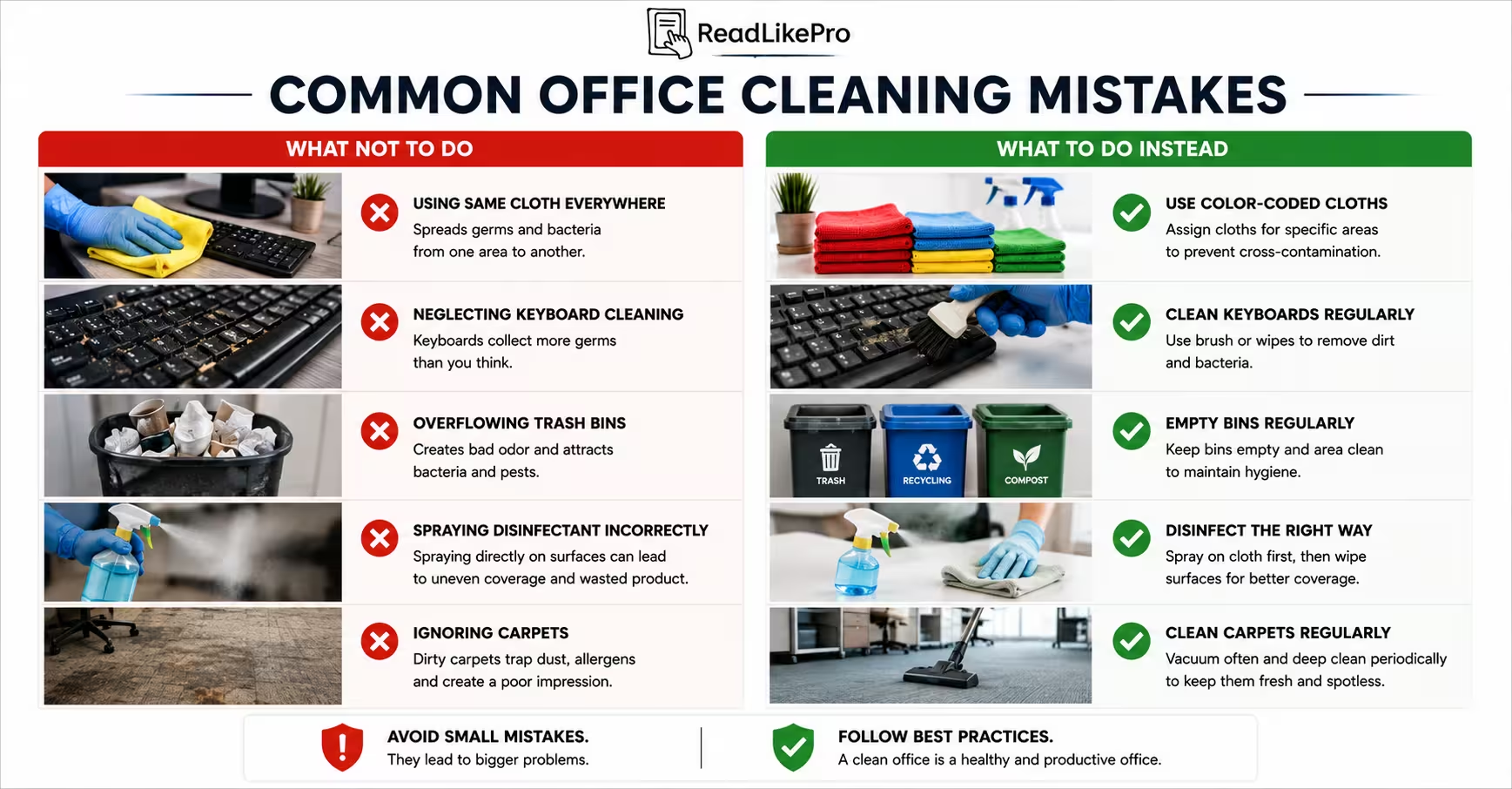
Even offices with a real cleaning schedule in place often lose the benefit of it through a handful of repeated mistakes. None of these are dramatic on their own — that’s exactly why they’re easy to overlook.
Treating “tidy” and “clean” as the same thing. A desk with nothing on it can still be covered in bacteria. Visual neatness doesn’t disinfect anything, and offices that only focus on appearance tend to skip the actual germ-killing step.
Using one cloth or sponge for everything. This is the opposite of the color-coding system covered earlier, and it’s still the most common setup in offices that handle cleaning informally. A cloth that touched the restroom sink shouldn’t make its way to the break room counter an hour later.
Spraying disinfectant and wiping it off immediately. Disinfectants need contact time to actually work — usually a few minutes of staying visibly wet on the surface. Spray-and-wipe-instantly mostly just spreads germs around rather than killing them.
Ignoring soft surfaces. Chairs, cushions, carpets, and curtains hold onto dust, allergens, and bacteria just as much as hard surfaces, but they rarely make it onto a daily checklist because they don’t look obviously dirty.
Skipping cleaning when no one’s visibly sick. Reactive cleaning — waiting until someone’s out with the flu before disinfecting — misses the point. By the time one person is sick, the surfaces around them have usually already been touched by several others.
Assuming more product means better results. Overusing chemical cleaners doesn’t deep-clean faster; it just leaves residue, irritates people with sensitivities, and on some surfaces (like the laminate and stainless steel covered earlier) actively damages the finish over time.
No clear ownership. When “everyone” is responsible for kitchen cleanup or wiping shared equipment, in practice no one is. The offices that stay consistently clean are usually the ones with a named person or a posted rotation, not a vague expectation.
Fixing even two or three of these tends to make a bigger difference than adding new tasks to an already long checklist.
When to Hire Professional Cleaning Help
| Office Size | Recommended Cleaning Frequency | Professional Service |
|---|---|---|
| Under 1,000 sq ft | Daily upkeep by staff | Deep clean every 2–3 months |
| 1,000–5,000 sq ft | Daily + weekly tasks in-house | Professional cleaning 3–5 times/week |
| 5,000+ sq ft or heavy foot traffic | Daily | Daily professional cleaning |
The jump from occasional deep cleans to daily service isn’t just about square footage — it’s about how many different people are touching the same surfaces. A 1,200 sq ft office with five people and a 1,200 sq ft office with thirty people don’t need the same plan, even though they’d land in the same row on paper. Use the table as a starting point, not a fixed rule.
Whoever you hire, confirm they carry general liability insurance, ask for itemized pricing rather than a vague flat rate, and check reviews from businesses similar in size to yours — a five-person startup and a 200-person office have very different cleaning needs, and a company built for one doesn’t always handle the other well.
FAQ: Professional Office Cleaning Tips
What’s the best office cleaning schedule to follow? A three-tier system works well for most offices: daily tasks for high-touch surfaces, restrooms, and waste; weekly tasks for floors, carpets, and glass; monthly tasks for deep carpet cleaning, HVAC maintenance, and full sanitization behind furniture.
How often should an office get a deep clean? Every three months at minimum for most offices. Spaces with heavy foot traffic or frequent client visits benefit from monthly deep cleans, since regular daily cleaning doesn’t reach carpet extraction, upholstery, or HVAC vents.
What are the most important hygiene habits for shared workspaces? Disinfect high-touch surfaces daily, use separate cleaning cloths for different zones to avoid cross-contamination, keep a strict kitchen routine, and clean shared electronics regularly with alcohol-based wipes.
What should I look for when hiring a commercial cleaning service? Insurance coverage, documented cleaning checklists, itemized pricing, and reviews from businesses your size. Ask directly whether they use EPA-registered disinfectants and color-coded tools — the answer tells you a lot about how seriously they take the work.
What’s the most common mistake offices make with cleaning? Confusing tidiness with cleanliness. A clutter-free desk can still be covered in bacteria if it’s never actually disinfected — visual neatness and germ control are two different things, and most offices only manage the first one.
Does a clean office actually affect productivity? There’s real research behind this, not just intuition. Princeton’s Neuroscience Institute found that cluttered, disorganized environments measurably reduce the brain’s ability to focus and process information — which means an unclean or chaotic office isn’t just unpleasant, it’s working against your team’s output every day.
Final Thoughts
None of these professional office cleaning tips are complicated on their own. What separates a genuinely clean office from one that just looks okay is consistency — having a schedule, sticking to it, and treating hygiene as part of how the business runs rather than something handled when it becomes obvious.
Start small if you need to. Pick one habit from this list, build it into the week, and add the next one once it sticks.