

Pull up HomeGuide’s house cleaning cost page and count how many prices it gives for the same house.
The headline says $120 to $280 per cleaning. The opening paragraph says a 2,000 sq ft home with three bedrooms and two bathrooms runs $110 to $320. Their cost calculator table puts a 3-bed 2-bath at $135 to $180. Their per-room table puts the same home at $140 to $190. Their per-square-foot table says a 2,000 sq ft home is $190 to $340.
Five numbers. One page. One house.
This isn’t sloppiness it’s what happens when you collect real quotes priced four different ways and try to publish them in one table. But it means the thing most people do before hiring a cleaner, which is look up an average, produces a number they can’t actually use.
House cleaning cost isn’t one figure. It’s five variables multiplied together, and the rest of this page is about filling them in for your house.
How These Numbers Were Assembled
Every source is named at the point of use. If a figure isn’t attributed below, it’s arithmetic from figures that are.
Pricing units are converted before comparison. Sources quote per visit, per hour, per room, and per square foot. A per-room figure and a per-visit figure aren’t comparable until both are normalized to the same house.
Where sources disagree, both numbers appear. Averaging conflicting data into one tidy figure destroys the most useful information — the fact that the industry itself doesn’t agree. Tipping and deep-clean multipliers are the clearest cases, and both are shown as ranges of published opinion, not as facts.
Marketplace data and vendor-blog data are labeled differently. Angi, HomeGuide, Thumbtack, and HomeAdvisor aggregate quotes homeowners actually received. Cleaning-software company blogs publish rate guidance aimed at cleaning businesses, which is a different thing and is flagged wherever used.
Anything with a legal or tax consequence is verified at the primary source. The household employment figures come from IRS publications directly.
The Short Answer for House Cleaning Cost
Across the four marketplace datasets, a standard house cleaning falls in the $120 to $280 per visit range, with HomeGuide putting the national average at $200 and Angi’s data near $176. HomeGuide’s floor is $60 and its ceiling is $400.
Hourly, HomeGuide reports $25 to $75 per hour per cleaner.
That per-cleaner wording is the single most expensive misunderstanding in this industry, so it goes first.
The Per-Cleaner Trap
When a company says $40 an hour, most people hear “$40 for every hour my house is being cleaned.” It almost never means that.
Two cleaners for three hours isn’t three billable hours. It’s six.
HomeGuide’s own hourly table shows exactly how this scales:
| Crew | Hours | Weekly rate | One-time visit | Same-day |
|---|---|---|---|---|
| 1 cleaner | 1 hr | $30 – $50 | $45 – $50 | $70 |
| 1 cleaner | 2.5 hrs | $75 – $90 | $80 – $100 | $135 |
| 1 cleaner | 4 hrs | $115 – $135 | $127 – $149 | $203 |
| 2 cleaners | 2 hrs | $130 – $155 | $150 – $170 | $250 |
| 2 cleaners | 4 hrs | $200 – $250 | $220 – $275 | — |
Source: HomeGuide, 2026
Two things worth noticing in that table beyond the crew math. Same-day booking costs roughly 60 to 80 percent more than a weekly rate for identical work. And a recurring weekly client pays less per hour than a one-time client for the exact same crew and duration — the discount is real and it’s built into standard pricing.
Ask on every call: is the rate per cleaner or per crew, and how many people are coming?
Cost by Bedrooms and Bathrooms
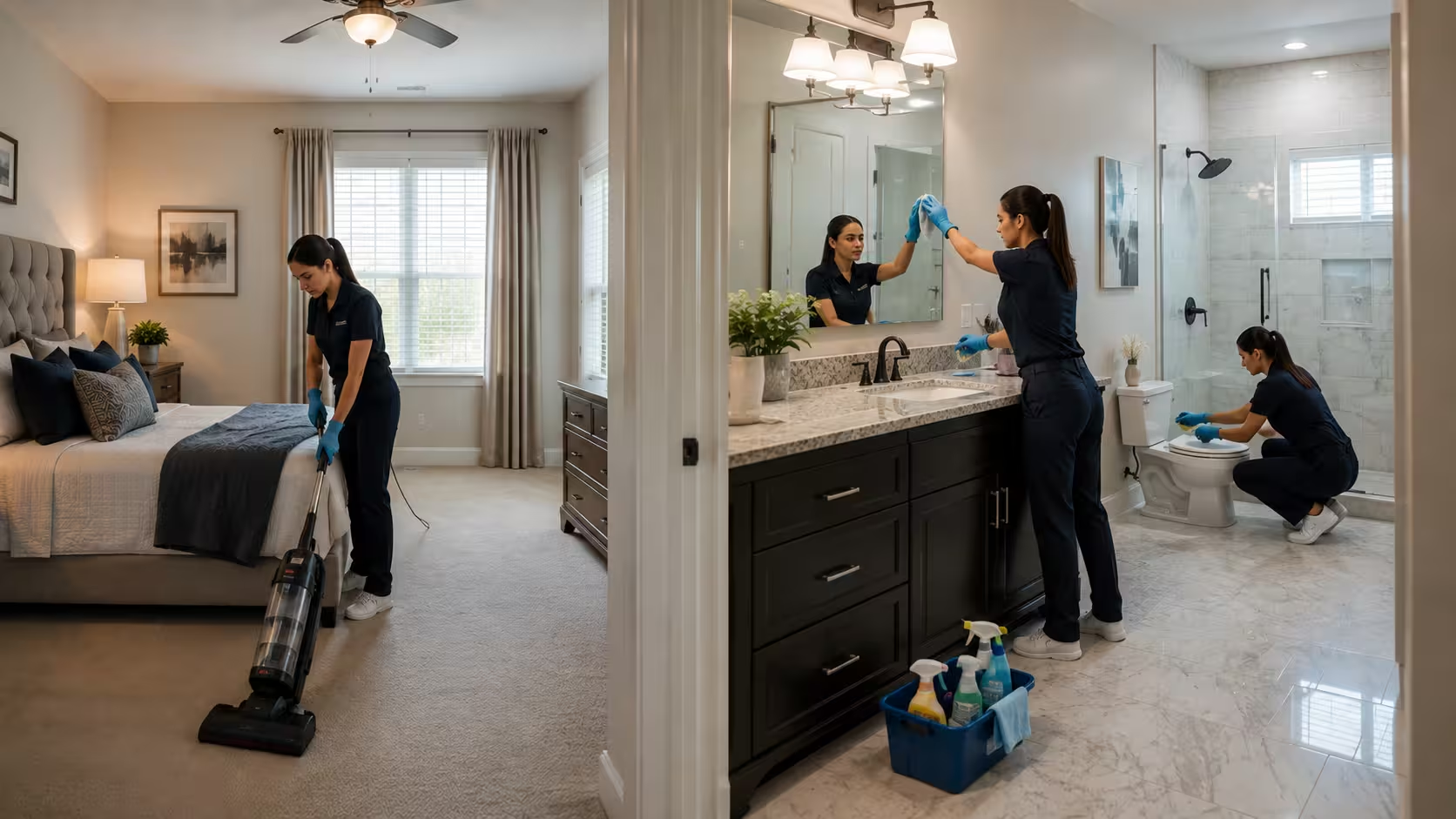
Square footage gets quoted more often, but bedroom and bathroom count is what most companies actually price against. HomeGuide’s per-room data:
| Bedrooms | Bathrooms | Typical cost |
|---|---|---|
| 1 | 1 | $75 – $110 |
| 1 | 2 | $110 – $130 |
| 2 | 1 | $100 – $120 |
| 2 | 2 | $135 – $195 |
| 3 | 1 | $130 – $180 |
| 3 | 2 | $140 – $190 |
| 4 | 3 | $200 – $225 |
| 5 | 3 | $210+ |
Source: HomeGuide, 2026
Read the second and third rows against each other. A one-bedroom with two bathrooms ($110–$130) prices above a two-bedroom with one bathroom ($100–$120). The extra bathroom costs more than the extra bedroom.
That’s not a quirk. A bathroom is the most labor-dense room in a house — hard surfaces, grout, fixtures, and mirrors each needing a different product and a separate pass. A bedroom is mostly floor. If you’re comparing your quote to a neighbor’s, bathroom count explains more of the gap than square footage does.
For your own figures rather than a national table, the ReadLikePro cleaning cost calculator prices size, bathroom count, and condition separately, which is closer to how a quote actually gets built.
Standard vs. Deep vs. Move-Out
HomeGuide’s size-based comparison:
| Home | Standard | Deep | Move-out |
|---|---|---|---|
| Studio | $60 | $90 | $100 |
| 1 bed 1 bath | $60 – $90 | $90 – $110 | $100 – $120 |
| 2 bed 2 bath | $95 – $130 | $135 – $195 | $135 – $210 |
| 3 bed 2 bath | $135 – $180 | $180 – $280 | $180 – $300 |
| 4 bed 3 bath | $140 – $200 | $200 – $400 | $200 – $390 |
| Each extra room | $10 – $30 | $35 | $35 |
Source: HomeGuide, 2026
On the deep-clean multiplier, the sources genuinely split. HomeGuide’s own table works out to roughly 1.3 to 1.6 times a standard clean. Housecall Pro, writing for cleaning businesses, advises charging 50 to 100 percent more. Deep cleaning as a standalone service runs $230 to $600 per HomeGuide.
So the honest guidance is a band, not a number: expect 1.3× to 2× a standard visit. What matters more is the direction of the check. If a company quotes a deep clean at barely above their standard price, that’s not a bargain — the labor difference is real, and an underquote shows up in the work.
Add-Ons: The Actual Per-Item Prices
Most cost guides say add-ons “will increase your cost.” Here’s what they cost:
| Add-on | Price |
|---|---|
| Changing bedsheets | $10 per bed |
| Wash and dry laundry | $5 – $20 per load |
| Interior window cleaning | $4 – $7 per window |
| Exterior window cleaning | $5 – $8 per window |
| Dusting blinds | $20 |
| Polish wood surfaces | $30+ |
| Cleaning inside cabinets | $25 – $45+ |
| Fridge cleaning | $12 – $50 |
| Oven cleaning | $15 – $35 |
| Baseboard cleaning | $35+ |
| Cabinet organization | $50 |
Source: HomeGuide, 2026
HomeGuide notes that oven and fridge cleaning together can push a bill up by more than $100.
Everything on that list is excluded from a standard clean by default. Standard scope, per HomeGuide, is mopping, dusting, vacuuming, emptying trash, cleaning sinks, faucets, mirrors, appliance exteriors, toilets, and making beds. That’s it.
Print the add-on table and hold it against your quote. If a company’s written scope doesn’t state its exclusions, ask them to put them in writing before you book.
Interior glass is the item people assume most often, usually because a cleaner wipes a patio door on the way past. At $4 to $7 per window it adds up fast on a full house, which is why window cleaning is quoted as its own job. Exterior work isn’t in the conversation at all — gutter cleaning is a separate crew at $70 to $200 for a one-story 1,500 sq ft home per HomeGuide, and no house cleaning quote includes it.
What the Franchises Actually Charge
Published rates for the three largest national names, per HomeGuide:
| Company | Rate | Notes |
|---|---|---|
| Merry Maids | $100/hr for two cleaners | Two-hour minimum; deep clean package from $345 |
| Molly Maid | $60 – $100/hr for a crew of 2–3 | Standard $120–$300; deep clean $300–$500 |
| The Cleaning Authority | $75 – $90/hr for two cleaners | Rotating deep-clean system across the month |
A useful reference point: HomeGuide reports Merry Maids franchises frequently offer $50 to $100 off across the first five recurring cleanings. If you’re planning to book recurring service anyway, the introductory offer is a legitimate lever — but check what the rate reverts to.
Independent vs. Company
| Cleaning company | Independent cleaner | |
|---|---|---|
| Hourly rate | $75 – $100/hr for 2 workers, 2-hr minimum | $20 – $50/hr per worker |
| Average cost | $150 – $250 | $135 – $180 |
| Licensing | Licensed | Usually not |
| Insurance | Insured and bonded | Usually not |
| Contracts | Signed | Basic or none |
| Price flexibility | Set prices | Negotiable |
Source: HomeGuide, 2026
The insurance gap has a price you can look up. If a cleaner is injured in your home and isn’t covered, the exposure lands on you. HomeGuide puts workers’ compensation coverage for a household worker at $135 to $265 per year — which is the actual cost of closing that gap, and worth weighing against the $15 to $70 per visit you save going independent.
Ask any company for a certificate of insurance. Legitimate operations send it without friction.
The tax question almost nobody covers. If you pay one individual directly and you control not just what gets done but how it gets done, the IRS may treat that person as your household employee rather than a contractor. For 2026, paying any single household employee $3,000 or more in cash wages during the year triggers Social Security and Medicare obligations on all of those wages, per IRS Publication 926. A separate test triggers federal unemployment tax at $1,000 or more in household wages in any calendar quarter. It’s reported on Schedule H with your Form 1040; IRS Topic No. 756 covers the withholding mechanics.
Run it against your real spend before assuming it doesn’t apply. An independent cleaner at $150 biweekly is $3,900 a year — over the line.
That’s not a reason to avoid hiring an individual. Plenty of households handle it correctly. It’s a reason to know which side of the line you’re on. Hiring through a company removes the question entirely, because the cleaner is their employee.
Why the First Clean Costs More
HomeGuide states it plainly: with a recurring service, the first cleaning takes longer and costs more.
The logic is sound from the company’s side. They’ve never seen your house and don’t know whether it’s been maintained for six weeks or six years. Many operators bill the first visit hourly and move to a flat rate once the home is a known quantity.
The problem is disclosure. You hear “$180 biweekly,” get invoiced well above that after visit one, and reasonably conclude you were baited.
Ask before booking: is the first clean priced differently, and can you cap it?
Where the Sources Disagree
Two questions where you’ll find confident, contradictory answers online:
Tipping. HomeGuide’s guidance is 10 to 15 percent of the total if you’re happy with the work, with a holiday bonus once a relationship is established. Other cost publishers put the norm at 15 to 20 percent. Nobody has survey data settling it. Practical read: 10 to 15 percent is defensible and nobody will think you cheaped out; independent cleaners generally prefer cash.
Supplies. Products are normally included in the price. Contrary to what several guides suggest, providing your own doesn’t usually cost extra — HomeGuide lists it as a way to save $5 to $10 per visit, and it lets you control what’s used on your surfaces. Worth asking about explicitly.
Fees That Don’t Appear in Any Published Average
Same-day and rush booking. Visible in the hourly table above — roughly 60 to 80 percent above weekly rates.
Cancellation. Most companies charge a minimum fee for last-minute changes. Get the window and the amount in writing; you will need to cancel eventually.
Travel. Common outside a company’s core service radius. Confirm your ZIP is in-zone.
Subscription structures. Some app-based marketplaces pair a discounted first clean with a recurring monthly membership charge. There’s nothing inherently wrong with the model, but the test is simple: ask whether you can stop the service by not booking again, or whether cancellation requires a process. If it requires a process, you’re buying a subscription, not a cleaning.
What This Costs Per Year
Per-visit pricing isn’t how anyone budgets. Using the $135 to $180 band HomeGuide gives for a 3-bed 2-bath:
| Frequency | Visits/year | At $135 | At $180 |
|---|---|---|---|
| Weekly | 52 | $7,020 | $9,360 |
| Biweekly | 26 | $3,510 | $4,680 |
| Monthly | 12 | $1,620 | $2,160 |
Biweekly — the most common recurring schedule — is a $3,500 to $4,700 annual commitment for a typical home. That’s a household line item worth deciding on deliberately.
The variable you control isn’t the rate. It’s condition. HomeGuide is explicit that the less work a crew has to do, the less you get charged, and that a home kept up between visits stays cheaper to clean. A kitchen wiped down for eight minutes daily never reaches the state that needs a deep-clean quote — which is the entire argument behind these home cleaning tips. Plenty of households land on the middle path: handle the weekly routine yourself, hire out twice a year for the work that never otherwise gets done.
Seven Things to Check Before You Book
- Is the rate per cleaner or per crew? The single most common source of billing surprise.
- Is the first clean priced differently, and can you cap it?
- What’s excluded? Get the exclusion list in writing, not just the inclusions.
- Certificate of insurance. One email. If it takes more than that, move on.
- Cancellation window and fee.
- Is the quote based on a walkthrough? Nobody can price a home accurately without knowing bathroom count, pets, and condition. A firm number given by phone with no questions is a placeholder that will change.
- If it’s a deep clean, is it priced like one? Under about 1.3× their standard rate, ask what’s actually included.
Frequently Asked Questions
How much does it cost to clean a 2,000 sq ft house?
Depends which table you read, which is the honest answer. HomeGuide alone gives $110–$320, $135–$180, $140–$190, and $190–$340 for a 2,000 sq ft 3-bed 2-bath, depending on whether they’re pricing by square foot, by room, or by visit. The tightest number for that home is $135 to $180 for a standard clean and $180 to $280 for a deep clean. Expensive metros run above that.
Is house cleaning cheaper hourly or flat rate?
Flat rate usually protects you better once the home is a known quantity — if the crew runs long, that’s their cost. Hourly favors you only if the home is small or already well maintained. HomeGuide’s data also shows recurring clients pay a lower effective hourly rate than one-time clients for identical crew and duration, so frequency moves your bill more than pricing structure does.
Do house cleaners bring their own supplies?
Yes, and it’s normally priced in. Supplying your own doesn’t typically cost extra — HomeGuide lists it as a $5 to $10 per visit saving, and it lets you control what gets used on stone, hardwood, and other surfaces that react badly to general-purpose products.
How much should I tip a house cleaner?
Published guidance ranges from 10 to 20 percent, with HomeGuide at 10 to 15 percent of the total. There’s no settled standard. A holiday bonus once you’ve built a relationship is common practice. Independent cleaners generally prefer cash.
Why is my quote higher than the national average?
Usually one of four things: bathroom count (a bathroom costs more than a bedroom), condition, metro location, or crew size. Ask which of those is driving it. A company that can’t break the number down for you built it by guessing.
What’s the difference between a housekeeper and a cleaning service?
A cleaning service is a company sending a crew for a defined scope on a schedule. A housekeeper is one person working more hours, often covering tasks a cleaning service won’t — laundry, cooking, errands. HomeGuide notes daily housekeeping can work out cheaper per hour than a weekly crew. The tax implications differ though, since a housekeeper you direct is far more likely to meet the household employee test above.
Can I negotiate house cleaning prices?
With independents, often — HomeGuide lists negotiable pricing as one of the defining differences. With established companies, rarely on rate, but frequently on scope and frequency. Moving from weekly to biweekly, dropping add-ons, or taking an introductory offer are the levers that actually move the number.
What to Do With This
- Get three quotes in your own ZIP. The spread between them is more informative than any national average.
- Confirm per cleaner or per crew before anything else.
- Get the exclusion list in writing and price the add-ons you actually want.
- Ask whether the first clean is priced differently, and cap it.
- Request the certificate of insurance — and if you’re hiring independently, price workers’ comp at $135 to $265 a year against what you’re saving.
- Check the $3,000 household employee threshold against your annual spend if you’re paying one person directly.
- Budget annually. Biweekly service is a $3,500 to $4,700 commitment.
The homeowners who feel ripped off by cleaning services almost never got bad work. They got a number they couldn’t break down, followed by charges nobody mentioned. Break down the number and the rest stops being a problem.
Sources
- HomeGuide — House cleaning services prices and hourly rates, 2026
- HomeGuide — Deep cleaning house cost
- HomeGuide — Move-out cleaning cost
- HomeGuide — Gutter cleaning cost
- Angi — Professional house cleaning cost data
- Thumbtack — 2026 house cleaning prices
- HomeAdvisor — Maid service cost guide
- Housecall Pro — House cleaning pricing guidance for cleaning businesses, 2026
- IRS — Publication 926, Household Employer’s Tax Guide (2026)
- IRS — Topic No. 756, Employment taxes for household employees

Baldeep builds and researches content sites full time. For ReadLikePro he
compiles home service pricing from contractor quotes, industry cost surveys,
and public data, then checks the numbers against more than one source before
publishing. He isn’t a licensed contractor, so every estimate here is a
research-backed range, not a quote for your specific job.