

Picture two houses on the same street. Same builder, same year, same 1,500 square feet of backyard. Same plan: a patio, some beds, new plantings.
One quote comes back around $9,000. The other lands near $15,000.
Nothing about the yards is different except a gate.
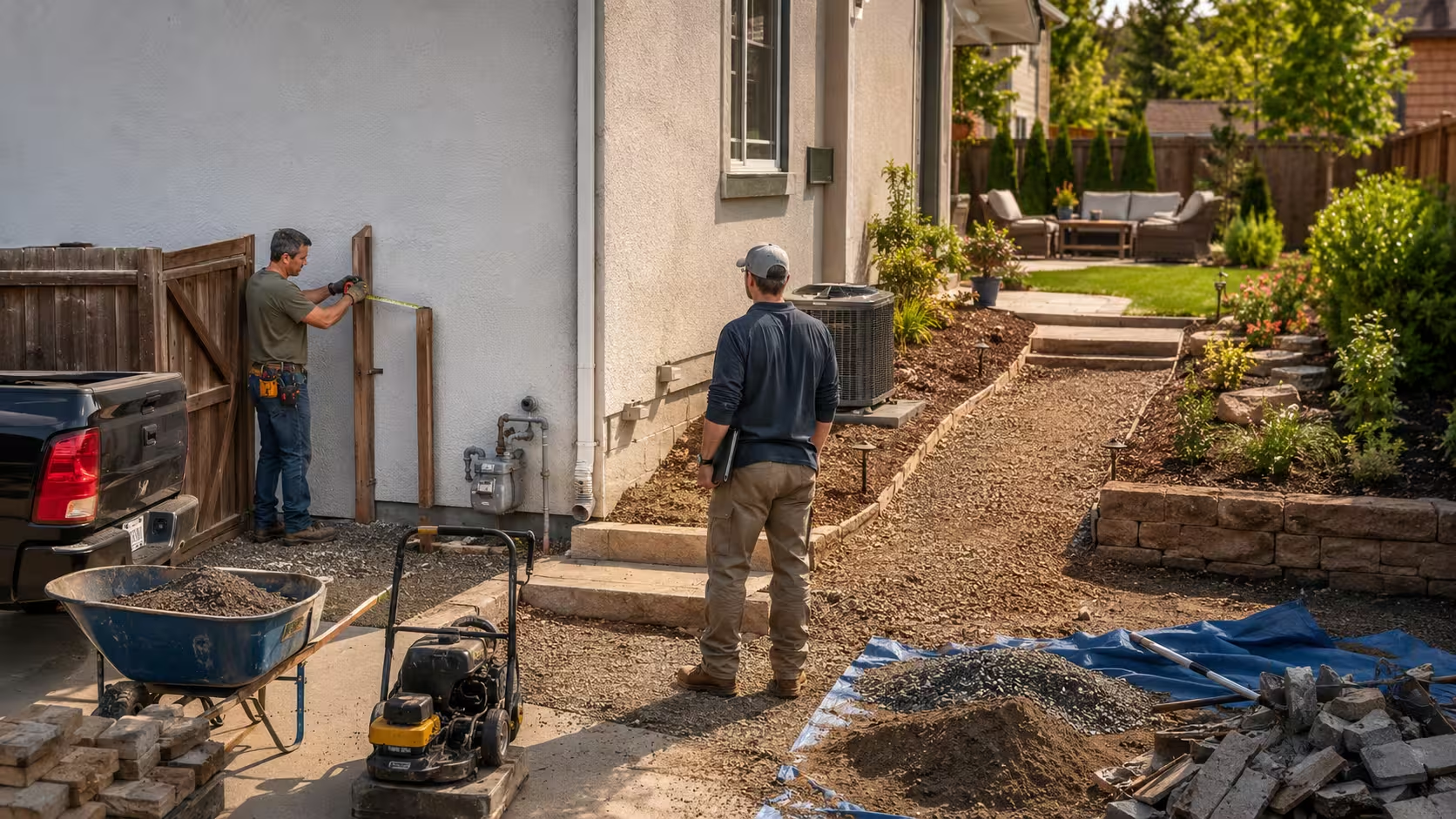
The cheaper house has a 48-inch side gate and a driveway that runs clear to the back fence. A mini skid-steer drives in, drops base rock where it’s needed, drives out. The other house has a 32-inch gate, a step down, and a gas meter in the way. Every pound of gravel, every paver, every scoop of excavated soil moves by wheelbarrow — one load at a time, through a gap barely wider than a person.
That’s a five-day job becoming a nine-day job. And since labor is where the money lives in this trade, the quote moves with it.
Landscaping cost in 2026 runs roughly $4.50 to $12 per square foot for most work, climbing toward $40 per square foot on a full tear-out and rebuild. But those numbers won’t tell you what your yard costs. Crews don’t price square footage. They price hours. And hours come from access.
Landscaping cost in 2026: the honest ranges
Here’s where the market sits before we get into why your number lands somewhere surprising inside it.
| Scope | Typical 2026 range |
|---|---|
| Small refresh (beds, mulch, a few shrubs) | $800 – $3,500 |
| Front yard makeover | $1,500 – $5,000 |
| Softscape install (lawn, plants, beds) | $4 – $8 per sq ft |
| Balanced softscape + one hardscape feature | $8 – $12 per sq ft |
| Hardscape-heavy work (patio, wall, walkway) | $15 – $30+ per sq ft |
| Full backyard renovation | $15,000 – $50,000 |
| Landscape crew labor | $50 – $120 per hour |
Angi’s cost data puts general landscaping between $4.50 and $12 per square foot, with major remodels reaching $40 per square foot. That top figure isn’t a typo. It’s what happens when demolition, disposal, and structural hardscape stack on top of each other.
Now the uncomfortable part.
Pull up five cost guides for this exact search and you’ll find “averages” of $3,647, $5,184, $8,500, and “$5,000 to $50,000.” None of them are lying. They’re averaging different transactions. A $600 mulch refresh and a $48,000 outdoor living build both count as “landscaping” in the same data set.
Which makes a national average close to useless for budgeting. So the rest of this guide builds your number from the bottom up instead.
Want a quick starting band first? Our landscaping cost calculator takes your yard size and project type and gives you a range in about a minute. Then come back here for the part that explains the spread.
Why square footage is the wrong unit
Ask a landscaper how they built your quote. Almost none will say “I multiplied your area by a rate.”
That’s consumer-facing shorthand. Internally the math runs the other way.
The crew estimates man-hours. Multiplies by a burdened hourly rate. Adds materials with markup, equipment, disposal, and a contingency. The per-square-foot figure is what falls out at the end — an output, not an input.
Why this matters comes down to a single number: labor is the biggest line in a landscaping job, running around 80% of total project cost according to HomeGuide’s contractor estimate data.
Materials are the visible part. Labor is the bill.
So if 80% of your cost is hours, and hours are set by how hard your site is to work in, then anything slowing a crew down is a price multiplier. Square footage barely registers by comparison.
What’s actually inside a “burdened hour”
When you see $85 an hour on a quote, that’s not somebody’s wage. Not close.
The Bureau of Labor Statistics recorded a mean hourly wage of $19.13 for landscaping and groundskeeping workers in its May 2023 survey, across roughly 930,000 workers nationally. Median sat at $17.96. Crew leaders and supervisors run higher.
Between that wage and the rate on your quote sits everything that makes a landscaping company a company:
- Payroll taxes and workers’ compensation — not cheap in an outdoor trade with heavy equipment exposure
- Vehicle, trailer, fuel, and equipment depreciation
- Drive time between jobs, which is paid but not billable
- Insurance, licensing, uniforms, software, an estimator’s salary
- Winter, when payroll continues and revenue doesn’t
- Profit margin, typically targeted around 15–20%
Industry pricing benchmarks put most landscape companies running both installs and maintenance at $75 to $100 per man-hour in 2026, with lean operators around $65–$75 and high-end design-build firms reaching $100–$145.
The practical takeaway for you: the burdened rate isn’t negotiable. It’s not padding. What you can influence is how many hours your yard demands — and that’s the bigger lever anyway.
The material markup nobody explains
Second thing worth knowing before you look at another quote.
Landscapers don’t sell plants at nursery price. HomeGuide’s data puts typical markup on sod, plants, and shrubbery at roughly 115% over the landscaper’s cost. A shrub the crew buys wholesale for $18 shows up on your estimate near $39.
Most homeowners learn this and think: fine, I’ll buy the plants myself.
Hold on. That markup is doing three jobs. It covers sourcing time and nursery runs. It covers losses on plants that don’t take. And it funds the plant warranty — most established firms guarantee installed material for a year, and that guarantee disappears the moment you supply your own stock.
If a $400 tree dies in month four, the crew that installed their tree replaces it. The crew that installed your tree does not.
Supplying your own material makes sense on bulk commodities with no survival risk — mulch, gravel, base rock, edging. It rarely makes sense on anything alive.
The 15-Minute Yard Access Audit
This is the part no cost guide gives you. It’s also the part that will actually predict your quote.
Before you call anyone, walk your property with a tape measure and write down four numbers. A crew leader is scoring these in his head during the first ninety seconds of a site visit. You may as well know your score before he does.
1. Gate and side-yard clearance
Measure the narrowest point on the path from street or driveway to your work zone.
Not the gate at its widest — the tightest pinch. Include every obstruction: gas meter, downspout, AC condenser, low branch, a step.
The threshold that matters sits around 36 inches. Compact track loaders and mini skid-steers, the workhorses of residential landscaping, generally need somewhere in the 34–48 inch range depending on model. Under 36 inches, most crews plan to hand-haul.
That’s not a small penalty. A machine moves a cubic yard of material in about a minute. A wheelbarrow needs eight or ten trips for the same yard.
2. Haul distance
Pace out the distance from where a truck can realistically park to the center of the work area.
Under 40 feet is easy. Over 100 feet with turns and you’re adding real hours to every delivery in and every load of debris out.
3. Slope and elevation change
Count the steps. Note whether the work area sits uphill or downhill from the staging point.
Uphill wheelbarrow runs are brutal and slow. Grades past roughly 15% start pulling in retaining, terracing, or erosion control that may not have been in your plan at all.
4. Disposal volume
What has to leave?
Old concrete, stripped sod, excavated soil, stumps, dead shrubs, a rotted deck. Disposal is the line item homeowners forget completely, and it carries both dump fees and the labor to load.
Excavation is the sneaky one. A 300 sq ft patio dug to a proper 8-inch base generates roughly 7 to 8 cubic yards of spoil. That’s two to three truckloads of dirt — moved by hand if a machine can’t reach.
Score your yard
| Access level | What it looks like | Effect on labor hours |
|---|---|---|
| Easy | 48″+ clear path, machine reaches the work zone, under 40 ft haul, flat, minimal disposal | Baseline |
| Moderate | 36–48″ pinch point, 40–100 ft haul, mild slope, one truckload out | roughly +20% to +40% |
| Hard | Under 36″, hand-haul only, 100 ft+, stairs or steep grade, heavy demo out | roughly +50% to +90% |
| Severe | No side access at all, through-the-house or conveyor required, retaining territory | Often doubles, sometimes reprices the project entirely |
Run the math and it stops being abstract.
A job estimated at 120 man-hours at $85 is $10,200 in labor. Push it to hard access at +60% and you’re at 192 hours — $16,320.
Same patio. Same pavers. Same square footage. Six thousand dollars of difference, generated by a gate.
These multipliers are a planning framework built from the labor-share and man-hour figures above, not a published statistic. Treat them as a way to anticipate your bids, not a formula to hold a contractor to.
What crews charge, by specialization
Not all landscaping labor bills the same. Knowing which trade your project actually needs stops you from over-hiring or under-hiring.
| Role | 2026 hourly range | When you need them |
|---|---|---|
| General landscape crew | $50 – $65 | Planting, mulch, sod, cleanup, basic grading |
| Hardscape installation | $50 – $120 | Patios, walls, walkways, steps, fire features |
| Landscape designer | $50 – $150 | Plans, plant selection, layout — no engineering stamp |
| Landscape architect | $70 – $250 | Structural work, drainage engineering, permit-level plans |
| Certified arborist | $100 – $250 | Tree health, hazard assessment, technical removals |
Those bands come from an industry analysis of US landscaping pricing covering labor rates by specialization, and they hold up across most regional markets.
The practical version: hiring an architect to lay out a flower bed is money burned. Hiring a general crew to build a five-foot retaining wall is a structural problem waiting to happen. Match the trade to the work.
Design fees deserve a note of their own. Standalone residential design commonly runs $2,000 to $8,000, or 10–20% of construction value on a design-build contract. Many firms credit that fee back if you build with them. Ask in writing before you pay it.
Cost by project type
Once you know your access score, apply it to real unit rates. These are 2026 installed prices before your access multiplier.
| Work | Installed cost | Unit |
|---|---|---|
| Grass seeding | $0.04 – $0.18 | per sq ft |
| Sod installation | $1.00 – $2.60 | per sq ft |
| Mulch, delivered | $15 – $65 | per cubic yard |
| Shrubs, installed | $25 – $300 | each |
| Trees, installed | $200 – $2,000+ | each |
| Paver patio (rectangular) | $15 – $20 | per sq ft |
| Stamped concrete | typically $12 – $20 | per sq ft |
| Natural stone patio | typically $25 – $50 | per sq ft |
| Segmental retaining wall | $20 – $35 | per sq ft of face |
| Natural stone wall | $35 – $60 | per sq ft of face |
| Irrigation system | commonly $2,500 – $8,000 | per system |
| Landscape lighting | commonly $200 – $500 | per fixture |
| Yard cleanup | $200 – $800 | per visit |
Spreading is separate from delivery on mulch — budget crew hours on top of the per-yard price. One cubic yard covers roughly 110 to 120 square feet at three inches deep, a conversion that saves most people from over-ordering by half.
Two boundaries worth drawing.
Recurring maintenance is a different purchase from installation. Mowing plans, fertilization schedules, and seasonal service price per visit and per season, not per square foot — we break that pricing model down separately in our lawn care cost guide.
Tree work is its own trade. If your project starts with clearing an existing tree, that’s arborist work priced on height, trunk diameter, and drop zone rather than yard area, and the numbers live in our tree removal cost breakdown.
Front yard vs backyard: the gap isn’t taste
Front yard makeovers average $1,500 to $5,000. Full backyard renovations average $15,000 to $50,000.
Every cost guide reports that gap. Most explain it by saying backyards get more features.
Partly true — backyards do collect patios, kitchens, fire pits. But there’s a mechanical reason underneath.
Front yards have perfect access. Truck parks at the curb. Work is fifteen feet away. Material goes straight from tailgate to bed, debris goes straight back. No gate, no pinch point, no hand-hauling.
Backyards are the opposite by definition. Every backyard job pays an access tax before a single plant goes in the ground.
Useful corollary: if your budget is tight and you want visible impact, front yard dollars stretch further. Not because the plants are cheaper. Because the labor is.
What else moves your number
Region — and here the data is unusually clear. BLS state figures show landscaping workers averaging $23.44 an hour in Massachusetts against $17.13 in Texas. By metro, the San Francisco Bay Area runs $24.95 while Houston sits at $16.91. That’s a 46% spread in base wage alone, before the overhead multiplier stacks on top. Same crew size, same job, very different bill.
Season. Prices peak May through July when every crew is booked and nobody needs your job. They soften November through February. Off-season booking commonly saves 8–15%, and you get better attention because the crew isn’t racing between four sites a day.
Complexity, which is not size. A rectangular paver patio runs $15–$20 per square foot. Take the identical square footage, add a curved edge, two stepped elevations, mixed border material, and a built-in bench, and you’re looking at $35–$45. Curves and elevation changes force cutting. Cutting is hours.
Bundling. Mobilization — getting crew, truck, and equipment to your property and set up — is a real cost absorbed into every job. Three separate small projects across three visits means paying it three times. Batching into one mobilization is one of the few genuine savings available to a homeowner.
Sequencing. If landscaping is one piece of a bigger renovation, put it last. Nothing is more expensive than a finished patio that a roofing crew has to drive equipment across. Our home renovation cost calculator helps sanity-check how the outdoor budget fits against everything else.
Reading a landscaping quote, line by line
Three estimates in front of you. Here’s how to actually compare them.
Mobilization or setup. Sometimes explicit, usually buried in labor. If one bid shows it and another doesn’t, the second isn’t cheaper. It’s hidden.
Labor — hours or lump sum? Ask for the man-hour estimate even on a flat-rate quote. Two bids at $12,000, one assuming 110 hours and the other 160, tell you something important about who has thought the job through. The low-hour bid is either more efficient or about to hit you with a change order.
Materials with quantities. “Plants — $3,200” isn’t a line item, it’s a placeholder. You want species, sizes, counts. Without them you can’t compare bids or hold anyone to spec.
Equipment. Machine day rates, machine delivery, operator time. If a bid assumes machine access and your gate is 32 inches, that bid is wrong and will be revised upward mid-project.
Disposal. Dump fees plus loading labor, on its own line. If it’s missing, ask where it went.
Contingency. Well-run firms commonly carry 8–12% on installs, higher on excavation or drainage where the ground can surprise everyone. A bid with zero contingency isn’t generous. It’s optimistic.
Deposit. Industry norm is 10–30% at signing with progress payments tied to milestones. Over 50% up front, or full payment before work starts, is worth walking away from.
Warranty. Plant material is typically one year, hardscape workmanship typically two to five. Get both in writing, along with what voids them.
Negotiable: material grade, phasing across seasons, supplying bulk commodities yourself, off-season scheduling, scope.
Not negotiable: the burdened labor rate, disposal fees, permits, and the contingency on excavation work.
Frequently asked questions
How much does landscaping cost per square foot in 2026? Most residential work runs $4.50 to $12 per square foot, with full tear-outs and major remodels reaching $40. Planting and lawn work sits at the low end. Hardscape-heavy projects run $15 to $30 and up. Where you land depends more on site access and complexity than on the size of the area.
Why did two landscapers quote such different prices for the same yard? Usually because they estimated different numbers of labor hours, and labor is around 80% of the bill. One may have assumed machine access where the other planned to hand-haul. One may have included disposal where the other left it out. Ask both for their man-hour estimate and the gap normally explains itself in thirty seconds.
Is landscaping cheaper in winter? In most of the country, yes. Off-season booking typically saves 8–15% because crews have open schedules. Planting itself is season-dependent, but design, hardscape, and contract signing are not. Booking in January for an April install is a common and sensible play.
How much should I budget as a share of my home’s value? The widely repeated real estate guideline is 5–15% of home value for a complete landscape. Treat that as a ceiling for full design-build, not a target. Most homeowners improving zone by zone spend far less and still capture most of the curb appeal benefit.
Do landscapers mark up plants and materials? Yes — roughly 115% over their cost on sod, plants, and shrubs is typical. That markup funds sourcing, replacement of losses, and the plant warranty. Standard trade practice, not a scam.
Can I supply my own materials to save money? On bulk commodities like mulch, gravel, and base rock, often yes. On plants, usually not worth it — you forfeit the warranty and take the survival risk yourself. Check first, because some contractors won’t install owner-supplied material at all, and those that do will exclude it from any guarantee.
What’s a normal deposit? 10% to 30% at signing, balance tied to progress milestones. Large custom material orders sometimes justify more. Full payment before work begins is not a normal term.
Before you call for quotes
Five things, and you’ll be ahead of most people hiring this trade.
- Run the access audit. Narrowest pinch point, haul distance, slope, disposal volume. Four numbers, fifteen minutes, one tape measure.
- Define zones, not the whole yard. Price the 400 square feet you’re actually changing. Nobody landscapes an entire lot at once, and pricing as though you will produces a scary, useless number.
- Tell every bidder your access constraints up front. Identical assumptions produce comparable bids — and it flushes out anyone who wasn’t going to check.
- Ask for man-hours on every quote. Fastest way to see who has actually thought it through.
- Get three bids and ignore both extremes. The lowest one usually finds its money later, through change orders.
Access is the number that moves your quote most. It’s also the only one you can measure yourself, this afternoon, with a tape measure.
Sources
- U.S. Bureau of Labor Statistics — Occupational Employment and Wages, Landscaping and Groundskeeping Workers, May 2023 (SOC 37-3011)
- HomeGuide — labor as roughly 80% of landscaping project cost, and 115% material markup
- SynkedUp — 2026 landscape contractor man-hour rate benchmarks
- Techo-Bloc — US landscaping cost report, hourly labor rates by specialization
- Angi — landscaping cost of $4.50 to $12 per square foot, up to $40 for major remodels

Baldeep builds and researches content sites full time. For ReadLikePro he
compiles home service pricing from contractor quotes, industry cost surveys,
and public data, then checks the numbers against more than one source before
publishing. He isn’t a licensed contractor, so every estimate here is a
research-backed range, not a quote for your specific job.