
Roof Replacement Cost in 2026: Prices by Material, Size, and Why Every Estimate You’ve Seen Disagrees

Roof replacement cost in 2026 runs $5,900 to $46,000, and most US homeowners land between $9,000 and $17,000 for architectural asphalt shingles on an average home. Per square foot of roof area, budget $4 to $11 for common materials and $12 to $28 for slate.
That’s the honest spread. Now the part nobody explains.
Search this topic and you’ll hit three different national averages: Angi says $9,607, HomeAdvisor says $9,528, and the Cost vs. Value Report says $31,871. Same country. Same year. Same material. A homeowner reads two of those pages and stops trusting all of them.
None are wrong. They’re describing completely different roofs, and until you know which one matches your house, no table on the internet helps you. So that’s where this guide starts.
How We Researched This Guide
Every figure below traces to a published dataset, a federal price index, or an industry shipment report. Nothing here is estimated from memory.
- Homeowner cost datasets — Angi, NerdWallet, HomeAdvisor, and This Old House’s 2026 survey of 1,000 homeowners
- Shipment and demand data — Asphalt Roofing Manufacturers Association Q1 2026 report, reported by Roofing Contractor
- Construction input prices — Associated Builders and Contractors’ analysis of BLS producer price index data
- Manufacturer price letters — archived publicly by Mueller Roofing Distributors
- Insurance settlement guidance — United Policyholders, a consumer nonprofit, plus Bankrate’s roof coverage explainer
- Claims frequency — Insurance Information Institute
Where sources disagree, we say so instead of picking whichever number sounds best.
How Much Does It Cost to Replace a Roof in 2026?
Short answer: $9,000 to $17,000 for a typical asphalt shingle roof, or $4 to $11 per square foot of roof area. Premium materials push the ceiling past $50,000.
| Roof size (roof area) | Asphalt shingle range | All materials range |
|---|---|---|
| Under 1,500 sq ft | $6,000 – $12,000 | $6,000 – $30,000 |
| 1,500 – 2,000 sq ft | $9,000 – $16,000 | $9,000 – $42,000 |
| 2,000 – 2,500 sq ft | $11,000 – $20,000 | $11,000 – $55,000 |
| 2,500 – 3,000 sq ft | $14,000 – $24,000 | $14,000 – $70,000 |
| Over 3,000 sq ft | $17,000 – $30,000+ | $17,000 – $85,000+ |
Fix one thing before using that table: roof area is not house square footage. HomeAdvisor puts a typical roof at 1.1 to 1.2 times the home’s footprint, and steeper pitches widen the gap further. Most 2,000 sq ft houses wear a 2,400–2,600 sq ft roof. Miss this and every calculation you run is off by a fifth before you begin.
Want a number matched to your pitch and material instead of a range? Our roof cost calculator does the area conversion and complexity weighting for you. No email, no sales call.
Why Does Every Site Report a Different Average Roof Cost?
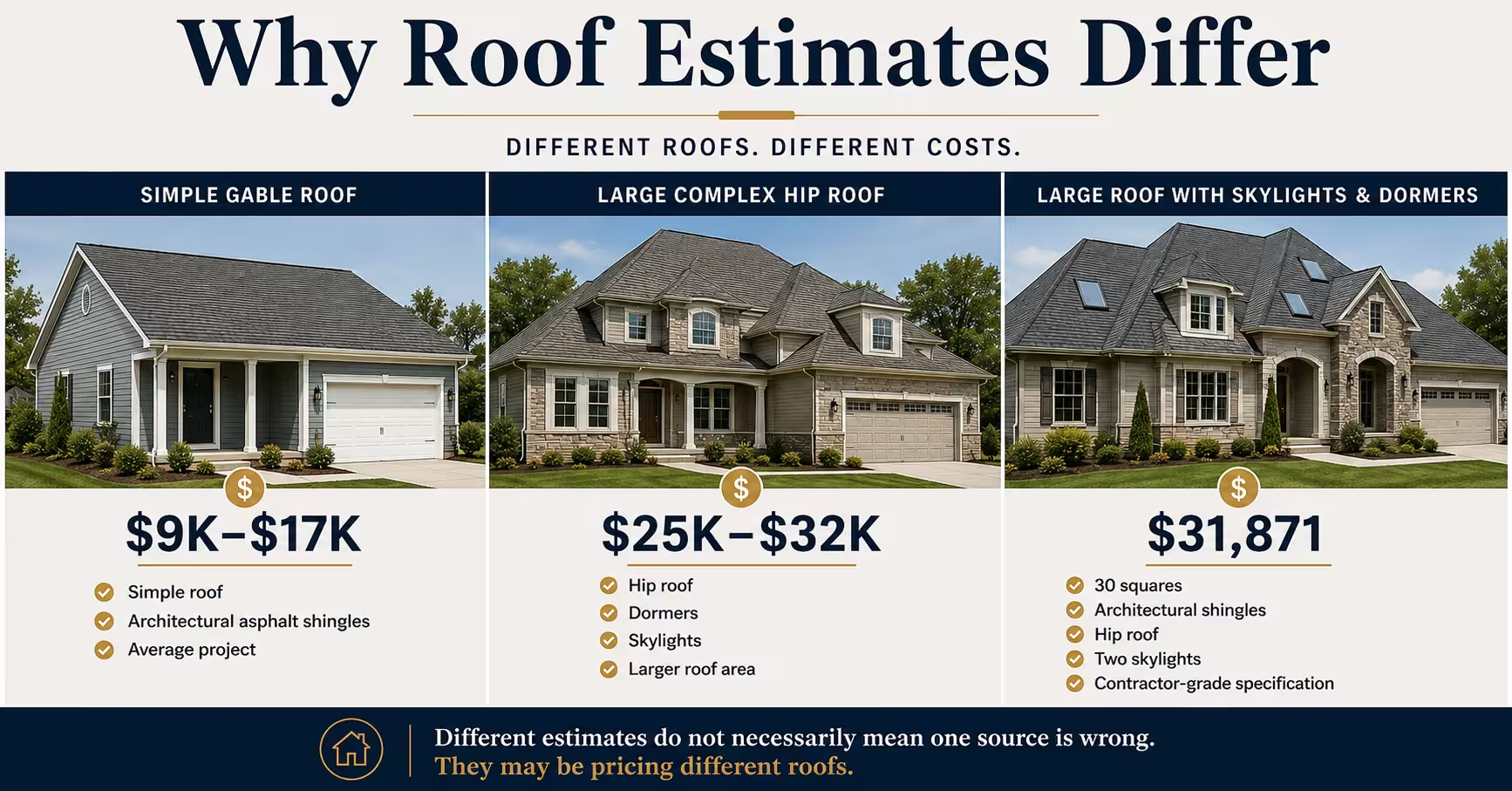
Because they’re pricing different roofs. The gap between $9,607 and $31,871 comes down to size and complexity, not disagreement.
Angi surveys its own customer base and reports $9,607, with a full range of $5,902 to $46,000. HomeAdvisor lands at $9,528 with a normal range of $5,869 to $13,220. Those two agree closely, and both describe the median American roofing job across all house sizes.
The Cost vs. Value Report reports $31,871. Bill Ragan Roofing, one of the few contractor sites that publishes the spec behind that figure, lists it as 30 squares of architectural shingles on a rectangular hip roof, with synthetic underlayment, galvanized drip edge, aluminum flashing, and two skylights.
Sit with that spec for a second. Thirty squares means 3,000 square feet of roof. Hip roofs carry four sloping planes instead of two, which multiplies cut waste and labor hours. Two skylights mean two flashing details that have to be done right. The number isn’t inflated. It describes a large, complex roof at a contractor-grade spec.
So which one is yours?
- Ranch house, simple gable, 1,600 sq ft of roof, architectural shingles → Angi and HomeAdvisor territory, roughly $9,000–$16,000
- Two-story colonial, hip roof, dormers, skylights, 2,800+ sq ft → much closer to the $25,000–$32,000 Cost vs. Value world
Both averages are real. They just belong to different houses.
Labor explains a second slice of the scatter. NerdWallet puts roofing labor at $40 to $90 per hour and notes it exceeds half of a typical bill. In This Old House’s 2026 survey, labor was the largest cost factor for 65% of respondents. Bay Area crews and rural Alabama crews install identical shingles at wildly different rates, and a national average erases that difference entirely.
Roof Replacement Cost by Material
Material is the biggest lever under your control. Figures below are installed costs — product, labor, and tear-off — not supply-house pricing.
| Material | Per sq ft installed | 2,000 sq ft roof | Lifespan |
|---|---|---|---|
| 3-tab asphalt shingles | $4 – $6 | $8,000 – $12,000 | 15 – 20 yrs |
| Architectural asphalt shingles | $6 – $9 | $12,000 – $18,000 | 25 – 30 yrs |
| Wood shake / cedar | $8 – $14 | $16,000 – $28,000 | 25 – 40 yrs |
| Metal (standing seam / panels) | $8 – $16 | $16,000 – $32,000 | 40 – 70 yrs |
| Clay or concrete tile | $10 – $18 | $20,000 – $36,000 | 50+ yrs |
| Slate | $12 – $28 | $24,000 – $56,000 | 75 – 100+ yrs |
NerdWallet’s shingle-level data runs wider at the premium end, listing metal at $10 to $35 and slate at $12 to $30 per square foot. That reflects specialty profiles and copper accessories more than typical residential work.
Asphalt shingles: still the default
Asphalt covers the large majority of American homes, and the split between its two tiers matters more than most homeowners expect.
3-tab is a flat single-layer shingle. Cheapest legal watertight roof you can buy. Right call if you’re selling within two years or it’s a rental. Wind ratings run lower and lifespan is shorter.
Architectural — also called dimensional or laminate — is what most crews install now. That extra $2 to $3 per square foot buys a heavier product, better wind performance, and roughly a decade of extra life.
Run it annually and architectural usually wins. An $18,000 architectural roof across 27 years works out to $667 a year. A $10,000 3-tab roof across 18 years is $556 a year, which looks cheaper until you count the second tear-off, second permit, and second week of disruption you’re buying inside that same window.
Class 4 impact-resistant shingles deserve attention in hail country. They cost more upfront, but many carriers discount premiums 15–30% for them. If you’re in Texas, Colorado, Oklahoma, or Kansas, get that discount figure from your insurer before choosing a shingle. The upgrade sometimes pays for itself.
Metal: the price gap narrowed, then reopened
Metal was long described as two to three times the price of shingles. That gap had been closing. Then 2026 pushed it back open.
Per the ABC analysis of BLS data, aluminum mill shapes rose 34.1% year over year through March 2026, steel mill products climbed 15.4%, and copper and brass mill shapes gained 21.3%. Comparing a standing seam quote from late 2025 against one issued now, the difference is real and it isn’t padding.
Tile and slate: check the structure first
Concrete tile weighs roughly three times what asphalt does. Slate can weigh more. Switching from shingles to either one frequently requires a structural engineer’s sign-off plus framing reinforcement — a separate line item that almost never appears in a headline cost. Budget for the inspection before you commit to the look.
What Changed in 2026 (And Why Your Neighbor Paid Less)
Most cost guides skip this entirely. If a 2024 quote is sitting in your inbox, it’s stale.
Two rounds of manufacturer increases landed in one year. Distributor letters archived by Mueller Roofing Distributors document GAF announcing 6–9% on shingles and accessories effective June 1, 2026. Owens Corning matched at 6–9% on the same date. CertainTeed went up to 10%, TAMKO up to 9%, and Atlas 5–8% effective mid-May. All of that landed on top of a 4–8% round across the same manufacturers earlier in spring. The increases stack. They don’t replace each other.
Input costs surged alongside. ABC chief economist Anirban Basu noted construction materials prices rose 4.8% year over year in March 2026, the steepest annual increase since January 2023, driven substantially by an oil price spike. Diesel jumped 37.8% month over month, which the Associated General Contractors called the largest one-month rise since 1990. Fuel touches roofing twice over: shingle manufacturing is petroleum-based, and every square gets trucked to your driveway.
Now the part that works in your favor. Demand fell while prices climbed. ARMA data shows US asphalt shingle shipments dropped 9.9% in Q1 2026 to 38.1 million squares, down from 42.3 million a year earlier. Built-up roofing fell 16.7%. Modified bitumen fell 13.8%.
Softer demand means crews have gaps in their calendars. That’s leverage, and it runs directly opposite to the “prices are rising, book now” urgency you’ll hear from sales reps. Contractors with an open week in October negotiate very differently from one booked solid through spring.
Hidden Costs: What Turns a $12,000 Quote Into a $16,000 Bill
This Old House’s 2026 survey found nearly 24% of homeowners paid for costs they hadn’t budgeted. These are the usual suspects.
| Add-on | Typical cost | When it applies |
|---|---|---|
| Tear-off and disposal | $1 – $2 per sq ft | Almost always; more per extra layer |
| Decking replacement | $2 – $5 material + $5 – $10 labor per sq ft | Discovered after tear-off |
| Permit | $150 – $1,200 | Varies enormously by city |
| Attic ventilation upgrade | $300 – $1,500 | Often required to keep the warranty valid |
| Flashing and drip edge | $300 – $1,500 | Should never be reused |
| Chimney or skylight re-flash | $300 – $2,000 each | Any roof penetration |
| Gutter replacement | $1,000 – $3,500 | Cheaper bundled with the roof |
| Steep pitch surcharge | +10% – 30% labor | Above roughly 8/12 |
| Second layer removal | +$1,000 – $2,500 | Common on 1990s and older homes |
Decking is the one that blindsides people. Nobody knows what’s under your shingles until they come off. Good contractors write the decking allowance into the contract at a per-sheet price — something like “$85 per 4×8 sheet, homeowner approves quantity before installation.” One who leaves it vague has left room for a change order you can’t argue with.
Watch for scope quietly stripped out of low bids. When one quote comes in dramatically under the others, the missing pieces are usually tear-off, new flashing, drip edge, or ice-and-water shield at the eaves. Ask every bidder to itemize those four. Comparing totals without comparing scope is how homeowners end up with a cheap roof leaking at the valleys in year three.
Should You Repair or Replace Your Roof?
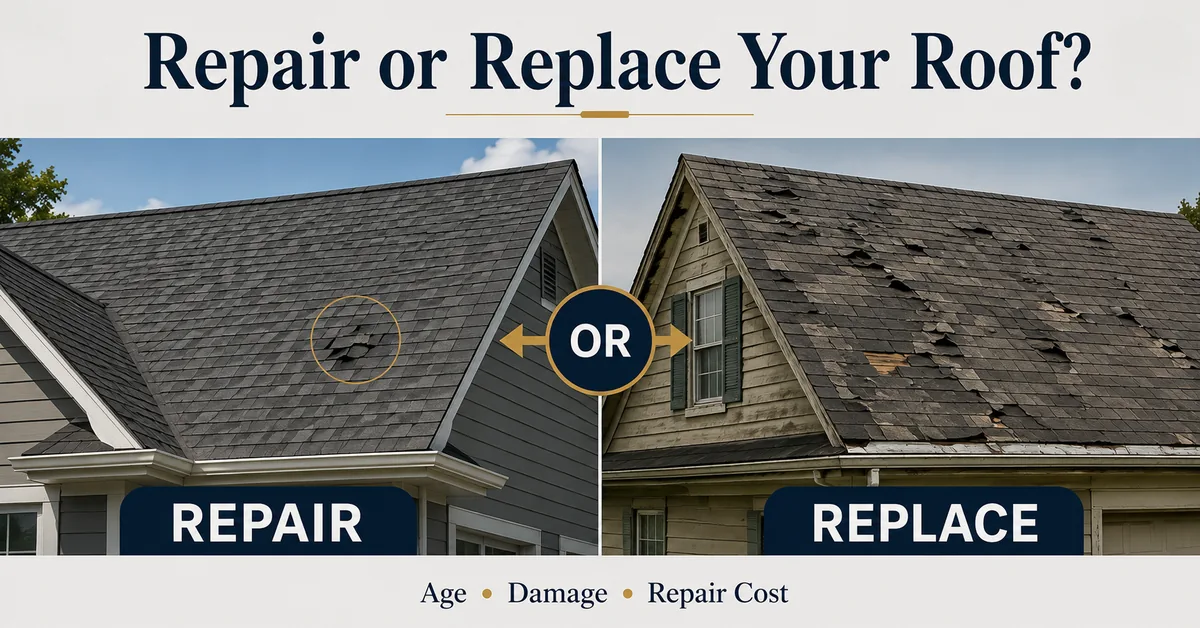
Use this threshold: when a repair quote reaches roughly 30% of replacement cost and your roof is past two-thirds of its rated lifespan, replacing usually wins. Below that line, repair.
You’re genuinely in replacement territory when:
- Leaks appear in multiple unrelated spots, not one recurring location
- The same area has already been patched twice
- Granule loss, curling, or cracking spans whole slopes instead of one section
- Decking damage extends well beyond the immediate leak
- Your shingle profile is discontinued and the roof is at its rated age
Staring at a water stain and trying to work out which side of that line you’re on? Our roof leak repair cost guide prices repairs by leak type, which tells you far more than any national average. If water is coming through right now, the emergency roof leak repair guide covers your first two hours before a contractor arrives.
One caution. Any full replacement recommended after a five-minute visual, with no photos and no attic access, is a red flag. Ask for documented damage before agreeing to anything.
Does Insurance Cover Roof Replacement? The Age Trap Explained
This belongs in a cost guide, because for many homeowners it’s the single largest number in the whole project.
Policies settle roof claims one of two ways.
Replacement Cost Value (RCV) pays what a new roof costs today, minus your deductible. Age isn’t subtracted.
Actual Cash Value (ACV) pays what your roof was worth the moment before damage, after depreciation. Older roof, smaller check.
United Policyholders illustrates the gap plainly: on a $20,000 roof that’s 10 years old, with a $1,000 deductible and depreciation of $1,000 a year, ACV leaves you paying $11,000 out of pocket. RCV leaves you paying $1,000. Same storm, same damage, same roof.
What’s changed recently: carriers across hail-exposed states have been shifting roof coverage to ACV at renewal once a roof hits a set age, commonly 15 years, sometimes as early as 10. Bankrate notes that RCV costs more and may simply not be offered on older roofs. The switch usually arrives as an endorsement buried in renewal paperwork, which is why most people discover it at claim time instead of renewal time.
Three things worth doing this week whether or not you’re replacing anything:
- Pull your declarations page and search for “actual cash value” and “roof surfacing.” Both present means you have an ACV endorsement.
- Check your deductible structure. Wind and hail deductibles are frequently percentage-based. On a $400,000 home, a 2% deductible comes to is $8,000 before depreciation even enters the picture.
- Record your roof’s install date somewhere findable. Can’t document age, and some carriers assign a default depreciation that won’t favor you.
For scale, the Insurance Information Institute’s homeowners claims data shows wind and hail is the most frequent property damage claim category by a wide margin.
To be direct about what insurance won’t do: policies cover sudden covered events. A roof that wore out from age isn’t a claim, no matter how rough it looks.
Does a New Roof Pay for Itself?
Partly, and less than roofing marketing implies. The Cost vs. Value Report puts asphalt shingle replacement at roughly 68% of cost recouped at resale, adding about $21,501 in resale value against a national average job cost of $31,871. Metal recoups closer to 50%.
Read that carefully. At 68% recouped, the project returns the project returns less than it costs. Roofing still outperforms most exterior projects, but “a new roof pays for itself” isn’t what the data says.
The stronger financial case has nothing to do with ROI. Put simply: a failing roof blocks the transaction. Buyers, appraisers, and lenders all treat a roof past its lifespan as a mandatory near-term expense, and it gets priced into offers at full replacement cost, not depreciated value. Replacing on your own schedule also beats replacing during an active leak, when interior repairs stack on top of the roof bill.
Planning to stay long term? Ignore resale percentages and use annual cost. Metal at $24,000 across 50 years is $480 a year. Architectural shingles at $14,000 across 27 years run $519. The premium material is often cheaper per year — assuming you’re genuinely staying that long.
How to Lower Your Roof Replacement Cost Without Cutting Corners
Roughly ordered by how much each one saves.
Get three itemized bids, not three totals. Spreads on identical scope routinely run $3,000 to $6,000. You can’t find that spread without line items.
Book in the off-season. Late fall and winter are slow across most non-snow markets. With Q1 2026 shipments down nearly 10%, contractor calendars are looser than they’ve been in years. Ask directly whether a flexible install date earns a discount.
Skip the top shingle tier. Cost vs. Value data consistently shows standard architectural shingles recoup a higher percentage than designer or luxury lines. That premium doesn’t fully transfer at resale.
Bundle the gutters. Doing gutters during the roof job avoids a second mobilization and a second round of ladder setup.
Ask about Class 4 insurance discounts before picking a shingle in hail states. A 15–30% premium reduction compounds across the roof’s life.
Never sign an Assignment of Benefits. Filing a claim and signing over control of it limits your ability to dispute pricing later.
Verify license, insurance, and manufacturer certification. An uncertified crew can’t register the enhanced warranty, which quietly costs you coverage already baked into the shingle price.
Frequently Asked Questions
How much does a new roof cost for a 2,000 sq ft house? Careful with the framing. A 2,000 sq ft house usually has a 2,400–2,600 sq ft roof. At that roof area, expect $12,000 to $20,000 for architectural asphalt shingles, and $20,000 to $40,000 for metal or tile.
Why do roof estimates vary by thousands for the same house? Usually scope, not dishonesty. One bid includes tear-off, new flashing, drip edge, and ice-and-water shield; another assumes reusing flashing and skips the shield. Ask each contractor to itemize those four and the gap normally explains itself.
How long does a roof replacement take? Most asphalt shingle roofs on an average home are torn off and reinstalled in one to three days. Tile, slate, and complex rooflines take a week or longer. Weather pauses everything, so ask how the crew protects an open roof overnight.
Will homeowners insurance pay for my roof replacement? Only for sudden covered damage — storm, hail, fire, falling trees. Age-related wear isn’t covered. And if your policy carries an ACV endorsement, even a covered claim may pay only depreciated value.
Is it cheaper to install new shingles over the old ones? Upfront, yes, by roughly $1,000 to $2,500 in avoided tear-off. Long term, usually not. An overlay hides decking damage, adds weight, runs hotter, and shortens the new shingles’ life. Most codes cap you at two layers, and that second tear-off costs more than the first.
Will roofing prices drop in 2027? Nothing in current data points that way. Manufacturers raised prices twice during 2026, and tariff-driven increases on steel, aluminum, and copper have historically not reversed. Softer demand may improve your position on labor, but material costs are unlikely to fall back.
What’s the best time of year to replace a roof? Late fall and winter across most markets, when crews are less booked. Asphalt shingles need moderate temperatures to seal properly, so extreme cold matters up north — ask how your contractor handles cold-weather sealing.
How do I know if a roofing quote is fair? Convert it to cost per square foot of roof area and check it against the material table above. Landing well below the range means something’s been removed from scope. Well above, ask which line items drive it.
How many squares is a 2,000 square foot roof? Twenty. Roofers price in squares, where one square equals 100 square feet of roof surface. Contractors quoting “20 squares” is describing 2,000 sq ft of roof, not a 2,000 sq ft house.
The Bottom Line
What you pay comes down to four things, roughly in this order: roof area, material, complexity, and local labor rates. National averages give you a ballpark and nothing more, which is exactly why one year produces both a $9,607 figure and a $31,871 figure without either being wrong.
Three moves before you sign anything. Measure roof area, not floor area. Read your insurance declarations page for the phrase “actual cash value.” Collect three itemized bids and compare the line items, not the totals.
Prices climbed twice during 2026, but shingle demand fell almost 10% in the same window. That combination doesn’t show up often, and at the negotiating table it currently sits on your side rather than the contractor’s.
To run your own numbers by material, pitch, and size, use the roof cost calculator. You’ll get a range to negotiate against instead of a single figure pretending to be precise.

Baldeep builds and researches content sites full time. For ReadLikePro he
compiles home service pricing from contractor quotes, industry cost surveys,
and public data, then checks the numbers against more than one source before
publishing. He isn’t a licensed contractor, so every estimate here is a
research-backed range, not a quote for your specific job.


[…] vs. metal roof cost survey, NerdWallet’s per-square-foot pricing breakdown, and our own roof replacement cost guide, which covers material pricing by roof size in more […]
[…] multiple leaks, widespread staining, or soft decking (a sign of structural rot) — at that point, what a full roof replacement costs is worth knowing, because patching leak after leak on a worn-out roof rarely pencils […]