

Ask three companies what a treatment costs and you’ll get three different numbers, none of which match the price on your first invoice. That’s the frustrating thing about pest control cost it looks random from the outside, but it isn’t. Every quote is built from a handful of factors the technician is weighing before they even walk your property. Once you can see those factors, the number stops feeling like a shakedown and starts making sense. Better yet, you learn which ones you can push on to pay less.
Most cost guides stop at a per-visit range and leave you there. This one goes after the parts that actually cost you money and almost never make the article: the contract cancellation fees the big brands don’t put on the quote (Terminix charges one, Orkin can bill you for the rest of the contract), the exact point where DIY stops saving you money under $20 of bait handles common ants, but termites and multi-room bed bugs never should — and the one nobody mentions, when to buy, because starting a plan in the off-season is cheaper than signing mid-infestation in July.
So this guide breaks down what really drives the price in 2026, where the money hides, and how to pay less. If you just want a number matched to your home right now, run your details through our pest control cost calculator — it gives you a first-year range in about thirty seconds. This page is the “why” behind that number.
Pest control cost at a glance (2026)
Here’s the national spread to sanity-check any quote against. Treat it as a frame, not a promise — your real price moves with everything we cover below.
| Service type | Typical 2026 range |
|---|---|
| One-time general visit | $100 – $600 |
| Initial visit (plan start) | $150 – $300 |
| Monthly plan (per month) | $40 – $75 |
| Quarterly plan (per visit) | $100 – $300 |
| Annual contract (per year) | $300 – $900 |
Most general treatments — ants, spiders, roaches, the usual suspects — land around $150 to $300 for a single visit. HomeGuide’s 2026 pricing data puts the one-time range as wide as $100 to $600 once you factor in home size and severity. Specialty work is a different tier entirely: termites and bed bugs run into four figures because they need real inspection, targeted chemistry, and follow-ups baked in.
The four things that actually set your price
Almost every dollar of variance comes down to four levers. Nail these and you can predict a quote before the inspector opens their mouth.
1. Pest type
This is the big one, by a wide margin. General pest control sits at the bottom of the range. Move up to carpenter ants, roaches, or rodents and the price climbs because the job needs targeting, not just a perimeter spray. Termites and bed bugs sit at the very top — specialized equipment, longer visits, repeat verification.
The gap is enormous. A general ant visit might be $200. A whole-home bed bug heat treatment can top $5,000. Same house, same company — the pest decides almost everything.
2. Severity
A few ant trails in the kitchen is one visit. A colony living inside a wall cavity means drilling, injection, and repeat treatments. After pest type, severity moves the number more than anything else, and it’s the one technicians assess differently from each other — which is exactly why two honest companies can quote the same house $200 apart.
Severe cases can run wild. HomeAdvisor reports that a serious roach infestation needing fumigation can reach $7,500 — many times a routine visit. The lesson: catch it early. A problem you treat in week one costs a fraction of the same problem in month six.
3. Home size and layout
Technicians price by the area they treat and the perimeter they walk. Homes over 3,000 square feet typically add about 25% to a quoted rate. Foundation type matters too — a house on a slab is quicker to treat than one with a crawl space or basement, where there’s more hidden surface to cover.
4. Service format
One-time, quarterly, monthly, or a prepaid annual contract. Today’s Homeowner puts a full annual plan at $300 to $900, but the format you choose changes far more than that headline suggests. This is the lever most people get wrong, and it’s worth its own section.
Why the advertised number isn’t your number
Here’s the trap that catches everyone. A company quotes “$150 a quarter” and it sounds cheaper than the outfit down the road at “$60 a month.” Per visit, sure. But run the math for the full year and the picture often flips.
The reason is the initial visit a heavier first treatment that resets the property before your regular schedule kicks in. It runs $150 to $300, and most advertised prices quietly leave it off. So that “$150 a quarter” plan isn’t $600 a year. It’s roughly a $180 initial visit plus three $150 visits — closer to $630 before tax. Still a fair deal for year-round coverage. Just not the number on the flyer.
That first-year total is the only number worth comparing between companies, and it almost never appears on a quote sheet. Rather than reprint a wall of math here, our cost calculator breaks out the initial visit, the recurring visits, and the year-one total for your exact pest and home size. Get that number first, then compare quotes against it.
Pest control cost by pest type
This is where “average” stops being useful. What you’re fighting sets the price.
| Pest | Typical 2026 cost | Worth knowing |
|---|---|---|
| Ants (general) | $150 – $350 | Often DIY-able; one visit plus follow-up if hired |
| Carpenter ants | $250 – $1,000 | Structural — needs inspection, not just spray |
| Cockroaches | $100 – $600 | Severe cases needing fumigation can hit $7,500 |
| Mice | $150 – $300 | Trapping plus basic sealing |
| Rats | $300 – $600 | Trapping, exclusion, and cleanup |
| Mosquitoes | $80 – $350 per visit | Seasonal — don’t pay for winter visits |
| Fleas | $150 – $400 | Yard treatment often needed on top of indoor |
| Wasps / hornets | $100 – $500 | Priced by nest and location |
| Bed bugs (per room, chemical) | $300 – $500 | Multiple visits almost always required |
| Bed bugs (whole home, heat) | $1,500 – $5,000+ | The high end of residential pest work |
| Termites (barrier or bait) | $700 – $2,500 | Localized spot jobs start around $250 |
| Termite fumigation (tenting) | $2,000 – $8,000 | Whole-home for drywood termites |
| Wildlife (raccoons, bats, etc.) | $300 – $1,500 | Removal is often the cheapest part |
A few of these are worth a closer look, because they’re where budgets blow up and where DIY can save you the most if you catch them early.
Ants are the most over-hired pest on this list. For common household ants, the fix is cheap bait and a tube of caulk, not a subscription. If you’re seeing trails on the counter, the full DIY plan in our guide on getting rid of ants in the house will handle most colonies for under $20. Carpenter ants are the exception those nest in wood and are worth a professional look.
Bed bugs are priced by the room and they’re relentless. Caught early in one room, aggressive DIY treatment can stop them for a couple hundred dollars in equipment. Let them spread and you’re staring down a $1,500–$5,000 whole-home heat treatment. That swing is why it pays to know how to get rid of bed bugs fast the moment you spot one.
Termites are the ones that turn a routine year into a five-figure one. Damage isn’t covered by most homeowners insurance either, which is exactly why annual monitoring plans usually $500 to $1,600 a year — exist. Cheaper than the alternative in a high-risk region.
Region and season: the two factors quotes don’t mention
Two identical houses can pay very different prices depending on where they sit and when you call.
Region. Warm, humid states think the Gulf Coast and the Southeast carry heavier year-round pest pressure, which pushes homes there toward monthly service and higher rates. Dry or cold-climate homes often get by with quarterly or even twice-a-year coverage. Coastal areas add termite and tick pressure on top. Local labor costs stack onto all of it.
Season. Pest work is seasonal, and so is the pricing. Mosquitoes are a spring-through-fall problem — you should never be paying for a winter mosquito visit. Fire ant mounds flare up after heavy spring rain along the Gulf. Rodents push indoors as fall turns cold. If you’re starting a plan and your problem isn’t active yet, the shoulder seasons are the calmest time to get set up and shop rates without pressure.
The practical move: match your service frequency to your actual climate, and refuse to pay for coverage that doesn’t apply to your region or the current season.
The contract trap most guides skip
This is the part that costs people real money, and it rarely makes it into a pricing table. When you sign a recurring plan, you’re often signing a contract — and the exit terms vary wildly.
Cancel a Terminix plan early and you’ll pay a cancellation fee. Cancel an Orkin plan early and, depending on terms, you can be on the hook for the remainder of the contract, which can run one to three years. Some competitors, like Aptive, charge a flat cancellation fee (commonly around $199) on annual plans.
None of that is automatically a dealbreaker — big brands earn their price with trained technicians and re-service guarantees. But you should know the exit cost before you’re locked in. Two questions clear it up before you sign:
- Is this a contract, and how long is it?
- What’s the exact dollar cost to cancel early?
If the answers aren’t clean and in writing, keep shopping. Plenty of reputable local companies offer strong service with no rigid contract at all. And watch the autorenewal many plans roll into a higher second-year rate unless you cancel in a written window. Put the renewal date in your calendar the day you sign.
DIY vs. professional: the real-dollar breakdown
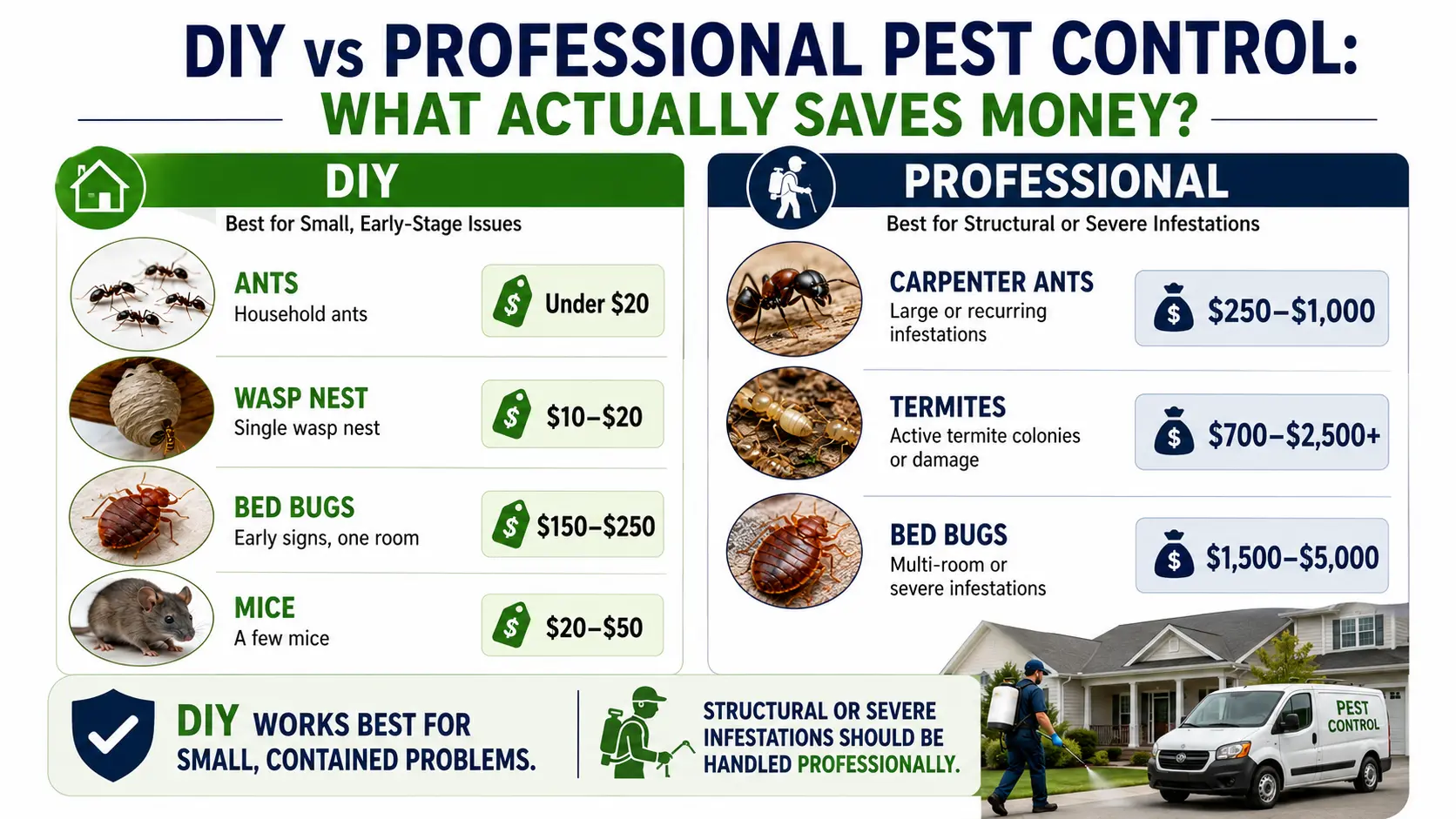
You don’t need a pro for everything, and the savings on the right jobs are large. Here’s roughly what DIY costs versus hiring out for the pests where doing it yourself actually works.
| Job | DIY cost | Professional cost | Verdict |
|---|---|---|---|
| Common household ants | Under $20 (bait + caulk) | $150 – $300 | DIY wins for most trails |
| A single wasp nest | $10 – $20 (spray) | $100 – $500 | DIY if it’s reachable and safe |
| Early bed bugs, one room | $150 – $250 (steamer, encasements, interceptors) | $300 – $900/room | DIY if caught early |
| Mice, a few | $20 – $50 (traps, steel wool) | $150 – $300 | DIY for a light problem |
| Carpenter ants in wall | Not realistic | $250 – $1,000 | Hire it out |
| Termites | Not realistic | $700 – $2,500+ | Always professional |
| Multi-room bed bugs | Not realistic | $1,500 – $5,000 | Always professional |
The pattern is simple. Over-the-counter products treat symptoms — the pests you can see — so they work best on early, contained problems. Anything structural (termites, carpenter ants), anything that reproduces faster than you can treat (roaches or bed bugs at scale), or anything with a safety angle (heights, wildlife that bites, repeated pesticide handling) is worth handing off. A $200 professional job that solves the problem beats six months of $40 DIY attempts that don’t.
How to get an honest quote
The quote process is where you win or lose on price. A few habits keep you out of the traps above:
- Get the year-one total in writing — not per visit, the full twelve-month number including the initial treatment.
- Ask what the re-service policy is. If a pest returns before the next scheduled visit, do they come back free? A clear guarantee beats a slightly lower headline price.
- Line up at least three quotes. Pricing on identical jobs varies enough that shopping around routinely saves $100 or more.
- Confirm what’s covered. General plans usually cover common insects and sometimes rodents, but termites and bed bugs are almost always separate, higher-priced work.
- Read the contract length and cancellation terms first. This is the line item that surprises people.
Frequently asked questions
How can I lower my pest control cost?
Match the plan to your actual situation instead of the salesperson’s pitch. Catch problems early (severity is a huge cost lever), DIY the pests that respond to bait and sealing, refuse seasonal coverage you don’t need, and always get the prepaid-annual price — companies often discount for cash upfront even when they don’t advertise it. Getting three quotes with matched scope does the rest.
Is DIY or professional cheaper for ants and roaches?
For common ants, DIY wins easily — bait and caulk run under $20 versus $150 to $300 for a visit. Roaches are a maybe: a light problem responds to gel bait, but a heavy infestation usually needs a professional, since roaches breed fast and hide deep. The honest rule is that DIY works when the problem is small, new, and in one place.
Does pest control cost more in some regions?
Yes. Warm, humid states carry heavier year-round pressure and higher labor costs, so homes there tend toward monthly service and steeper rates. Dry or cold-climate homes often get by with quarterly or twice-yearly coverage. Coastal areas add termite and tick pressure on top of the base rate.
When is the cheapest time to start pest control?
The shoulder seasons — late fall and early spring — before pest activity peaks. You’ll have the technician’s full attention, less pressure to sign fast, and room to shop rates. Starting mid-infestation in peak summer is when you overpay.
Are quarterly plans worth it over one-time visits?
If you need more than two visits a year, a plan almost always wins — quarterly service breaks the breeding cycle of common pests and the free callbacks between visits are worth more than most people expect. For a single, contained problem, one-time is cheaper. Run both through the calculator to see the year-one gap for your situation.
Why was I quoted far more than the average?
Usually scope or severity. One company may be pricing interior-only while another includes an exterior barrier, an attic application, and two follow-ups. Severity assessments also vary between technicians. Before comparing two numbers, make sure they describe the same job — matched scope usually shrinks the gap a lot.
The short version
Pest control cost isn’t random — it’s built from four levers: the pest, how bad it is, your home’s size and layout, and the service format you pick. You can push on most of them. Catch problems early, DIY the ones that respond to bait and sealing, match your plan to your climate and season, and read the contract before you sign.
For a typical home, budget roughly $150 to $300 for a one-time general visit or $425 to $700 for year one of a quarterly plan — with termites, bed bugs, and serious rodent jobs living in their own, much higher tier. Get three quotes, insist on the full twelve-month number in writing, and run your details through the calculator before the inspector arrives. Do that and you’ll pay a fair rate for a problem that actually gets solved.
Sources
- HomeGuide — Pest Control Prices (2026)
- HomeAdvisor — Cost to Hire a Pest Control Service
- Today’s Homeowner — How Much Does Pest Control Cost?

Baldeep builds and researches content sites full time. For ReadLikePro he
compiles home service pricing from contractor quotes, industry cost surveys,
and public data, then checks the numbers against more than one source before
publishing. He isn’t a licensed contractor, so every estimate here is a
research-backed range, not a quote for your specific job.