

A dirty kitchen that has been ignored for a week takes 40 to 50 minutes to properly clean from scratch. That same kitchen, wiped down for 8 minutes every evening, never reaches that point.
That gap is the whole story. The homes that always feel clean are not cleaned more often — they are maintained differently. Small daily actions prevent the kind of buildup that turns cleaning into a project.
These home cleaning tips are built around that principle. Whether you are starting fresh in a new apartment, trying to reset a routine that stopped working, or just tired of the Sunday panic-clean cycle, this guide gives you a structure that holds up through real life.
Why Most Home Cleaning Routines Fall Apart
Most people clean reactively. Things get bad enough, motivation kicks in, everything gets scrubbed, and then the cycle resets. Two weeks later, it looks the same.
The problem is not effort — it is timing. Reactive cleaning means you are always fighting a fully developed mess. Preventive cleaning means the mess never develops.
According to a 2024 survey by the American Cleaning Institute, conducted among 1,000 US adults, 21% of Americans say cleaning feels overwhelming. That number is not about the work itself. It is about not having a house cleaning routine that keeps things manageable before they get out of hand.
The fix is not cleaning harder. It is cleaning earlier — and in the right order.
How Much Time Does a Clean Home Actually Require?
Before building any home cleaning schedule, it helps to have an honest number in your head.
According to Ecovacs’ Americans’ Home Cleaning Habits Survey, covering 1,000 US adults, Americans spend an average of 56 minutes per week on floor care alone. The kitchen gets cleaned roughly 20 times per month, bathrooms between 16 and 20 times.
A realistic time budget across the three tiers looks like this:
| Tier | Frequency | Time |
|---|---|---|
| Daily maintenance | Every day | 15–20 minutes |
| Weekly room tasks | Spread across the week | 60–90 minutes total |
| Monthly deep clean | Once per month | 2–3 hours |
Total weekly commitment: roughly 1.5 to 2 hours for most homes. What determines the outcome is not how much time you spend — it is whether that time gets applied before buildup sets in.
The Daily Routine That Prevents 80% of the Work
Most cleaning guides lead with motivation. This one leads with a more practical point.
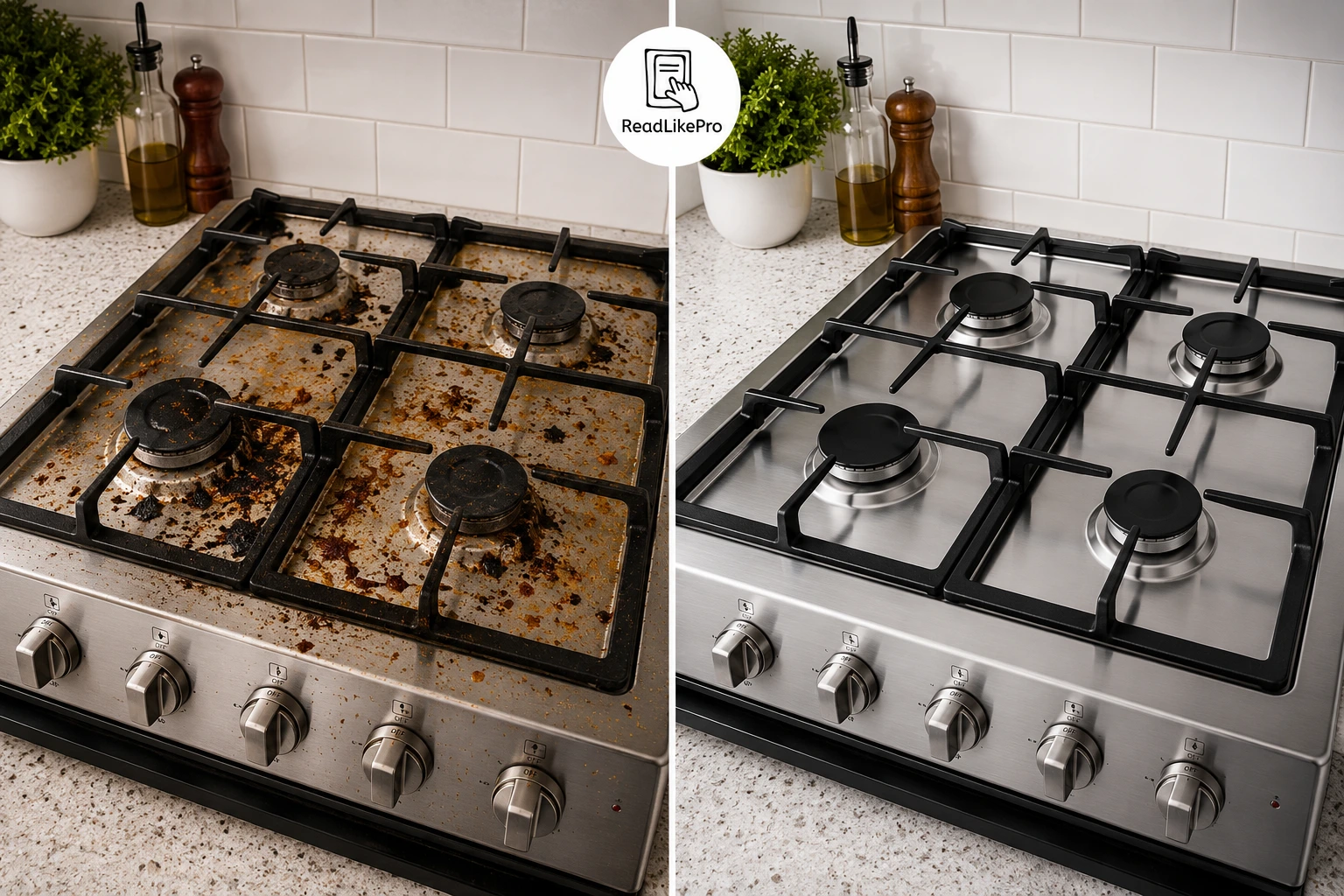
A kitchen wiped down for a few minutes after every meal rarely needs more than 10–15 minutes of weekly cleaning. The same kitchen left unattended for several days typically takes significantly longer — not because it is dramatically dirtier, but because dried residue, grease buildup, and surface grime each require actual effort to break down rather than a quick wipe.
That compounding effect is the only reason a daily routine matters. Not discipline. Not aesthetics. The work you skip today becomes harder work later.
Morning (5–8 minutes)
Make your bed. It takes about 90 seconds and has a disproportionate effect on how the room reads for the rest of the day. Most people find that a made bed makes the entire room feel more manageable — even when other surfaces are not perfect. A bed with rumpled sheets can make a freshly vacuumed room feel messy. A made bed makes a room with laundry on a chair feel like a work in progress rather than a mess.
Wipe the kitchen counter and rinse dishes immediately after breakfast. Food residue addressed while still wet takes about 20 seconds of wiping. The same residue 6 hours later — dried, bonded to the surface, possibly attracting flies — takes 3 minutes of scrubbing and a cleaning product. The task is identical in theory. In practice it is completely different work.
During the Day
Wipe spills the moment they happen. A tomato sauce splash takes 10 seconds wet. Leave it until evening: 3 minutes and some effort. Leave it until Sunday: it may have stained. The window between “effortless” and “actual job” is about 20 minutes for most food spills.
Put things back immediately after use. Clutter is not a cleaning problem — it is a replacing problem. The pile on the kitchen counter, the stack on the coffee table, the clothes on the chair — none of those require cleaning products. They just require returning things to where they came from. When that habit is consistent, a large portion of visible disorder disappears without ever touching a cloth.
Evening (5–10 minutes)
Sweep or vacuum the kitchen floor. Wipe the stovetop. Clear whatever has accumulated on the main living room surface. Done.
This takes less than 10 minutes. What it prevents is waking up to a kitchen that already looks like it needs cleaning before the day has started — which is one of those small things that has a surprisingly large effect on how the rest of the morning goes.
Practical note: Set a 15-minute timer when you start the evening routine. A defined endpoint makes it easier to begin. Without one, “cleaning the kitchen” is an open-ended task that is easy to procrastinate. With one, it is a countdown.
The Weekly House Cleaning Routine and Room-by-Room Tips
Weekly tasks handle actual hygiene — the daily routine only holds the line. The most effective structure is one room per day across the week rather than one big Saturday session. Saturday sessions feel like a project. One room on a Tuesday evening feels like nothing.
Skip the weekly routine consistently and the consequences are predictable: the bathroom develops soap scum that now requires a scrubbing product instead of a wipe. The kitchen microwave interior starts to smell. The bedroom floor under the bed accumulates a visible dust layer. None of these are catastrophic on their own — but all of them turn routine maintenance into actual cleaning work.
Bathroom (15–20 minutes)
Most people clean the toilet and stop. The surfaces that actually drive bathroom deterioration faster are the ones people miss: the tank lid, the base of the toilet where it meets the floor, the underside of the faucet head where mineral deposits build, and the grout lines between tiles.
Scrub the toilet bowl with a brush and disinfectant. Wipe the seat, lid, tank, and exterior base — the base collects splash residue and is one of the first things that makes a bathroom smell even when the bowl is clean. Clean the sink, faucet, and mirror. Mop the floor, including behind the door where dust gathers undisturbed.
The single most effective bathroom maintenance habit that almost nobody does consistently: run the exhaust fan for 10 minutes after you leave the shower, not just while you are in it. Bathroom mold grows primarily in conditions of lingering moisture — and running the fan during your shower does relatively little to dry the room afterward. Running it after you leave is what actually clears the humidity.
Store cleaning supplies inside the bathroom permanently. Supplies that are already in the room get used. Supplies stored in a cupboard down the hall tend to stay there.
Kitchen (20–25 minutes)
The daily counter wipe handles crumbs and fresh spills. The weekly clean handles what the daily pass cannot: the inside of the microwave, the fridge door seals, the drip trays under burners, the rubber gaskets on appliance doors, and the exterior of the oven.
One surface most articles underemphasize: the kitchen sink drain and basin. The CDC’s home hygiene guidance notes that kitchen sinks are among the most heavily contaminated surfaces in residential homes — often carrying higher bacterial concentrations than bathroom surfaces because of constant food residue and moisture contact. Scrub the basin, clean the drain rim, and pour hot water or a diluted disinfectant down the drain weekly.
Empty the trash bin and wipe the inside before putting a new liner in. A bin that only ever gets a fresh bag — never a wipe — develops a smell that no liner contains.
Floors and Dusting (20–30 minutes)
The order is non-negotiable: dust first, vacuum second, mop last.
Dust particles are lighter than air and stay suspended for several minutes after being disturbed. If you vacuum first and then dust shelves, the particles that fall during dusting land on a floor you just cleaned. You have to vacuum again. Dust everything first — wait 5 minutes — then vacuum — then mop. One pass, not two.
Use microfiber cloths for dusting, not feather dusters. A feather duster moves particles into the air. A microfiber cloth traps them. The difference is visible within a week: surfaces dusted with microfiber stay clean noticeably longer because the dust is gone rather than redistributed.
Three surfaces that almost never appear on weekly checklists but accumulate dust faster than most others: the tops of kitchen cabinets (grease-coated dust that bonds and eventually drips), the blades of ceiling fans (heavy buildup that falls as a cloud when the fan is turned on after a week off), and window sills (especially in older homes where outdoor dust enters through frame gaps).
Bedroom (10–15 minutes)
Change the sheets. Every week. Not every two weeks — every week.
Dust mites accumulate in bedding and are one of the most well-documented indoor triggers for respiratory irritation and disrupted sleep. Weekly washing in warm water significantly reduces their presence. This matters practically for anyone who wakes up with a stuffy nose, irritated eyes, or disrupted sleep without an obvious cause — bedding is frequently the culprit in an otherwise reasonably clean home.
Most allergy and asthma guidance recommends washing bedding in water at or above 130°F to effectively reduce dust mite populations. Check your washer’s temperature settings if allergies are a concern. Then vacuum under the bed — it is where dust, debris, and pet hair accumulate fastest and get disturbed least.
Living Room (10–15 minutes)
Vacuum the sofa cushions and underneath them, not just the floor. Upholstered surfaces collect skin cells, dust, and dander faster than hard floors because the fibers trap particles rather than letting them settle visibly. A sofa that looks clean can carry weeks of buildup inside the cushion fabric.
Wipe remotes, light switches, and the TV screen. These are among the most frequently touched surfaces in any home and among the least often cleaned. Remote controls and light switches get handled dozens of times daily — including by people who have just come in from outside, handled food, or used the bathroom — and rarely make it onto anyone’s weekly cleaning list.
The Room Nobody Cleans: Laundry Area and Utility Space
Every competitor article covers kitchen, bathroom, bedroom, living room. Almost none of them cover the laundry area — which is consistently one of the highest-moisture, highest-bacterial-load spaces in a home.
Wipe down the washing machine drum seal weekly. The rubber gasket on front-loading washers traps moisture and develops mold within weeks if not dried between uses. Leave the washer door open after every cycle so air can circulate. Wipe the dryer lint trap housing — not just the filter — with a damp cloth monthly. And clean behind and underneath both units once a month: lint that accumulates behind a dryer is one of the leading causes of residential dryer fires according to the US Fire Administration.
Monthly Deep Cleaning: What Most People Skip
Monthly deep cleaning tasks are what separate homes that feel genuinely fresh from homes that are technically clean but carry a background staleness. Most people skip them, which is exactly why certain areas start to feel off after a few months despite regular weekly effort.
Kitchen Appliances Deep Cleaning
Pull the refrigerator out from the wall and vacuum the condenser coils at the back. Dust-clogged coils force the motor to work harder, raise energy bills, and shorten the appliance’s lifespan. It takes 5 minutes and should happen every 2–3 months at minimum.
Deep clean the oven interior. Descale the kettle, coffee maker, and any other appliances that contact water regularly — mineral deposits from hard water reduce performance and can affect taste.
Windows and Blinds
Window blinds are among the most neglected surfaces in American homes according to multiple cleaning surveys. Monthly attention is far easier than the annual project-level clean that results from ignoring them. Clean windows also noticeably improve natural light quality throughout the interior — it is one of those changes that affects how a room feels without most people being able to immediately identify why.
Baseboards, Door Frames, and Wall Panels
These surfaces accumulate a combination of dust, fingerprints, and scuff marks that are invisible up close but affect the overall cleanliness reading of a room significantly. A monthly wipe with a damp microfiber cloth takes 10 minutes for an entire home and makes the walls read as clean rather than aged.
Storage and Closets
Tackle one storage area per month. Closets, under-sink cabinets, and pantries accumulate clutter silently. The ACI’s 2024 research found that 47% of Americans report a clean home helps them focus better. Organized storage — even when it is not visible — contributes to that. Disorder behind closed doors has a measurable background effect on how a space feels to live in.
What Cleaning Products to Use on Which Surfaces
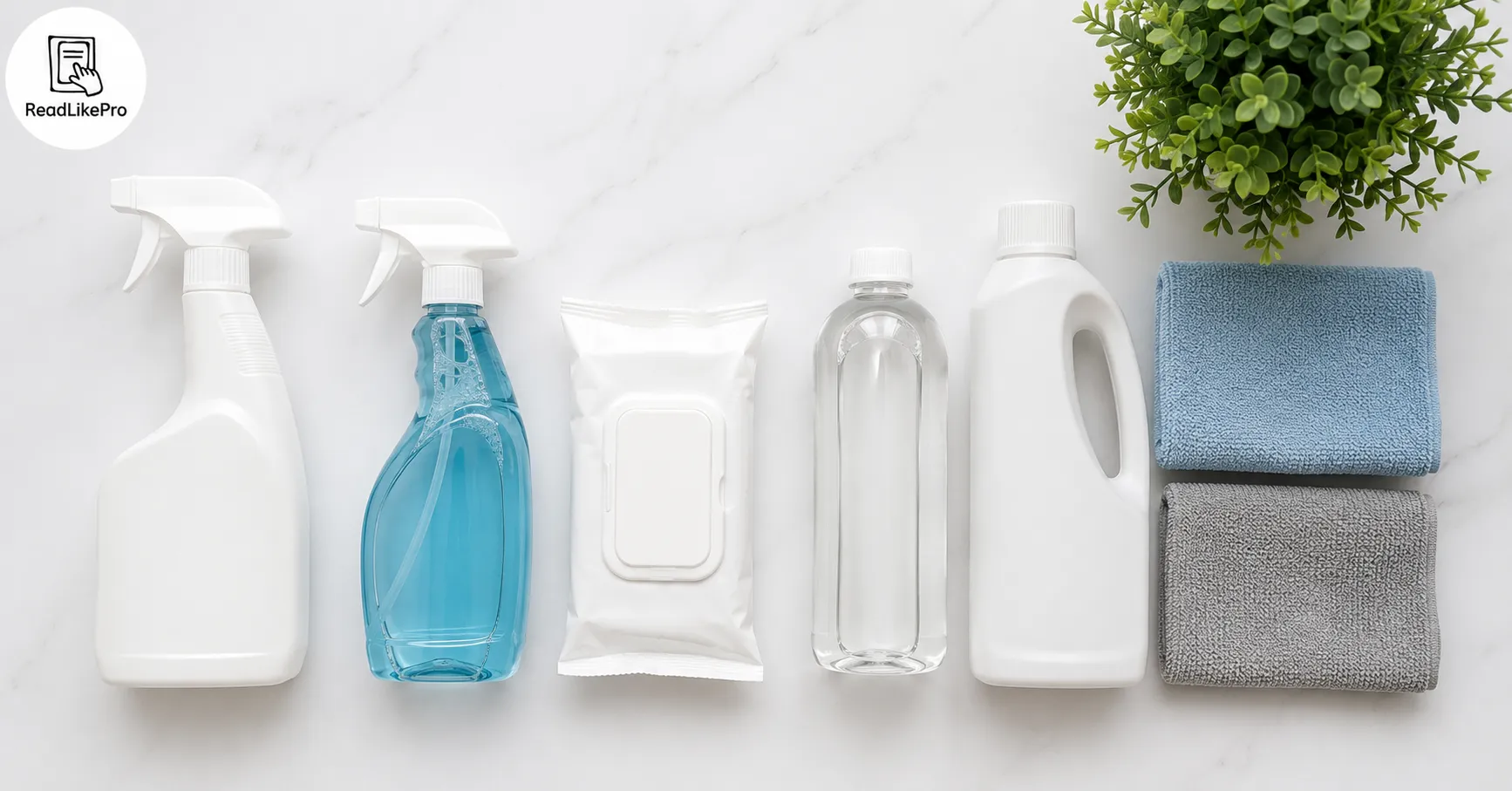
One of the most consistently overlooked home cleaning tips is matching the product to the surface. Using a single all-purpose spray on every surface in the home is a shortcut that causes damage over time — some products degrade materials they are not designed for, others simply do not work on certain surfaces. Keeping a proper home cleaning schedule also means knowing which products to reach for in each room.
| Surface | Use This | Avoid This |
|---|---|---|
| Kitchen counters (laminate) | All-purpose disinfectant spray | Bleach — fades and dries laminate over time |
| Bathroom tiles | Disinfectant spray + grout brush | Vinegar on natural stone — erodes the surface |
| Glass and mirrors | Ammonia-free glass cleaner | Paper towels — leave lint streaks |
| Hardwood or vinyl floors | pH-neutral floor cleaner | Vinegar-based products — damage the finish |
| Electronics (keyboards, remotes) | 70% isopropyl alcohol wipe | Any liquid spray directly on the surface |
| Carpet and rugs | Vacuum + dry powder cleaner | Steam cleaning wool rugs — causes shrinkage |
| Stainless steel appliances | Microfiber cloth + mineral oil finish | Abrasive scrubbers — scratch the surface |
The EPA and CDC recommend soap and water as the primary cleaning approach for most household surfaces. Disinfectants are effective and useful but are not necessary in every room on every pass — in a healthy household, routine cleaning frequency matters more than disinfectant strength.
If you are weighing whether to hire a professional cleaner occasionally instead of handling deep cleans yourself, the ReadLikePro Cleaning Cost Calculator gives you a realistic estimate of what professional home cleaning runs in your area before you commit to a service.
Natural Cleaners: Where They Work, Where They Don’t
These are useful additions to any house cleaning routine — but they are not universal. Baking soda and white vinegar work well for specific tasks. Knowing where they work saves money. Knowing where they do not prevents surface damage that no deep cleaning can fix.
White vinegar is effective against most common mold species, cuts through grease on glass, and descales coffee makers and kettles. Do not use it on natural stone countertops (marble, granite, travertine), hardwood floors, or cast iron. The acidity erodes stone sealant and strips seasoning from cast iron.
Baking soda is an effective odor neutralizer for refrigerators, trash bins, and carpet. As a gentle abrasive it works on baked-on residue in ovens and pots. It does not disinfect surfaces — it cleans and deodorizes, which is a different function.
Mixing the two produces a fizzing reaction that looks dramatic but is mostly water and CO₂. The acid-base reaction cancels out the effective properties of both. Use them separately for the tasks each handles well.
Home Cleaning Tips for Specific Situations
Not every home has the same challenges. These home cleaning tips are organized by situation — pets, rental apartments, and tight schedules each have specific considerations that standard guides overlook.
If You Have Pets
Pet hair and dander accelerate buildup on every soft surface. Vacuum upholstered furniture and rugs twice per week rather than once. Keep a lint roller near the main entrance for furniture visible to visitors. Wash pet bedding weekly alongside your own sheets — it carries the same dust mite and dander load.
Enzymatic cleaners (available at most hardware and pet stores) are the only product that effectively removes pet urine odor at the source. Standard cleaners mask the smell temporarily. Enzymatic cleaners break down the uric acid compounds that cause it.
If You Rent an Apartment
Focus particular attention on ventilation. Apartments — especially older buildings — have smaller bathrooms, less airflow, and shared HVAC systems that create faster mold conditions. Run the bathroom fan after every shower and leave bathroom and kitchen cabinet doors open occasionally to allow air circulation under sinks.
Document the condition of the apartment at move-in with dated photos. Clean specifically with move-out expectations in mind: baseboards, inside oven, inside fridge, grout lines, and window tracks are the surfaces most landlords check.
If Your Schedule Is Tight
The minimum viable routine that keeps a home from deteriorating is: make the bed every morning, wipe the kitchen counter after every meal, and do one focused 20-minute room clean per weekday evening. Five days of 20 minutes is more effective — and easier to sustain — than one 2-hour Saturday session.
If even that feels like too much to start, begin with one room only. Get the kitchen onto a consistent daily wipe routine and leave everything else. One room under control creates momentum. Trying to fix everything at once does not.
Common Home Cleaning Mistakes Worth Knowing
These are the mistakes that quietly undermine an otherwise solid house cleaning routine — most people make at least two of them without realizing.
Dusting after vacuuming. The order matters. Dust surfaces first, let particles settle for a few minutes, then vacuum the floor. Reversing this puts a layer of dust back onto a clean floor.
Using one cloth for everything. A cloth that has been used on a toilet should not go near a kitchen counter. Keep cloths separated by room — different colors make this easy to maintain without thinking about it. The same system used by professional cleaning companies applies just as well at home.
Cleaning without decluttering first. Wiping around objects is not cleaning — it is moving dust from one place to another. Clear surfaces before cleaning them. It takes less time overall and produces a visibly better result.
Relying on a single deep clean. The ACI’s 2024 National Cleaning Survey found 21% of Americans feel overwhelmed by cleaning — and a significant part of that is the consequence of letting things build to the point where a full deep cleaning reset is required. A consistent daily and weekly routine prevents that cycle entirely.
Ignoring air quality. Surfaces are visible. Air is not. Replace HVAC filters every 60–90 days. Run kitchen exhaust fans while cooking. Open windows when weather allows. The EPA notes that indoor air can carry higher concentrations of pollutants than outdoor air in many homes — regular airflow management is part of a complete cleaning approach.
How to Build a Cleaning Routine That Actually Sticks
The reason most home cleaning routines fail is not that people stop caring. It is that the routine was designed around motivation — a resource that runs out — instead of habit, which does not require any.
Habit stacking is the most reliable method. Attach each cleaning task to something you already do automatically.
- After making coffee → wipe the counter
- After every shower → wipe the bathroom mirror and sink
- After dinner → clear the table, load the dishwasher, wipe the stove
- Before going to bed → clear the main living surface
After a few weeks these feel like one action, not two. The cleaning task stops requiring a decision.
Keep supplies in the room where they get used. One of the most practical home cleaning tips that rarely gets mentioned: a toilet brush stored in the bathroom gets used regularly. The same brush stored in a hallway cupboard gets used when someone remembers it, which is less often than it should be. Accessibility is not a minor detail — it is one of the primary factors that determines whether a cleaning task happens on schedule.
One room at a time if starting from zero. Trying to implement a full daily-weekly-monthly system from nothing is how routines collapse in week two. Start with the kitchen. Get that consistent. Add the bathroom two weeks later. Build gradually enough that each addition feels small.
When DIY Home Cleaning Is Enough and When It Is Not
For most households, a consistent daily and weekly cleaning schedule is sufficient to maintain a genuinely clean home without professional help. There are situations where it makes sense to bring in outside help occasionally:
- Post-renovation cleaning (construction dust penetrates everywhere and requires commercial-grade equipment to fully remove)
- Move-in or move-out cleans (landlords and buyers have a higher cleanliness standard than daily living)
- Seasonal deep cleans (twice a year — spring and fall — for carpet extraction, window washing, and appliance servicing)
- After illness (when thorough disinfection of shared surfaces is important)
For these situations, understanding what professional cleaning actually costs in your area makes budgeting straightforward. The ReadLikePro Cleaning Cost Calculator provides realistic local estimates based on home size and service type.
The same principles that make home cleaning efficient — consistent routines, high-touch surface focus, color-coded tools — apply at a larger scale in professional environments. The professional office cleaning guide on ReadLikePro covers those protocols for anyone managing a shared workspace alongside a home.
Complete Home Cleaning Checklist
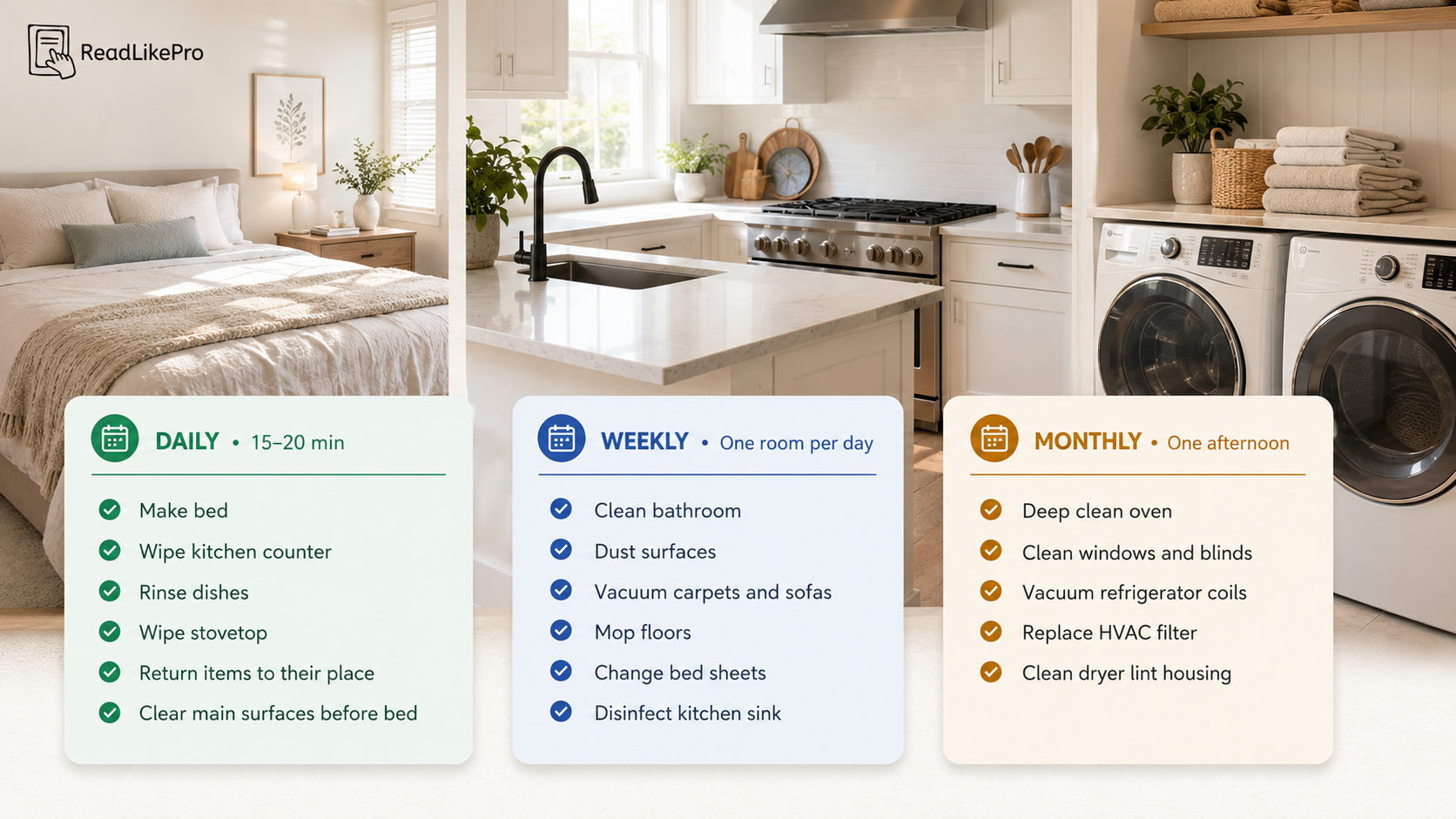
Print this out or save it it covers your full house cleaning routine across all three tiers. Most checklists just list tasks. This one adds the skip consequence so when you are short on time and deciding what actually matters, you have a real basis for the decision.
Daily (15–20 minutes total)
| Task | What Happens If You Skip It |
|---|---|
| Make bed | Room reads as disordered all day regardless of what else is clean |
| Wipe kitchen counter after meals | Fresh residue wipes in seconds — dried residue bonds and requires a cleaning product |
| Rinse dishes or load dishwasher | Dried food requires soaking — a quick rinse becomes a scrubbing job |
| Wipe stovetop after cooking | Grease bakes on with the next use — requires a degreaser within a few days |
| Return items to their place | Displaced items compound — clutter grows faster than most people expect |
| Sweep kitchen floor and hallway (evening) | Tracked debris gets pressed in and is harder to vacuum by the next morning |
| Clear main living surfaces before bed | Next morning starts in a space that already looks used |
Weekly (One room per day — 15–25 minutes each)
| Task | What Happens If You Skip It |
|---|---|
| Scrub toilet bowl, seat, tank, base | Mineral stains set quickly and require acid-based cleaner to lift — a wipe no longer works |
| Clean bathroom sink, faucet, mirror | Soap scum layers build up — scrubbing effort roughly doubles by the second week |
| Run exhaust fan 10 min post-shower | Lingering moisture creates the conditions bathroom mold needs to establish in grout |
| Mop bathroom and kitchen floors | Sticky residue bonds to the surface — wet mopping alone stops being effective |
| Dust all surfaces top to bottom first | Particles accumulate into a visible layer — requires a damp wipe rather than a dry cloth |
| Vacuum carpets, rugs, sofas | Allergens compact deeper into fibers over time — surface vacuuming stops reaching them |
| Mop all hard floors after vacuuming | Fine grit acts as an abrasive underfoot — scratches vinyl and hardwood finish gradually |
| Change bed sheets and pillowcases | Dust mites accumulate in bedding and are a well-documented trigger for sleep disruption and respiratory irritation |
| Wipe remotes, light switches, door handles | Among the most frequently touched and least frequently cleaned surfaces in the home |
| Empty and wipe inside trash bins | A liner alone does not contain odor — the bin base develops a persistent smell |
| Clean microwave interior | Food splatter bakes onto walls with each subsequent use — requires scraping rather than wiping |
| Disinfect kitchen sink basin and drain | Per CDC guidance, kitchen sinks carry high bacterial loads — often more than bathroom surfaces |
| Wipe washing machine drum seal | Rubber gaskets trap moisture and are prone to mold growth if not dried regularly |
Monthly (2–3 hours total)
| Task | What Happens If You Skip It |
|---|---|
| Vacuum refrigerator condenser coils | Dust-clogged coils raise energy bills and shorten appliance life |
| Deep clean oven interior | Baked-on grease produces smoke and smell at cooking temperatures |
| Descale kettle and coffee maker | Mineral deposits reduce heating efficiency and affect taste |
| Clean windows and all blinds | Light quality drops visibly — becomes a major cleaning project at 3 months |
| Wipe baseboards, door frames, wall panels | Scuff and dust layer makes walls read as aged even in a clean room |
| Vacuum under all furniture including bed | Dense undisturbed dust layer unreachable by surface vacuuming |
| Check or replace HVAC air filter | Clogged filter raises heating/cooling costs and circulates particles |
| Reorganize one storage area or closet | Silent clutter creates background disorder that affects how home feels |
| Wash shower curtain or scrub door tracks | Mold establishes in folds and track grooves — visible within 6 weeks |
| Clean dryer lint housing and behind unit | Lint buildup is a documented residential fire risk — US Fire Administration |
| Wipe tops of kitchen cabinets and fan blades | Grease-coated dust drips onto surfaces below — fan buildup falls as debris |
Frequently Asked Questions
How often should you clean your house? For most households, a 15–20 minute daily routine plus focused weekly room tasks spread across separate days is the right cadence. The kitchen requires the most frequent attention — averaging around 20 cleans per month for most families, according to Ecovacs’ US survey data. Bathrooms follow closely at 16–20 times per month.
What is the correct order to clean a house? Always work top to bottom and dry before wet. Start with dusting (ceiling fans, shelves, surfaces), then wipe counters and appliances, then vacuum floors, then mop. Cleaning in reverse order means debris from upper surfaces falls onto areas you have already cleaned.
What surfaces need disinfecting most? The CDC identifies doorknobs, light switches, countertops, faucet handles, toilets, and sinks as the highest-priority high-touch surfaces for regular cleaning. In kitchens, the sink basin carries a particularly high bacterial load and benefits from daily disinfection.
Does cleaning actually improve mental health? The data consistently says yes. The ACI’s 2024 Wakefield Research survey found 87% of Americans feel better — mentally and physically — when their home is clean. In the same survey, 60% reported reduced stress and anxiety specifically linked to home cleanliness. A 2025 ACI survey found 84% agreed cleaning positively affects their mental health.
How do you clean a house that has gotten completely out of hand? Declutter before anything else. Pick up and return everything to its place first — cleaning around clutter does not work. Then tackle one room completely before moving to the next. Start with the kitchen or bathroom, whichever is more critical. Visible progress on one room creates momentum that makes the rest more manageable.
Are natural cleaners like vinegar and baking soda actually effective? For specific tasks, yes. White vinegar cuts grease on glass, descales appliances, and handles most common mold species. Baking soda neutralizes odors and works as a mild abrasive on baked-on residue. Neither should be used on natural stone surfaces. And mixing the two produces mostly water — the acid-base reaction cancels out both products’ useful properties.
How do you keep a clean house with a busy schedule? The minimum effective routine is a daily 8-minute kitchen wipe-down and a 20-minute focused room clean on weekday evenings, rotating through rooms across the week. Five consistent 20-minute sessions outperform one two-hour Saturday session both in results and in how sustainable it is to maintain.
One Room. Fifteen Minutes. Start There.
The difference between a home that always feels clean and one that only gets clean occasionally is not effort. It is whether the home cleaning tips above get applied consistently before things get bad.
A daily routine running 15 to 20 minutes handles most of the work. A house cleaning routine spread across the week — one room per day — keeps hygiene and maintenance current without ever requiring a full Saturday. Monthly deep cleaning handles what the weekly routine cannot reach.
None of that requires a burst of motivation. It requires a home cleaning schedule that runs in the background of a normal day.
Pick one room. Set a timer. That is the whole entry point.

Baldeep builds and researches content sites full time. For ReadLikePro he
compiles home service pricing from contractor quotes, industry cost surveys,
and public data, then checks the numbers against more than one source before
publishing. He isn’t a licensed contractor, so every estimate here is a
research-backed range, not a quote for your specific job.